TRANSMISSION // 2611.27214v1
A Better Coordinate System for AI-Generated Speech?
Source published
A study finds that whitening speech-codec latents raises an automatic naturalness score in one text-to-speech setup, with a possible speed–quality trade-off. Human listening tests are still needed.
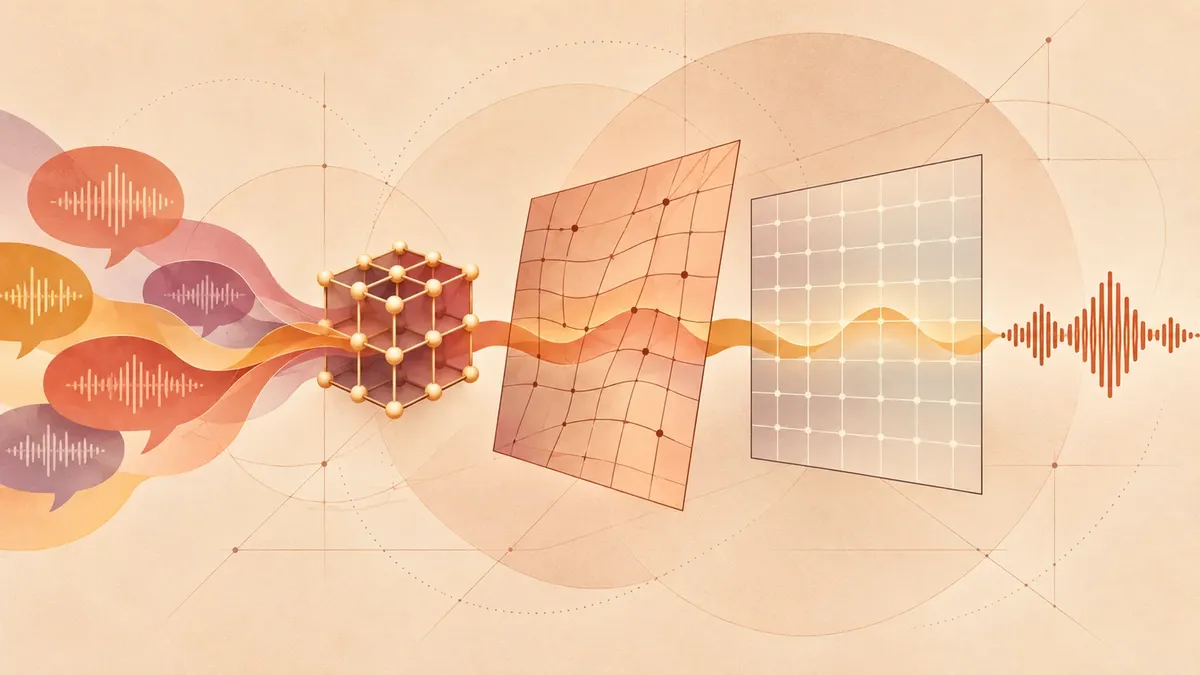
Text-to-speech models can generate speech in a codec’s compressed representation, but that representation may be awkward for a flow model to learn. A preprint tests whether changing the latent coordinates helps—and finds a consistent improvement in an automatic naturalness proxy on one single-speaker dataset.
Why change the coordinates?
Some text-to-speech systems generate speech indirectly. They first produce a sequence of compact numerical representations, called latents, which a separately trained audio decoder turns into a waveform. A flow model learns to move from random noise toward the latents associated with the requested speech.
The catch is that a codec’s latents are designed to help reconstruct audio, not necessarily to make this noise-to-speech-generation process easy. If some latent directions vary much more than others, learning a flow in ordinary coordinates may be poorly conditioned. The authors of a new preprint ask whether a fixed mathematical transformation—zero-phase component analysis, or ZCA—can make the coordinates more suitable for generation.
What the researchers did
The team developed Embedded Acoustic Flow TTS (EAF-TTS), a system that generates codec latents conditioned on phones and their durations. It uses a frozen WaveVAE codec to encode and decode audio, and a shared neural network both generates the latent sequence and makes a final correction before decoding.
The main experiment compares two versions of the system: one using scalar normalization and one using ZCA-transformed latents. ZCA estimates correlations among latent channels from training data, then rescales and rotates the coordinates to make their covariance more uniform. Its statistics are fixed, so it adds no learned parameters. Crucially, the intervention is more than applying a transform at inference: training, sampling, the effective loss metric, and the perturbations used for the final correction all change together.
Both systems used the same codec and model architecture, training budget, and matched random seeds. The primary comparison used three training seeds and fixed checkpoints after 100 epochs. It evaluated 399 text-disjoint LJSpeech validation utterances with ground-truth phone durations, a setup that focuses on acoustic generation rather than testing the duration predictor.
The main naturalness measure was UTMOS22 Strong, an automatic score intended to predict naturalness. It is not a human rating, and the researchers note that it was not calibrated for this system. They also measured word error rate and exact-match rate using speech recognition, and compared generation speed using an internal real-time-factor measurement.
What they found
The 64-dimensional training latents were strongly uneven in their variation: their covariance condition number was 1355.44. This describes the spread of latent directions, but does not itself show that changing coordinates will make generated speech sound better.
On the validation set, ZCA increased UTMOS by an average of 0.405 points over scalar normalization across the three matched seeds; the reported variation across seeds was 0.027. All three seed comparisons were positive. However, the absolute scores remained below those for audio reconstructed directly from the codec. The result is therefore an improvement in a proxy score, not evidence that the system reached natural human speech quality.
The other measures did not show a consistent improvement at the full 20-call setting. Word error rate, exact-match rate, and a measure of acoustic distance varied across seeds. In a sweep that reduced model calls without retraining, ZCA with five calls scored 0.375 UTMOS points above the 20-call scalar baseline and had a reported 3.34-fold lower generation-path real-time factor. With three calls, the advantage was smaller—0.165 points—with a reported 5.03-fold reduction. At two calls, the UTMOS score fell sharply.
These comparisons are not proof that ZCA makes the flow solver intrinsically faster or better at using fewer steps. Both coordinate systems changed when the number of calls fell, and ZCA’s advantage over scalar normalization shrank at reduced call counts. The authors interpret the result as using some of ZCA’s higher full-step proxy score as “headroom” for fewer calls. The timing measurement also excludes text processing and duration prediction, so it is not an end-to-end speed benchmark.
What remains uncertain
The findings are narrow: one single-speaker English dataset, one codec checkpoint, one system configuration, and three training seeds. The main validation split was text-disjoint, but it was a development validation set—not a prospectively untouched blind test. A separate test split was repeatedly accessed during development and is explicitly treated as diagnostic, not blind evidence.
There was no human listening study. The researchers also did not establish that word error or exact-match performance was equivalent between systems: finding no statistically detectable degradation is not the same as demonstrating equivalence. A separate text-only comparison was directionally consistent, but mixed different checkpoint types, making the effect harder to attribute to ZCA alone.
Because this is a preprint, its claims have not necessarily been peer-reviewed. The paper itself calls for blind-text testing, human listening, matched checkpoint comparisons, and experiments separating the effects of changing coordinates from changing the training loss metric. For now, the result is a promising, system-specific demonstration that how a speech model represents its internal audio can affect an automatic naturalness score—not a general recipe for better-sounding or faster speech.
- text-to-speech
- flow matching
- audio codecs
- latent representations
- ZCA whitening
- speech synthesis
Reviewed cross-references
These connections were reviewed by a model, not independently fact-checked by a human. Similarity does not imply agreement; consult the original papers and the evidence below.
How Rhythm-TTS Gives Synthetic Speech More Room to Breathe
Shared method: Both papers use flow matching to generate continuous acoustic latents for speech synthesis: EAF-TTS studies a train-data-estimated ZCA coordinate protocol in single-speaker LJSpeech, while Rhythm-TTS generates latents from a discrete-token-derived prior for zero-shot TTS and adds probabilistic rhythm planning. This is a shared generation method, not evidence that either system’s results validate the other’s.
Model review: · openai-codex/gpt-6-luna
Evidence and provenance
Selected excerpts, not complete papers. PDF extraction can omit figures or damage equations, tables and reading order; sources may be preprints.
2611.27214v1 — Original paper
Excerpt reference:
static/papers/2611.27214v1.md:13-55
Basis: Paper text
Source SHA-256:c22e0cb0e7a382e0d4c7f52f0785d18a53985ae9240526493f138880d48ed1c42510.02848v3 — Original paper
Excerpt reference:
static/papers/2510.02848v3.md:13-83
Basis: Paper text
Source SHA-256:434d8b484830dafbd2bb255fec399d334336a853c45b8e81a6885e6ac7bd65b3
Related reading
Automatically matched by shared topic keywords. These links do not imply that the sources agree or establish a consensus.
How Rhythm-TTS Gives Synthetic Speech More Room to Breathe
Source published
Shared keywords: flow matching, text to speech
ChainFlow drafts several AI tokens by predicting where a model’s internal states go next
Source published
Shared keywords: flow matching, latent representations
Teaching graph generators which hidden dimensions matter
Source published
Shared keywords: flow matching, latent representations
Giving AI-Generated Dialogue a More Natural Voice
Source published
Shared keywords: text to speech
A discrete-time bridge between deterministic diffusion and flow matching
Source published
Shared keywords: flow matching