TRANSMISSION // 2611.27208v1
Teaching a vision-language model to read handwritten maths
Source published
On a CROHME test set, a small-adapter training approach helped Qwen3-VL generate structured handwritten equations. Exact structural matches remained limited.
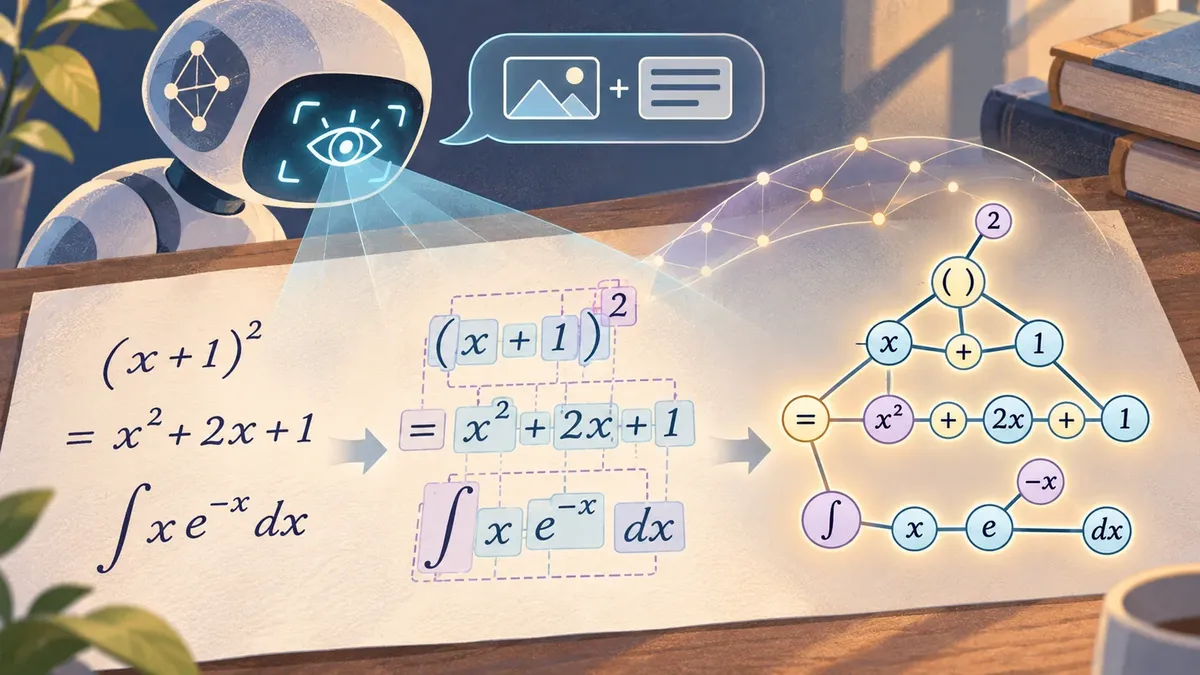
A handwritten equation is more than a row of symbols: where a mark sits can change its meaning. In one benchmark test, researchers adapted a compact vision-language model to output a structured representation. The results show both the potential of task-specific training and the difficulty of getting every structural detail right.
Recognising handwritten mathematics means recovering both the symbols and their spatial relationships. A model might identify the right digits and operators but mistake a superscript for an ordinary neighboring symbol, changing the expression. Manh Tuan Ha and colleagues ask whether a compact vision-language model can learn these relationships efficiently, rather than simply transcribing an equation as plain text.
The authors adapt a 4-bit Qwen3-VL-4B model using rank-16 Low-Rank Adaptation (LoRA). LoRA adds small trainable components while leaving the model’s main weights fixed, reducing the demands of fine-tuning. The model is trained on instruction-formatted examples from CROHME 2019, a benchmark of handwritten mathematical expressions with structural annotations. Its target is a linearized Symbol Label Graph (SLG): a sequence that encodes symbols and relations between them.
The study compares the adapted model with a task-specific vision-transformer and transformer-decoder baseline implemented by the authors, and with a zero-shot Qwen3-VL configuration that receives no task-specific training. The evaluation uses greedy decoding and reports two measures on 1,198 test examples. Exact match counts an output as correct only if its complete structural sequence matches the reference. BLEU-4 measures overlap in short token sequences, so it can give credit for a largely similar output even when some structure is wrong.
On this test set, the CROHME-only fine-tuned model achieved 524 exact matches, or 43.74%, and a BLEU-4 score of 77.67. The authors’ ViT baseline reached 4.92% exact match and BLEU-4 of 43.26 under the same reported protocol. The zero-shot Qwen3-VL configuration achieved no exact matches. These results show that, in this experiment, task-specific training helped the model produce the benchmark’s structural format; general multimodal capability alone did not suffice. The comparisons do not establish a general or statistically reliable advantage: the paper reports one principal seed and no uncertainty estimates.
The gap between BLEU-4 and exact match matters. Many predictions shared substantial token overlap with the reference but still failed the strict whole-sequence test. In mathematics, a single misplaced relation can matter even when most symbols are right. The authors’ examples illustrate this distinction, including outputs that look plausible when rendered but do not match the required SLG representation.
More training examples did not automatically help. The team added 2,000 manually rewritten expressions based on generated formulas. On the same test set, that version scored 42.32% exact match and BLEU-4 of 75.46—both below the CROHME-only result. The authors suggest the added handwriting may not align well with the CROHME distribution. The experiment shows that, in this setup, increasing the sample count was not enough; it does not establish which specific difference caused the decline.
The findings are preliminary. The paper uses one CROHME split, one principal random seed and a limited set of configurations, and does not establish statistical significance or state-of-the-art performance. Several comparison systems are local implementations, not results copied from published leaderboards, so the comparisons apply to the authors’ protocol rather than serving as a definitive ranking. BLEU-4 is not the official CROHME graph metric, and neither reported measure directly tests whether two outputs render as mathematically equivalent formulas.
This is an arXiv preprint, not evidence of peer review. The experiments evaluate one benchmark setting; transfer to other datasets or handwriting styles was not evaluated. The study’s focused contribution is a demonstration that parameter-efficient adaptation can train a compact vision-language model to generate structured mathematical outputs on CROHME, while exact structural matches remain far from universal.
- handwritten mathematics
- vision-language models
- Qwen3-VL
- LoRA
- CROHME
- symbol label graphs
- mathematical expression recognition
Related reading
Automatically matched by shared topic keywords. These links do not imply that the sources agree or establish a consensus.
UniCompress packs four vision-language skills into a smaller model
Source published
Shared keywords: vision language models
Vision-language models may not need to give words a place in the picture
Source published
Shared keywords: qwen3 vl, vision language models
Teaching vision-language AI when a short answer is enough
Source published
Shared keywords: qwen3 vl, vision language models
LandslideFM pairs landslide mapping with image-based descriptions
Source published
Shared keywords: vision language models
When visual AI learns the answer but loses the thread
Source published
Shared keywords: vision language models