TRANSMISSION // 2611.27206v1
One encoder, many body signals: LingSante-Pulse
Source published
A preprint describes a shared AI encoder for ECG, EEG, PPG and EMG signals, reporting benchmark rankings and selected sleep and apnea results.
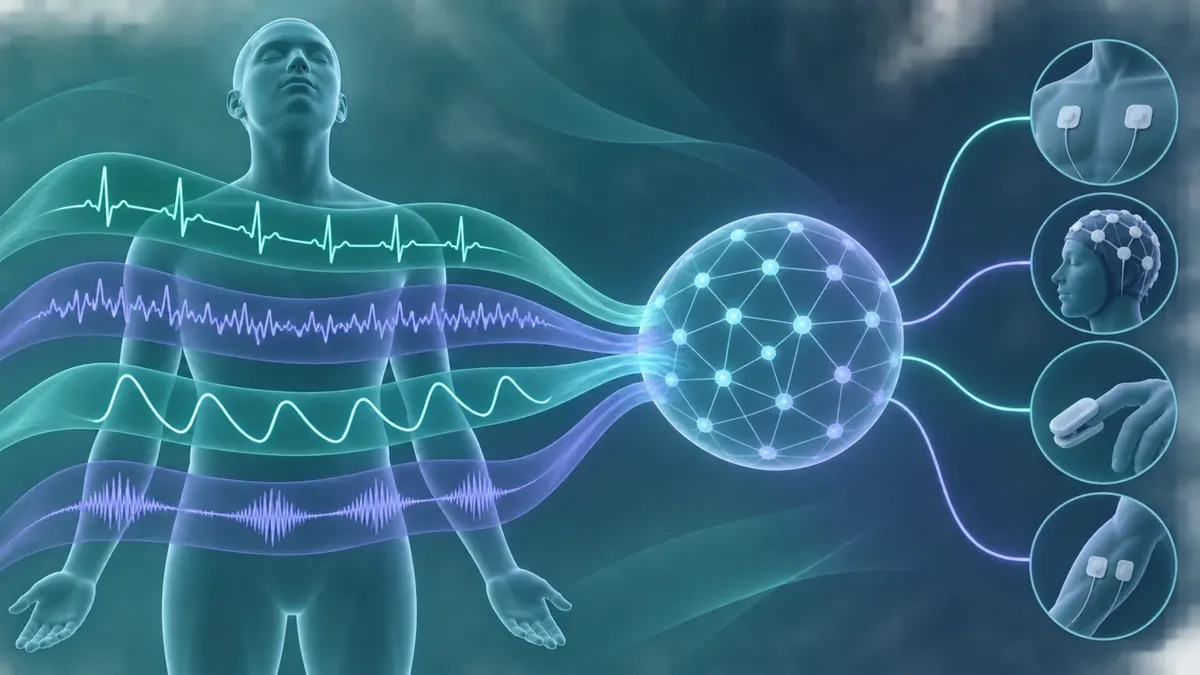
Could one AI system learn useful patterns from different kinds of body signals—and still work when only one sensor is available? LingSante-Pulse is a proposed framework that combines physiological recordings during pretraining, then evaluates its learned representations across a range of tasks.
The challenge of combining body signals
Clinical monitors and wearable devices can capture different physiological signals, but the devices may record only some of the same signal types. That makes it difficult to learn both what is useful within an individual signal and what different signals have in common.
The authors of LingSante-Pulse ask whether one model can learn reusable representations across signal types—and support predictions from a single sensor as well as from multiple signals. A representation is a model’s learned encoding of its input, which can then be used in downstream tasks.
A shared encoder and combined training objectives
LingSante-Pulse uses a shared, signal-conditioned encoder. According to the abstract, it processes each physical channel independently and supports different numbers and combinations of signals. The authors combine three objectives during training: pairwise cross-modal alignment, structured random-feature prediction (RFP), and masked waveform reconstruction.
The paper abstract describes these objectives as jointly learning physiological relationships and preserving informative structure within signals. It does not provide enough methodological detail to explain precisely how each objective works, or how the training data and comparisons were assembled.
The authors report evaluations across 38 general physiological task configurations involving PPG, ECG, EEG and EMG. They say the frozen encoder achieved the best dataset-balanced mean rank in each domain. This is a summary of relative rankings across the evaluated configurations; the abstract does not give the underlying results or explain how far apart the methods were.
Selected task results
The abstract reports two sleep-assessment results: multimodal staging on the HMC dataset reached a Macro-F1 score of 0.7784, and EEG-only staging on the Sleep-EDF dataset reached 0.7941. For screening for sleep apnea using a single ECG lead, the reported AUROC was 0.9183.
The authors also describe controlled experiments. They report that function prediction and waveform reconstruction provided complementary supervision for retaining temporal and rhythmic information. Representations trained with continually refreshed random supervision reportedly generalized to unseen teacher realizations. The abstract further says that correct auxiliary-modality correspondence improved respiration-only representations.
What the evidence can tell us
Taken together, these are the authors’ reported results for a shared encoder tested across several signal types, sensor configurations and tasks. They suggest that the approach may support reusable physiological representations, including in some single-sensor settings. The abstract alone does not show how the model would perform beyond the evaluated tasks and datasets. More generally, benchmark results are not by themselves evidence of clinical readiness, improved patient outcomes or reliability in everyday monitoring.
This article is based on the paper’s abstract, not a full-text review. The abstract does not provide the details needed to independently assess dataset composition, comparison methods, uncertainty estimates or the magnitude of differences between models. The source is an arXiv preprint; the supplied material does not establish its peer-review status. The reported findings should be read with those evidence limits in mind.
- physiological signals
- wearables
- ECG
- EEG
- multimodal AI
- pretraining
- arXiv preprint
Related reading
Automatically matched by shared topic keywords. These links do not imply that the sources agree or establish a consensus.
AI can read an image yet struggle to reason about it
Source published
Shared keywords: arxiv preprint, multimodal ai
BrainBind compares EEG and fMRI video retrieval—and exposes limits on unseen episodes
Source published
Shared keywords: arxiv preprint
Teaching a Vision-Language Model When to Abstain—While Preserving Its Answers
Source published
Shared keywords: multimodal ai
Linked tokens aim to speed multimodal AI
Source published
Shared keywords: arxiv preprint, multimodal ai
A new way to keep multimodal AI’s interactions in check
Source published
Shared keywords: multimodal ai