TRANSMISSION // 2611.27200v1
How unequal cavity losses could steady single-photon emission
Source published
A theoretical study proposes using carefully tuned differences in cavity loss to preserve photon blockade despite detuning. The result comes from analytical calculations and simulations, not an experimental demonstration.
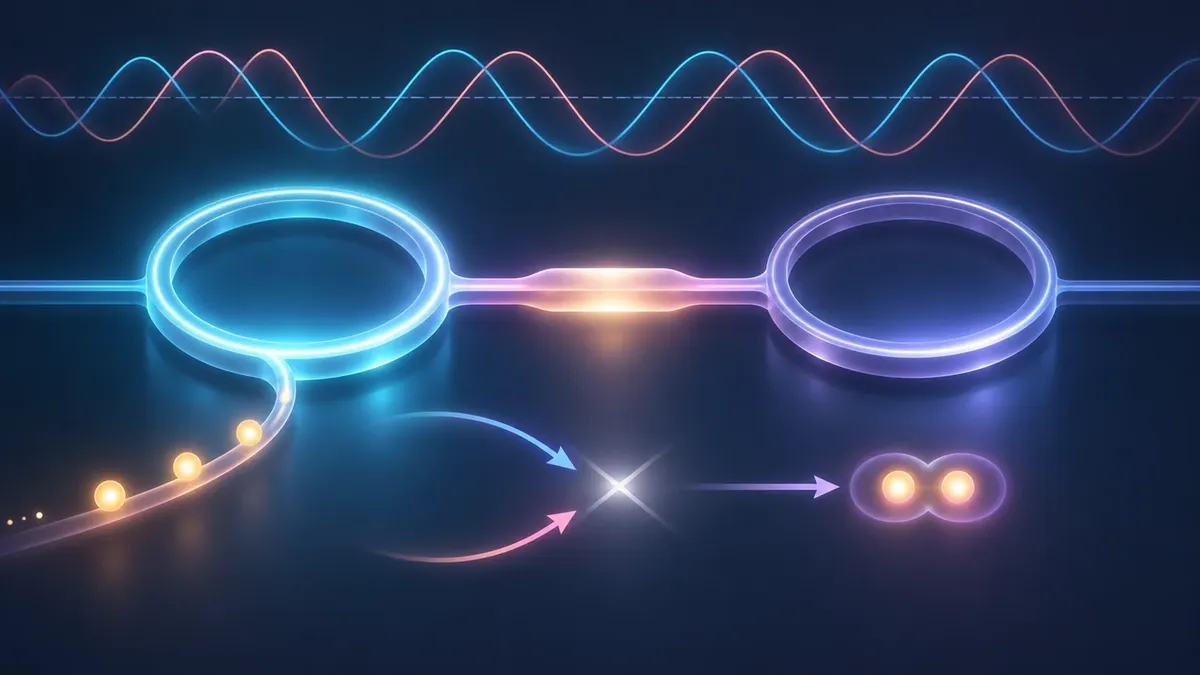
In a proposed two-cavity system, loss is not just something to minimize: a particular imbalance may help light emerge one photon at a time, even when the drive is off resonance.
A cavity that emits light one photon at a time could be useful in quantum technologies. But making a second photon unlikely is not always straightforward. In a proposed two-cavity design, researchers find that tuning the cavities’ different loss rates may help: their calculations identify a condition that suppresses two-photon events even when the driving frequency is detuned from resonance.
The work, by Zhi-Qiang Zhang and colleagues, examines unconventional photon blockade. In ordinary photon blockade, a strong optical nonlinearity shifts a cavity’s resonance after one photon enters, making a second photon harder to add. The unconventional version relies instead on interference: two different routes to a two-photon state can cancel each other. If their amplitudes have the right relative phase, the system can favor zero or one photon without requiring the same strong nonlinearity.
Here, the authors model two coupled cavities with a second-order optical nonlinearity. This interaction converts one photon in cavity B into two photons in cavity A, or the reverse. Both cavities are driven, at frequencies chosen to match that conversion process, and both lose photons to their surroundings. The key change from earlier symmetric setups is to treat the cavities’ decay rates as independent parameters.
The team first derives conditions for cancelling the two-photon amplitude in a weak-driving, low-excitation approximation. In this simplified picture, they keep only a small set of states: the vacuum, one photon in either cavity, and two photons in cavity A. They identify two families of blockade conditions. One requires the drive to be on resonance and generalizes a condition from previous work to unequal decay rates. The other requires cavity B’s decay rate to be twice cavity A’s. Under that specific ratio, the authors derive a drive condition that, in their model, works for arbitrary detuning.
To test the analytical predictions beyond the simplified calculation, they numerically solve a Lindblad master equation for the system’s steady state. They assess photon statistics using the zero-delay second-order correlation, g²(0): smaller values indicate stronger suppression of photon pairs relative to the mean photon number. In the reported simulations, the unequal-loss condition produces a deeper antibunching minimum than the resonant comparison shown in the paper. The mean photon numbers for the two compared conditions are nearly the same, suggesting that the stronger suppression does not require reducing the cavity’s photon population in those examples.
The proposed mechanism is phase locking. The direct route to two photons in cavity A and the indirect route—first exciting cavity B, then converting that photon into two in A—normally acquire different phases as detuning changes. With the specified decay-rate ratio, the authors’ analysis makes the relevant complex detunings proportional. The drive can then set the two routes to cancel without retuning for each detuning.
There are important limits to what this establishes. This is a theoretical study, not a demonstration in a working device. The exact cancellation is derived in a weak-drive approximation with a restricted set of excitation states; numerical master-equation calculations provide a broader check within the model, but do not establish performance in a fabricated cavity. The paper’s detuning plots cover a finite range, even though the analytical condition is stated to hold for arbitrary detuning. Real devices may also have imperfections or additional effects not captured by the model. The reported brightness comparison is likewise a result for the simulated conditions, not a general guarantee.
The paper is an arXiv preprint (version 1), so its findings should be treated as provisional rather than as peer-reviewed consensus. Its contribution is a specific, testable design idea: engineer dissipation asymmetry as part of the interference scheme, rather than assuming that equal cavity losses are always preferable.
- quantum optics
- photon blockade
- single-photon sources
- cavity dissipation
- quantum interference
- second-order nonlinearity
Related reading
Automatically matched by shared topic keywords. These links do not imply that the sources agree or establish a consensus.
How photon-pair graphs make NOON states
Source published
Shared keywords: quantum interference, quantum optics
A neutron ‘transistor’ controls spin through quantum interference
Source published
Shared keywords: quantum interference
How selecting quantum outcomes could make a clock appear to run ahead
Source published
Shared keywords: quantum interference
A hybrid cavity could let light read a molecule’s vibrations
Source published
Shared keywords: quantum optics
How squeezed light can tip the balance of electron emission
Source published
Shared keywords: quantum optics