TRANSMISSION // 2611.27175v1
Felid targets the cost of encrypted AI fine-tuning
Source published
Felid proposes changes to reduce costly operations in encrypted transformer fine-tuning. Its authors report faster training for a two-layer BERT-style model, but the available evidence is only an abstract.
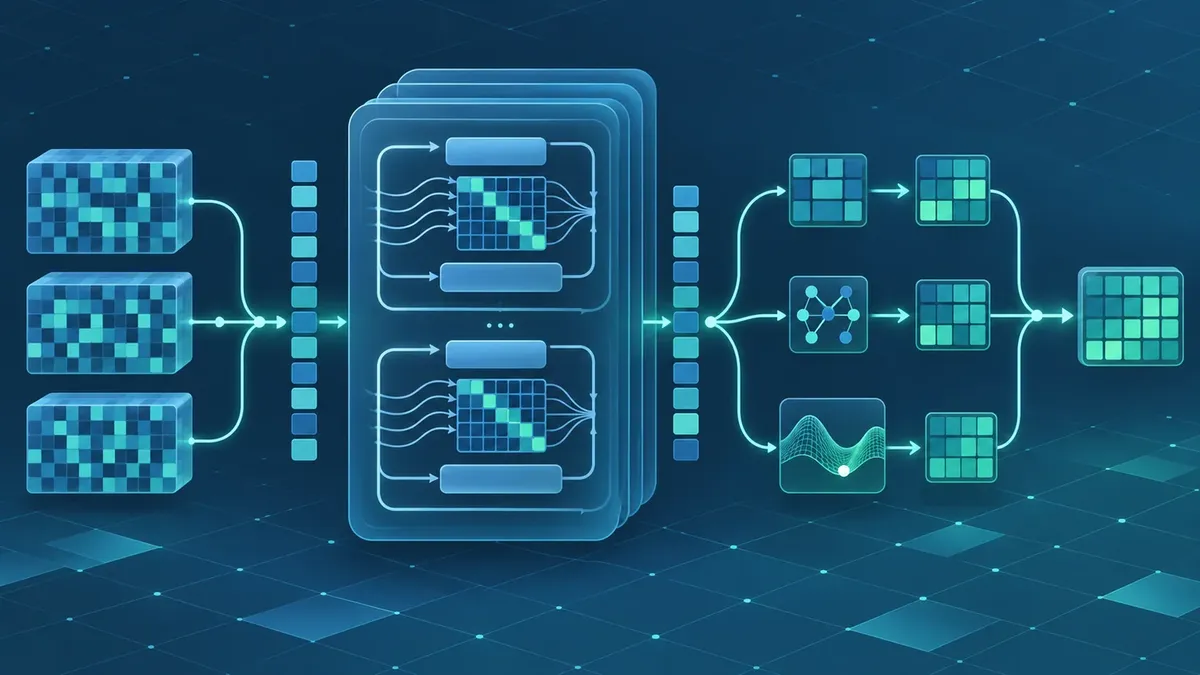
Could a transformer be fine-tuned while its training data are encrypted? Fully homomorphic encryption is designed to support computation on encrypted data, but the added computation can be expensive. Felid proposes changes to the way that work is organized and reports reduced operation counts and faster training in one experiment.
Fine-tuning adapts a pretrained model using examples for a particular task. Those examples can be sensitive, so researchers are exploring fully homomorphic encryption (FHE), a method intended to let computations be performed on encrypted data. The challenge Felid addresses is computational cost: encrypted computation can make transformer fine-tuning expensive.
The paper, Felid: A Flexible and Efficient Design for Transformer Fine-Tuning over Encrypted Data, focuses on operations performed on ciphertexts rather than proposing a new transformer architecture. Its abstract describes a packing strategy that can batch a flexible number of inputs, as well as algorithms tailored to different matrix operations. The aim is to reduce the work required across the fine-tuning computation.
The proposed approach
The authors report reducing ciphertext rotations and relinearizations during matrix operations, and reducing bootstrapping invocations across the computation flow. They also describe using functional bootstrapping to incorporate the evaluation of element-wise activation functions into the bootstrapping step. The abstract presents these as ways to lower computational complexity, but does not provide enough detail to explain the underlying mechanics or assess the implementation.
FHE is intended to enable computation without first decrypting the data. However, the abstract does not specify a threat model or provide enough information to establish what a service could learn or what security guarantees apply to a complete system. Felid’s stated focus is efficiency in encrypted computation.
Results reported by the authors
Against the work they describe as the latest state of the art, the authors report a 30-fold reduction in ciphertext rotations and relinearizations across matrix operations, and 2.5 times fewer bootstrapping invocations over the computation flow. They also report fine-tuning a two-layer BERT-style model with a batch size of 16 in 650 seconds, which they describe as an eightfold speedup over their comparator.
These figures are claims reported in the abstract, not independent measurements. The abstract does not name the comparator or provide details needed to evaluate the comparison, such as hardware, encryption parameters, or the complete experimental setup. It also does not say how the model’s task performance was assessed. Operation counts and runtime alone cannot establish that encrypted fine-tuning preserves the quality of a model trained without encryption.
What the evidence cannot show
The evidence available here is the abstract, not the full paper. We therefore cannot inspect its methods, tables, baselines, or discussion of limitations. The abstract reports one experiment involving a two-layer BERT-style model; it does not establish how results generalize to other models, tasks, datasets, hardware, or encryption configurations. It also does not report tests on larger contemporary language models, so the available evidence cannot establish performance at that scale.
These limits do not show that the reported results are incorrect. They mean the claims cannot be fully evaluated from the supplied source material. The paper is an arXiv preprint, and the available information does not establish whether it has undergone peer review. Felid’s abstract describes a targeted effort to reduce the cost of encrypted transformer fine-tuning, with reported operation-count reductions and a runtime result for a specific model setup. Further assessment requires the full methods and independent evaluation.
- fully homomorphic encryption
- privacy-preserving machine learning
- transformer fine-tuning
- encrypted computation
- BERT