TRANSMISSION // 2611.27151v1
A U-Net Emulates Lyman-Alpha Forests in Vast Volumes
Source published
A 3D U-Net maps simulated gravity-only matter fields to Lyman-alpha absorption in larger volumes. It reproduces several statistics within each simulation suite, with limits on rare transparent regions and transfer between suites.
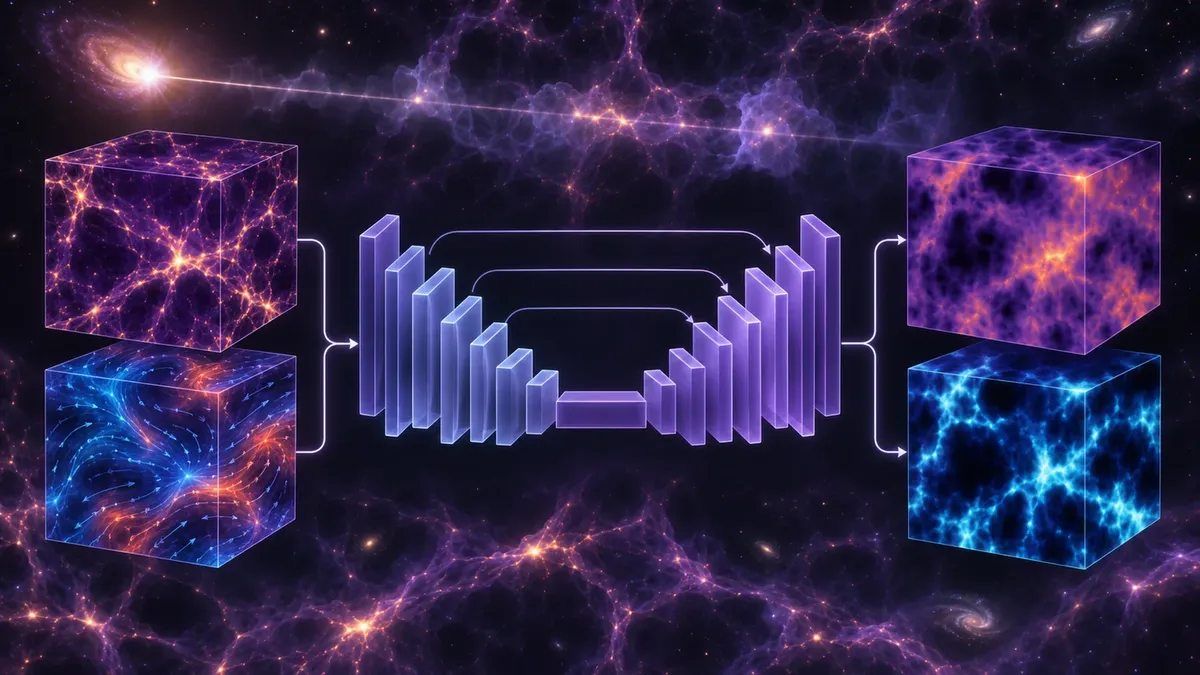
The Lyman-alpha forest is a pattern of absorption from neutral hydrogen in the intergalactic medium, imprinted on distant quasar light. Researchers use it to study matter in the young Universe, but producing large, detailed simulated forests is costly. A new preprint tests whether a neural network can map simulated matter and velocity fields to forest predictions in volumes much larger than those used for training.
Why make a simulated cosmic forest?
As quasar light passes through the intergalactic medium, neutral hydrogen absorbs some wavelengths. The resulting pattern, called the Lyman-alpha forest, helps astronomers trace cosmic matter at high redshift. Its statistical patterns can inform studies of structure growth, neutrino masses and dark-matter properties.
To interpret survey data, researchers need mock forests that capture large-scale structure as well as small-scale gas physics. Hydrodynamical simulations model gas and gravity, but the paper describes the combination of large volumes and detailed resolution needed for surveys as prohibitively expensive. The authors ask whether a model trained on smaller simulated regions can predict the forest in much larger ones.
Learning a mapping from simulated fields
Bhaskar Arya, Soumak Maitra and Shadab Alam trained a three-dimensional U-Net to map simulated dark-matter density and line-of-sight velocity fields to Lyman-alpha optical depth. Optical depth describes how strongly light is absorbed; transmitted flux is calculated from it. The inputs came from gravity-only simulations, and the training targets came from hydrodynamical simulations. The network predicts fields—it is not trained on observed quasar spectra.
The researchers tested the method at about redshift 3 in two simulation suites. In IllustrisTNG, they trained on a 110-comoving-megaparsec box and tested on an independent 300-megaparsec box, using both 2LPT approximations and N-body inputs. In FLAMINGO, they trained on a 1-gigaparsec box and tested on a 2.8-gigaparsec box using N-body inputs. In each suite, the test volume was roughly twenty times larger than the training volume.
They compared predictions with hydrodynamical reference fields using the flux distribution, the one-dimensional power spectrum along sightlines, correlations between power-spectrum scales, and the bispectrum and connected trispectrum. These statistics describe different features of the forest, including absorption strengths, clustering and links between scales. The power spectrum was included in training; the flux distribution, correlation matrices and higher-order statistics were not directly targeted.
Good within-suite agreement, with limits
Within each suite, the network reproduced the one-dimensional power spectrum to 2–3% for wavenumbers up to 1 inverse megaparsec. Across the full retained ranges, reported differences were 3.6–4.5% for TNG, depending on the input fields, and 4.5% for FLAMINGO. The bispectrum differences were 3.9–5.3% in TNG and 4.4% in FLAMINGO; connected-trispectrum differences were 10–11.2% in TNG and 16% in FLAMINGO. These results concern transfer to larger volumes within each simulation suite, not a general guarantee of accuracy for other simulations or conditions. A simpler fluctuating Gunn–Peterson approximation performed less well on the reported comparisons.
The network recovered the flux distribution over most of its range and the broad pattern of correlations between scales. One clear exception was FLAMINGO near full transmission: the model underpredicted the number of very transparent pixels. The authors suggest that rare, low-density environments may be underrepresented in the training samples. They also note that a deterministic model trained to minimize average squared error can smooth out extremes. The good broad agreement therefore does not mean every part of the predicted distribution is equally accurate.
Transfer between simulation suites was more difficult than transfer to a larger volume within one suite. In a separate test, a network trained on resolution-matched TNG fields was applied to FLAMINGO. It predicted FLAMINGO’s power spectrum to roughly 10% in the three long-wavelength bins with wavelengths larger than the TNG training volume; the prediction increasingly underestimated power at smaller scales. The small number of long-wavelength bins makes this a limited check, not evidence of general cross-suite accuracy. Differences in cosmology and gas-physics prescriptions remain relevant even after matching resolution and mean transmitted flux.
What the results do—and do not—show
The long-wavelength tests within each suite are also sparse: only two TNG bins and one FLAMINGO bin lie below the training box’s fundamental wavenumber. The authors call their agreement encouraging, rather than conclusive evidence of extrapolation to all large scales. The study is at one redshift, with one cosmology and thermal history per suite. Its grids are relatively coarse, and it uses noiseless simulated sightlines rather than observational data. It does not include observational noise, spectrograph resolution, continuum-fitting uncertainties, metal-line contamination or damped absorbers.
The method could help generate large mock catalogues for survey analyses, including estimates of covariance—the way uncertainties across scales are related. But the study tests selected simulated settings and statistics; it does not establish performance across cosmologies or validate predictions against real survey data. The paper is marked as prepared for submission to JCAP. It is a preprint, and its peer-review status is not established by the supplied source.
- Lyman-alpha forest
- cosmological simulations
- U-Net
- machine learning
- IllustrisTNG
- FLAMINGO
- large-scale structure
Related reading
Automatically matched by shared topic keywords. These links do not imply that the sources agree or establish a consensus.
A vision transformer reconstructs velocities in FLAMINGO skies
Source published
Shared keywords: cosmological simulations
Tracing the branching roots of dark-matter haloes
Source published
Shared keywords: cosmological simulations
Why Galaxy Bias Depends on How You Measure It
Source published
Shared keywords: cosmological simulations, large scale structure
Measuring the cosmic web’s statistical memory—and the limits of the measurement
Source published
Shared keywords: cosmological simulations, large scale structure
Reading the early universe through the cosmic web
Source published
Shared keywords: cosmological simulations, large scale structure