TRANSMISSION // 2611.27140v1
An FPGA learns to keep quantum dots on track
Source published
A hardware-based learning loop stabilized simulated quantum-dot operating points despite modeled drift, noise and charge jumps—but the test used an emulated device.
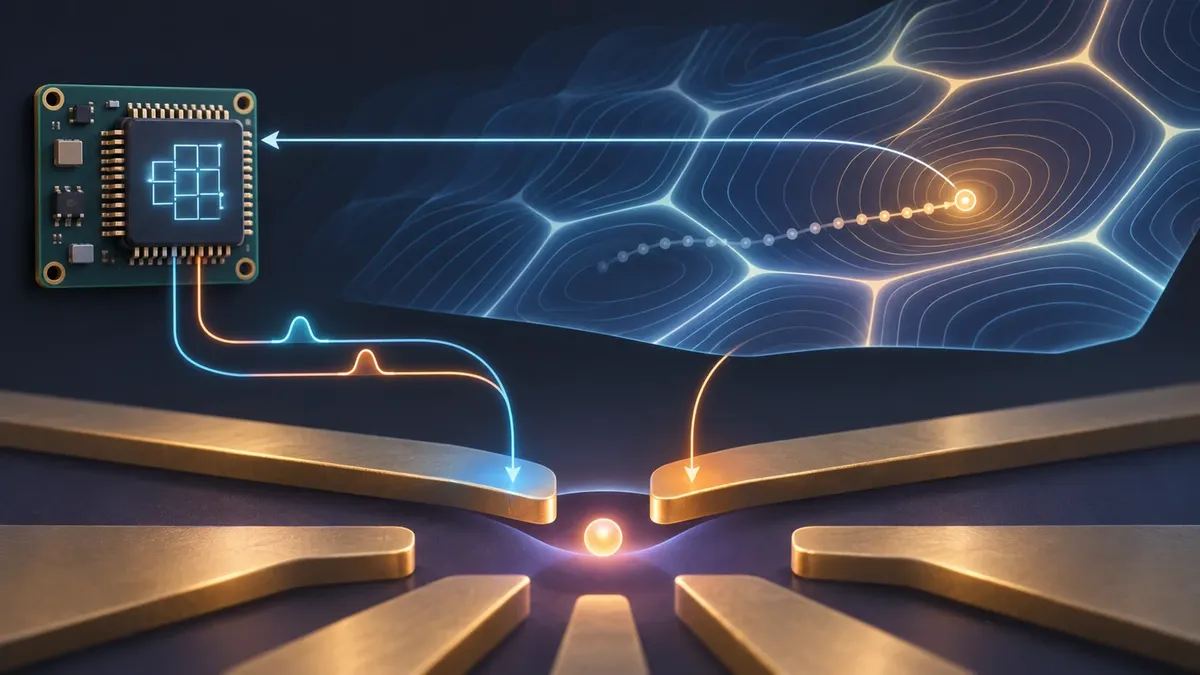
Spin qubits in quantum dots need carefully adjusted gate voltages, and those settings can shift as the electrical environment changes. Researchers tested whether a compact FPGA controller could keep a dot near a desired operating point using local measurements rather than repeated scans of the full device. The results are promising, but the quantum-dot response was simulated, not measured from a physical qubit device.
Keeping a quantum-dot spin qubit tuned is not a one-time job. Voltages on nearby gates define the dot’s charge state and operating conditions, but electrical noise can slowly shift the landscape, while abrupt charge rearrangements can move the desired setting suddenly. Repeatedly scanning the device to find the right point again can be slow. Could a small hardware controller instead make local adjustments as conditions change?
Leonardo Gaytan and colleagues tested an approach called multiplexed gradient descent (MGD), implemented on a field-programmable gate array, or FPGA. Their aim was to stabilize a quantum dot at selected operating points without giving the controller a complete map of how all the gates affect the device.
Learning from two nearby measurements
In the method, the FPGA simultaneously gives each gate a small, randomly chosen voltage nudge. It measures a sensor-based cost at two nearby settings, one on either side of the current setting. Comparing those readings estimates which direction locally improves the cost. The controller then adjusts the gate voltages and repeats the process.
This local strategy differs from approaches that first collect broad charge-stability scans and then analyze them. The FPGA receives only a single cost value for each measurement; it is not supplied with the simulated device’s cross-capacitance matrix, which describes how gate voltages influence dot potentials. The design also uses simple fixed-point arithmetic and bit shifts rather than floating-point calculations or hardware multipliers.
There is an important boundary to what the team tested: the controller ran on a room-temperature FPGA, while a computer program emulated the quantum-dot sensor and its response. The researchers added modeled noise, including slow drift and abrupt two-level charge jumps. This was a test of a hardware control algorithm interacting with an emulated device, not a demonstration on a working quantum dot or a cryogenic FPGA.
Stabilization under modeled disturbances
In the emulated tests, the controller could seek a minimum in a simulated charge-stability landscape and hold the system near an idling point. In one configuration with ten gates, it maintained the target within the study’s defined tolerance at the stated baseline noise level. The authors also tested a version with as many as 100 gates. For the simulated landscape, adding gates had little effect on convergence once the number of gates reached eight or more; the authors attribute this to the cost depending on just two relevant dot-potential directions in their model. That result does not establish performance for arbitrary devices or larger, more complex tuning tasks.
The controller also tracked modeled drift and recovered from simulated jumps. Its behavior depended on the learning rate: larger steps followed faster drift more closely but were more affected by measurement noise, while smaller steps were steadier in noisier conditions but could lag behind a moving target. In a jump test, the authors report recovery to within their chosen tolerance after jumps of different sizes. These findings describe the tested simulations and settings, not guaranteed performance in a physical device.
The FPGA implementation used no hardware multipliers, and its logic added only tens of nanoseconds per iteration in the reported setup. But each iteration required two measurements, each lasting one millisecond in the test. The measurement process—not the FPGA’s computation—therefore set the update speed. The authors estimate that the controller’s logic could fit within a future cryogenic-control power budget; they did not demonstrate operation at cryogenic temperature.
What remains uncertain
The main next step is to replace the emulated sensor response with measurements from a real quantum dot, then establish how reliably the controller works across devices and operating conditions. The study assumes the system has already been tuned into the desired charge occupancy; it addresses local stabilization, not the full process of finding and configuring a qubit from scratch. In the pulsing-point test, one sensor constrains the cost in only one direction, a limitation the authors say could be addressed with two sensors.
The paper is an unreviewed preprint, and its front matter contains placeholder publication details. Its results should therefore be read as an early engineering demonstration, not as proof that autonomous tuning has been solved at scale. The work suggests a practical route toward compact, local feedback, while leaving real-device validation and cryogenic integration as open tests.
- quantum dots
- spin qubits
- FPGA
- quantum control
- multiplexed gradient descent
- cryogenic electronics
Related reading
Automatically matched by shared topic keywords. These links do not imply that the sources agree or establish a consensus.
Stressed thin films could make silicon qubits’ valley splitting more predictable
Source published
Shared keywords: quantum dots
Industrial silicon growth delivers purified layers and working spin qubits
Source published
Shared keywords: quantum dots
Circular gratings guide photons from telecom quantum dots
Source published
Shared keywords: quantum dots
A quantum charge sensor gets a strong signal from a faint microwave probe
Source published
Shared keywords: quantum dots
A Trapped Ion Could Help Cool and Control a Levitated Nanoparticle
Source published
Shared keywords: quantum control