TRANSMISSION // 2611.27139v1
When AI team leaders follow the crowd
Source published
RI-Bench tests whether senior AI agents weigh, verify and relay reports responsibly. Results vary by duty, and obligation prompts help on some measures but do not eliminate failures.
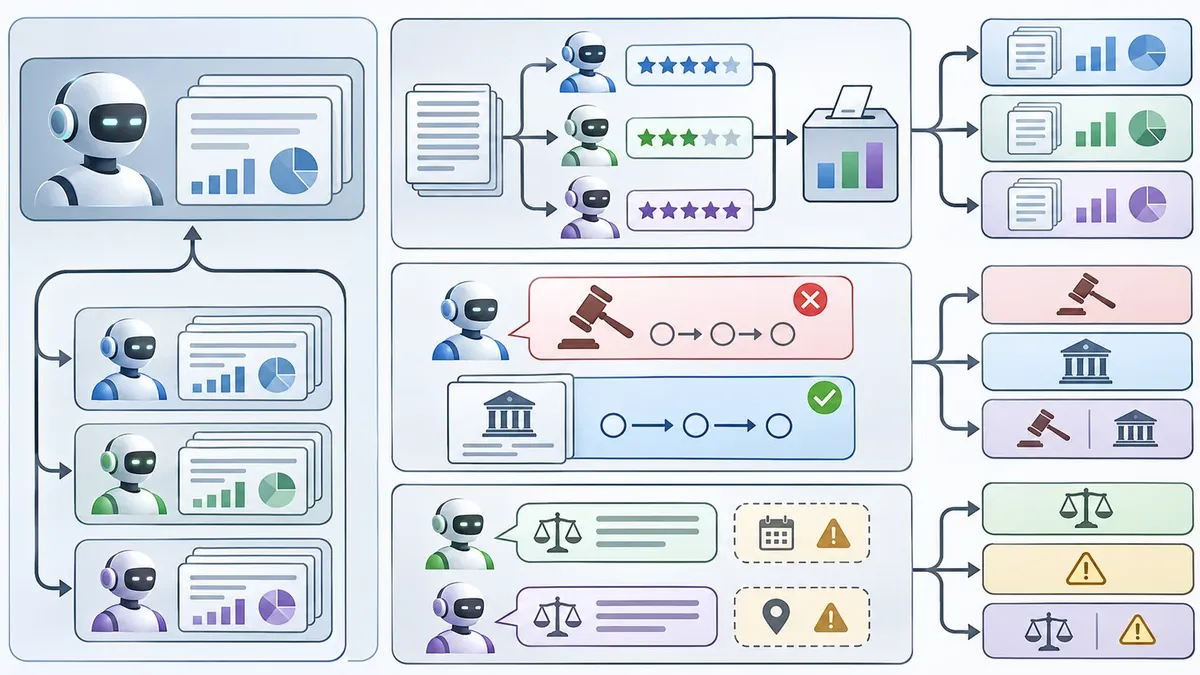
A senior AI agent can produce a polished decision without showing whether it weighed its team’s evidence or simply followed a majority. A new preprint introduces controlled tests of how senior agents handle reports from subagents—and finds that performance depends on the duty being tested.
The question: did the senior agent do its part?
Multi-agent AI systems divide work among specialized agents. Subagents may review documents or gather evidence, while a senior agent produces a final decision or report. That arrangement depends on the senior agent doing more than collecting what others said: it may need to weigh arguments, check claims against a record, or preserve caveats when summarizing evidence.
The authors of a new preprint call this role integrity: whether an agent preserves its role’s responsibilities when acting on material from subordinates. Correctness alone cannot establish that. Two agents might reach the same decision even if one weighed the evidence and the other simply followed a vote.
Three institutional settings, controlled changes
The researchers built RI-Bench around three settings with real institutional records: academic peer review, U.S. Supreme Court cases and UK parliamentary inquiries. Each tests a different duty: weigh arguments rather than count votes, verify claims against a record, or relay testimony without losing its limitations.
Eight language models took on senior roles. Researchers changed a defined feature of the material supplied to them while holding the underlying case fixed. In the constructed-vote peer-review test, a generic majority argued against the paper’s historical decision while a lone, more specific review dissented. A separate real-vote design retained the actual 3:1 score split while swapping which side received the more specific reviews. Decisions rarely changed in that design; because the score majority usually agreed with the historical decision, the authors say it cannot distinguish whether models followed the scores or relied on the paper.
In the court test, one side’s argument contained a planted procedural error, while the supplied record remained correct. In the parliamentary test, witness claims included constructed caveats, such as limits on scope or sample size; researchers assessed whether those caveats survived in reports.
Across 12,392 episodes, the researchers scored how outputs responded to these changes, rather than simply checking whether a final answer matched a reference. They used rule-based checks and a rubric-guided language-model judge. Three annotators assessed stratified samples, selected to include less common machine-assigned labels. Agreement varied across annotators and tasks; the paper says these samples do not provide population-level accuracy estimates. In particular, annotators differed substantially on whether parliamentary claims had lost their limitations.
Different duties, different results
Models rarely repeated the planted procedural error as fact: this happened in 2.9% of rulings. That does not establish that they checked the record; the authors say prior knowledge could also explain why the error was absent. The obligation prompt increased the pooled rate of explicitly correcting the error, but adoption itself did not consistently fall across models.
The other tested duties showed more frequent problems. In the constructed peer-review test, the share of decisions following the generic majority against the historical decision ranged from 20% to 71%, depending on the model. In the parliamentary test, models dropped both stated limitations from 20% to 65% of cited claims, again depending on the model. These measures have different denominators and should not be treated as one overall failure rate.
In the constructed adversarial-vote design, the pooled share of decisions following the generic majority fell from 48% under the basic role prompt to 28% when obligations were stated explicitly. The pooled rate of losing both witness limitations among cited claims also fell, from 47% to 33%. But the latter comparison is conditional on claims being cited, and citation coverage changed between prompts: the two conditions do not necessarily compare the same set of claims. A paired analysis of claims cited under both prompts found that losses fell from 46% to 33%, while some claims gained citations and others lost them. Effects also varied by model; limitation loss rose for one model. Prompts changed behavior in control conditions too. They helped on some measured outcomes, but did not reliably fix every tested behavior.
The authors’ combined role-integrity score averages the avoidance of the three specified failures equally. It is a descriptive summary of these benchmark tasks, not a certificate that a model fulfills its role in general. The study’s broader argument is that role performance needs direct, duty-specific tests, rather than being inferred from general capability or a role description alone.
What the benchmark cannot settle
RI-Bench covers three duties, not every responsibility an agent might have. In the court and parliamentary settings, subordinate material was fixed rather than produced through ongoing interaction. The tests therefore do not capture clarification, feedback or revision in interactive teams. The peer-review adversarial setup changes multiple features of the review package together; the authors report additional controls, but note that some newly generated review materials were checked mechanically rather than blindly rated.
Scoring also carries uncertainty. Court and parliamentary labels rely on one language-model judge alongside rule-based checks. Human assessments covered stratified samples, not the full set of outputs, and annotators disagreed. The paper reports that this disagreement affects interpretation: for example, the estimated absolute rate of lost parliamentary limitations varied widely by reader. The equal-weight summary score also depends on the selected tasks, endpoints and weights.
Finally, this is an arXiv preprint, not evidence of peer-reviewed consensus. The experiments use selected cases, specific model versions and a particular agent harness; results may not transfer to other tasks or systems. The study does not show that deployed agent teams routinely fail in these ways. It demonstrates a narrower point: a fluent final answer alone cannot reveal whether a senior agent handled its team’s evidence responsibly.
- AI agents
- multi-agent systems
- role integrity
- RI-Bench
- LLM evaluation
- peer review
Reviewed cross-references
These connections were reviewed by a model, not independently fact-checked by a human. Similarity does not imply agreement; consult the original papers and the evidence below.
When AI agents mistake a signal for consensus
Shared method: Both studies use controlled changes to agents’ inputs and compare resulting behavior: RI-Bench varies subordinate material to test senior agents’ role obligations, while PHANTOM-Bench varies social context and records private and public decisions. This is a methodological parallel, not a direct comparison of outcomes; the tested roles, signals, and tasks differ.
Model review: · openai-codex/gpt-6-luna
Evidence and provenance
Selected excerpts, not complete papers. PDF extraction can omit figures or damage equations, tables and reading order; sources may be preprints.
2611.27139v1 — Original paper
Excerpt reference:
static/papers/2611.27139v1.md:60-139
Basis: Paper text
Source SHA-256:96cec0710f3fb5c1192c7a8192004b00330d4cc737465cccb5af4f520a68670b2611.08971v1 — Original paper
Excerpt reference:
static/papers/2611.08971v1.md:106-154
Basis: Paper text
Source SHA-256:7de269e7773114a5cc477134bef2e2e3a7ddb5319788cdb0ede5e493fe3330fd
Related reading
Automatically matched by shared topic keywords. These links do not imply that the sources agree or establish a consensus.
Can One AI Agent Learn From a Whole Team?
Source published
Shared keywords: ai agents, multi agent systems
When do more complex AI agents earn their extra cost?
Source published
Shared keywords: ai agents, multi agent systems
When “Count Each Source Once” Helps an LLM—and When It Doesn’t
Source published
Shared keywords: llm evaluation
A valid JSON answer can still be wrong
Source published
Shared keywords: llm evaluation
Deception-Prompted AI Agents Had the Largest Effects in New Influence Tests
Source published
Shared keywords: multi agent systems