TRANSMISSION // 2611.27125v1
Why language-model students can struggle to learn from teachers
Source published
On-policy distillation trains a language model with feedback on its own responses. A preprint traces how mismatches can impede learning or encourage repetition, and tests a targeted alternative.
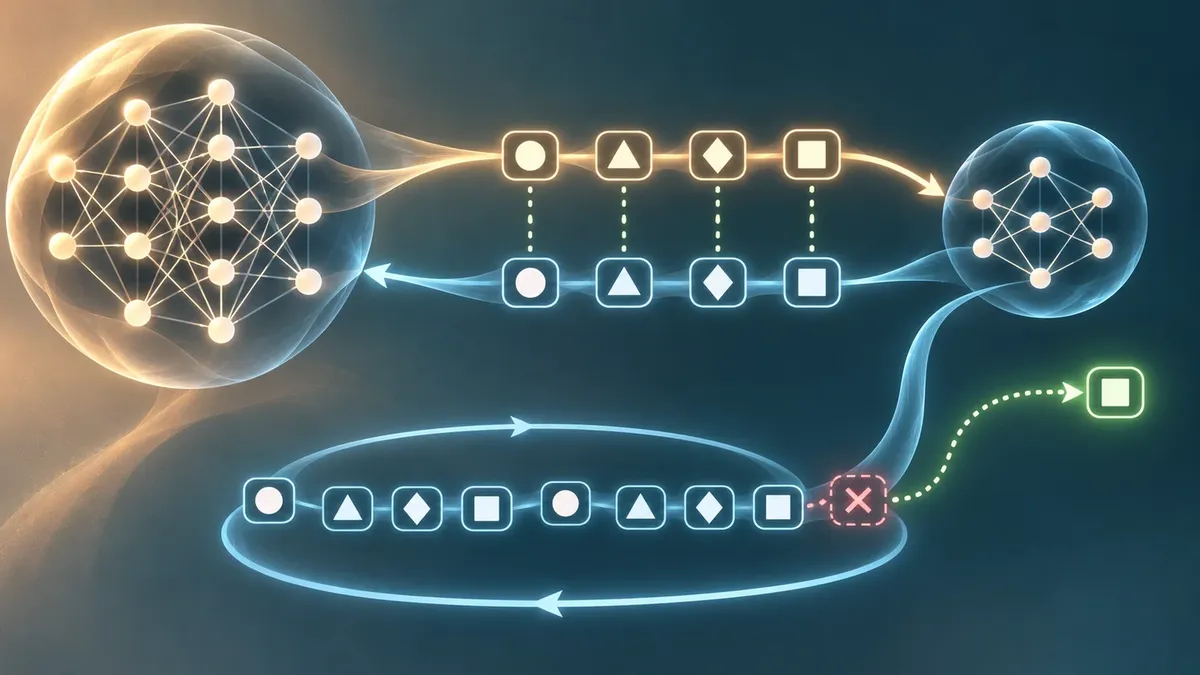
A teacher model can give detailed feedback on a student’s words, yet the student may still fail to learn the teacher’s preferred behavior. Researchers analyze why this happens in on-policy distillation, including how token mismatches can affect later responses, and test a method that redirects feedback at selected points.
The question: when does feedback fail?
On-policy distillation (OPD) trains a language model using responses the student generates itself. A teacher then supplies token-level feedback on those responses. The approach aims to make training better match the situations a student encounters when generating text, but it can also go wrong: responses may become longer or repetitive, and performance may deteriorate.
The authors of this arXiv preprint ask why a capable teacher does not always help its student learn. They examine a failure pattern they call “spurious agreement”: the student’s output has substantial local overlap with the teacher’s at the prefixes the student visits, yet its overall response becomes repetitive.
How the researchers investigated it
The work combines mathematical analysis of a simplified, single-state softmax policy with experiments on language models. Its main routing evaluations use three Qwen3 student sizes—1.7 billion, 4 billion and 8 billion parameters—with a Qwen3-8B teacher. The researchers study base-model and supervised fine-tuned (SFT) starting points, and evaluate mathematical reasoning and code generation. Separate diagnostic experiments examine additional teacher–student pairs.
A central diagnostic is top-p coverage: how much probability the student assigns to the teacher’s most likely tokens, taken together until they account for a chosen share of the teacher’s probability. Low coverage means the teacher favors tokens the student is unlikely to produce. The researchers also trace how updates at one token position affect other positions through shared model parameters, and how those changes alter later generations.
Finally, they introduce state-dependent KL routing. Rather than use the same kind of feedback everywhere, the method applies a distribution-level comparison when the student poorly covers teacher-preferred tokens or substantially underestimates some of the teacher’s probability mass. Elsewhere, it retains the standard sampled-token update.
What they found
In the simplified analysis, a sampled-token update can move the sampled token in the direction suggested by the teacher, but the size of that change depends on the student’s existing probability for the token. If that probability is very low, the update may barely raise it. Other tokens can also shift in ways that do not match the teacher’s preferences. In a language model, shared parameters mean that updates at one position can alter learning at others, sometimes changing the direction an update would take on its own.
The authors use a mismatch in the token used to end a response as a case study. In this Qwen3 setup, the student and teacher use different termination tokens. During training, the student’s own ending token is suppressed, while the teacher’s preferred alternative remains difficult to learn. Responses grow longer and completion rates fall. In intervention tests, aligning the termination tokens or masking the gradient at termination positions reduced the fraction of rollouts hitting the length cap from 0.95 to 0.25; it did not eliminate capped responses. The authors say the failure is not inevitable for every mismatch: it is especially relevant when the teacher strongly favors a token the student cannot produce and the response needs, such as an ending or format token.
Across the main routing evaluations, the researchers report that their method improves average accuracy over sampled-token OPD on the tested math and code benchmarks. For mathematical reasoning, reported gains in mean Avg@8 range from 1.38 to 2.50 percentage points, depending on model size and initialization; for code generation, they range from 2.92 to 3.44 points. Avg@8 is the mean accuracy across eight generated responses. The paper also reports Best@8, a bootstrap-based estimate of best-of-eight performance; it is not the observed fraction of questions solved at least once in the original eight responses.
What remains uncertain
The main routing evaluations use one model family and one teacher size, alongside particular datasets, training choices and benchmarks. The paper’s diagnostic experiments go beyond that setup, using other teacher–student pairs, but they do not establish that the routing method will improve results across other architectures, tasks or deployment settings. The termination-token example is a case study, and the authors explicitly note that not every mismatch causes the same failure.
This source is an arXiv preprint, so its claims should be considered provisional rather than treated as settled findings. The account here is based on the supplied paper text; extracted tables and equations may not preserve all formatting. The broader takeaway is therefore limited: in these experiments, measuring where the student’s likely tokens diverge from the teacher’s helped identify situations where ordinary token-by-token feedback may provide weak correction.
- on-policy distillation
- language models
- knowledge distillation
- AI training
- model alignment
- Qwen3
Reviewed cross-references
These connections were reviewed by a model, not independently fact-checked by a human. Similarity does not imply agreement; consult the original papers and the evidence below.
How misalignment can travel through AI training
Shared method: Both papers study on-policy distillation in which students generate their own trajectories and teachers provide token-level supervision. Zhang et al. analyze learning instability and performance on Qwen3 reasoning and code tasks; Askin et al. examine transfer of misalignment across several models and training channels. This shared training setup does not show that the instability mechanisms in the first study cause the safety effects in the second.
Model review: · openai-codex/gpt-6-luna
Evidence and provenance
Selected excerpts, not complete papers. PDF extraction can omit figures or damage equations, tables and reading order; sources may be preprints.
2611.27125v1 — Original paper
Excerpt reference:
static/papers/2611.27125v1.md:138-291
Basis: Paper text
Source SHA-256:5872d2fa2a24e81b8f08c981d64f2aff6144f73e06785646038ec2e0d48d6e782605.12798v2 — Original paper
Excerpt reference:
static/papers/2605.12798v2.md:131-175
Basis: Paper text
Source SHA-256:e1122325e2a7338c63c6a403a4df092fd18ad5b64b8cf6405cbd12cd27352a39
Related reading
Automatically matched by shared topic keywords. These links do not imply that the sources agree or establish a consensus.
Can a checklist help an AI model learn from a text-only teacher?
Source published
Shared keywords: ai training, knowledge distillation
UniCompress packs four vision-language skills into a smaller model
Source published
Shared keywords: knowledge distillation, on policy distillation
How misalignment can travel through AI training
Source published
Shared keywords: language models
How Language Models Balance New and Existing Skills
Source published
Shared keywords: ai training, knowledge distillation, language models
Turning a mixture of experts into a dense language model
Source published
Shared keywords: knowledge distillation, language models