TRANSMISSION // 2611.27121v1
Why a drone sometimes needs to move to see again
Source published
A camera blackout can end on a timer—or only when a drone leaves a dark zone. A simulated recovery system is designed to handle both.
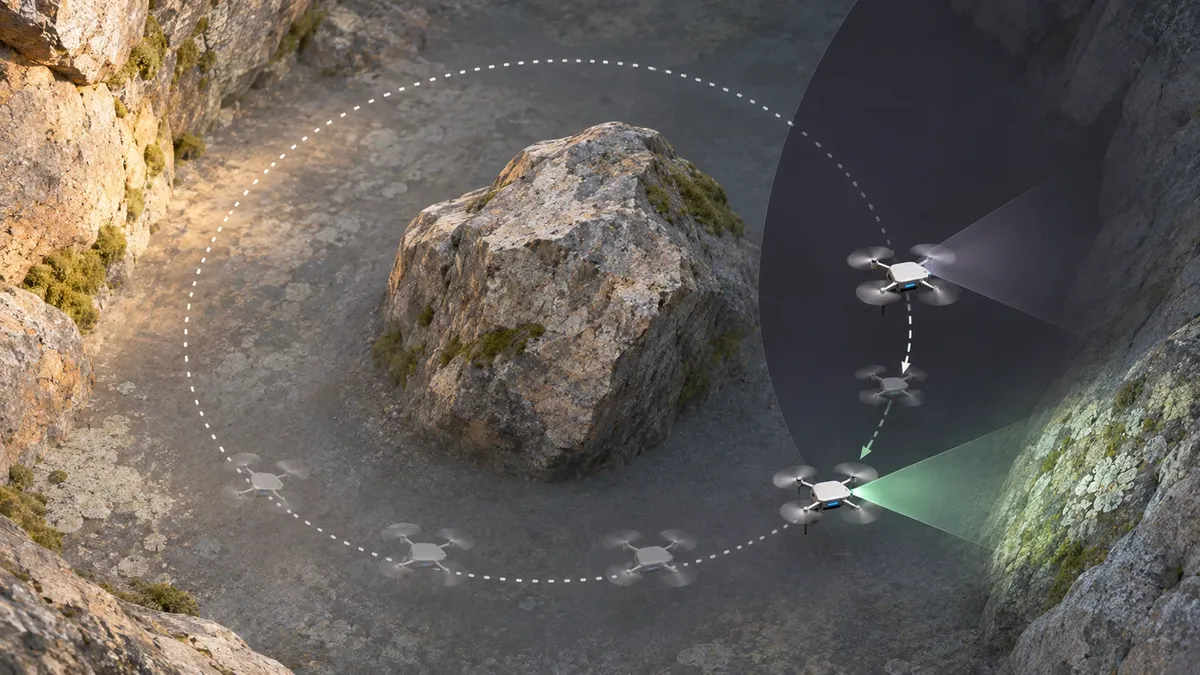
When a quadrotor loses camera vision, waiting may help—or keep it trapped without a view. A preprint tests a recovery module that briefly probes backward, then resumes flight when it can.
A drone loses its camera view. Should it stop and wait, or keep moving? The answer depends on why the view disappeared—and, at first, the drone may not be able to tell.
In one kind of outage, frames are withheld for a set time and then return automatically. In another, vision is unavailable in a particular physical region: the drone must leave that zone before its cameras can see again. In simulations studied by Jinyuan Zhang and Shengshuo Jiao, both outages initially looked alike to the onboard system. But the useful responses differed. Hovering worked well for timed blackouts and failed in the spatial dark zone; continuing blindly could cross the zone but was risky during timed blackouts.
The researchers propose treating recovery as an active-observability problem: the drone must move in a way that helps restore useful visual information, not merely keep following its route or remain stable. Their paper, Portable Active Recovery under Timed and Position-Dependent Visual Outages, is an arXiv preprint, not a peer-reviewed publication.
A cautious probe, then a decision
The team built a recovery module that sits between a drone’s position estimate and its existing flight controller. It does not change the controller’s learned weights or require retraining. Instead, when visual updates stop arriving, it detects the loss, brakes with limits on acceleration and jerk, and retraces its recent path for a short, bounded distance. Moving back toward previously seen scenery can bring the cameras out of a spatial dark zone and restore visual tracking.
If that probe does not restore vision, the module waits before continuing along the planned route—a response suited to a timed blackout. When vision returns, it allows the vehicle to settle before rejoining its trajectory. An optional map-based correction can also help with position estimates, though the paper reports that such corrections can be harmful when the visual-inertial estimate is already relatively accurate.
The system uses onboard-style signals, including camera updates, inertial measurements and the route reference. The experiments did not provide the controllers with external localization such as GPS or motion capture. The authors also evaluated the module on top of several unchanged host controllers, including MPPI, SimpleFlight and DATT-L1.
What the simulated flights found
The main benchmark used 48 newly generated scenes, with 1,920 simulated flights across the tested approaches. Each flight faced one of two principal outages: an eight-second timed blackout or a position-dependent zone. The authors’ main score was the worst-condition completion rate—the lower completion rate across the two outage types—using a criterion that required both task progress and acceptable localization.
For the full configuration, which combined the recovery module with a gated prior-map branch, the reported worst-condition completion was 88.5% (95% interval: 81.2%–94.8%). It completed 93 of 96 timed-blackout flights and 85 of 96 spatial-outage flights under that scoring rule. In a paired hover-and-wait test, the vehicle completed 93 of 96 timed blackouts but none of the 96 spatial outages. The paper reports 13 hard failures in that spatial-outage test; the remaining flights also failed the completion criterion.
Without retraining SimpleFlight, adding recovery components raised its reported worst-condition completion from 68.8% to 86.5% in a paired evaluation. A separate, smaller test on ten fresh scenes assessed two flight speeds. SimpleFlight with the module reached 90% at each speed, with no hard failures in those tests. These are results from distinct experimental batches; they should not be read as one combined estimate.
The authors’ trace analysis points to a less obvious explanation for some outcomes. They argue that the key issue was not simply reducing inertial drift while the cameras were blind. Instead, the quality of visual-inertial relocalization when frames returned mattered: matching previously seen texture could help the estimator correct its position, while returning to unfamiliar scenery sometimes produced larger errors. This is an interpretation supported by the study’s simulation traces and additional replay tests, not a general law established for every drone or environment.
What remains uncertain
The results are encouraging within the tested setup, but the tests were not physical flights. They used a circular route, cleanly imposed stereo-camera outages, two speeds and simulated dynamics; the authors specifically identify obstacle-rich routes, partial visual degradation, onboard-compute testing and real-world flight validation as next steps. The optional map correction also showed a tradeoff: replaying camera–inertial data from the EuRoC dataset found that it could worsen estimates after short blackouts and help after longer ones. That replay evaluated the estimator, not the complete flying system.
The reported confidence intervals capture uncertainty under the authors’ scene-based analysis, but they do not establish performance in untested settings. The paper also notes that recovery costs time: supervised flights took roughly 9–14 seconds longer to finish. Because this is a preprint, its methods and conclusions have not yet been certified through peer review. The practical takeaway is therefore limited: in these simulations, combining a brief backward probe with a fallback response handled two visually similar but physically different outages better than relying on a single response.
- quadrotors
- robotics
- visual-inertial odometry
- camera outages
- drone recovery
- active perception
- simulation
Related reading
Automatically matched by shared topic keywords. These links do not imply that the sources agree or establish a consensus.