TRANSMISSION // 2611.27118v1
DCN/DNC Ratio Is Linked to Temperature in Massive Star-Forming Regions
Source published
A survey finds a moderate association between gas temperature and the DCN/DNC abundance ratio in late-stage massive star-forming regions, but the cause remains uncertain.
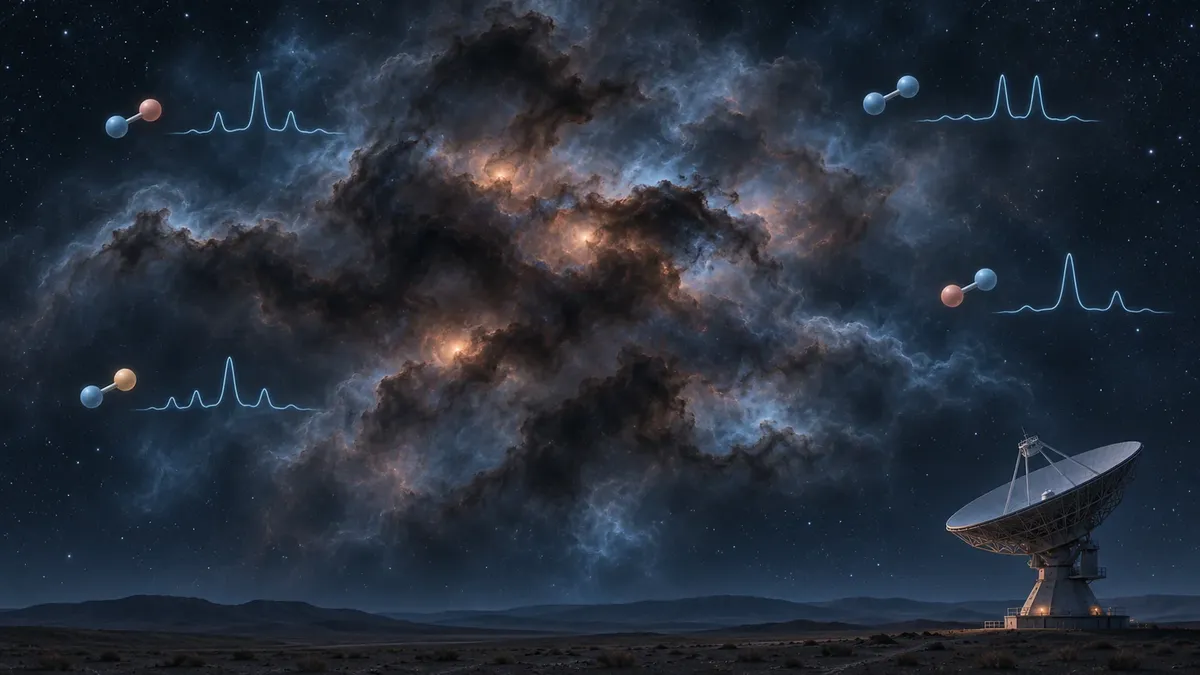
Deuterated molecules can reveal clues about the chemistry of star-forming clouds. In observations of late-stage massive star-forming regions, researchers found that warmer gas tends to have a higher abundance of DCN relative to DNC. The association is statistically significant, but it has substantial scatter and does not show that temperature alone controls the chemistry.
In dense clouds where stars are forming, molecules offer clues about conditions that are difficult to observe directly. Deuterated molecules—those in which hydrogen is replaced by its heavier isotope, deuterium—can reflect both the environment and its chemical history. This study asks whether the balance between two related molecules, DCN and DNC, is associated with gas temperature.
DCN and DNC are isomers: they contain the same atoms arranged differently. Their abundance ratio could be related to the chemistry of their non-deuterated counterparts, HCN and HNC, as well as to the ways deuterium is incorporated into molecules. Earlier observations hinted at a temperature dependence, but the evidence was limited. The researchers set out to test the relationship across a larger sample, deriving abundances from molecular signals rather than relying only on the relative brightness of emission lines.
Observing molecular signals
The team used the Yebes 40-metre radio telescope to observe 101 late-stage massive star-forming regions. They measured transitions of DCN, DNC, and rarer isotopic forms of HCN and HNC containing carbon-13 or nitrogen-15. The isotopologue observations were used to infer the column densities of the parent molecules HCN and HNC, applying adopted isotope ratios. Those conversions carry systematic uncertainties that were not included in the quoted errors.
For gas temperatures, the researchers used earlier measurements of methyl acetylene (CH₃CCH). Its rotational temperature is closely related to the kinetic temperature of dense gas. The team estimated molecular column densities under two simplifying assumptions: that the emission was optically thin and that the gas was in local thermodynamic equilibrium. They then calculated abundance ratios and compared them with temperature.
Temperatures derived from CH₃CCH were available for only part of the sample. The main Pearson correlation analysis of [DCN]/[DNC] used 43 regions where both molecules were detected and a temperature was measured. The authors also used a generalized Kendall analysis, which can incorporate upper and lower limits for measurements that were not detected. This is a separate statistical test, not evidence that every source showed the same pattern.
A moderate association, not a rule
Among the 43 sources in the Pearson analysis, the association between temperature and the logarithm of [DCN]/[DNC] was moderate and positive (correlation coefficient 0.51). The generalized Kendall analysis, including censored measurements, also found a statistically significant positive association (τ = 0.25, p = 0.011). In this sample, warmer regions therefore tended to have more DCN relative to DNC. The considerable scatter between regions indicates that temperature is not the only factor involved.
Other ratios showed different patterns. The fraction of HNC present as DNC had a weak negative association with temperature, while the corresponding fraction for HCN showed no statistically significant correlation. The parent-molecule ratio [HCN]/[HNC] also showed substantial scatter and no statistically significant temperature association in this sample. The authors note that carbon-13 isotopologue lines may be affected by optical depth. Nitrogen-15 lines are generally weak, and H¹⁵NC in particular had a low detection rate. These limitations could obscure an underlying temperature relationship, but the observations do not confirm one.
Possible chemistry, with open questions
The researchers suggest that the DCN/DNC association may involve more than a temperature-related change in the balance between HCN and HNC. One proposed explanation is that deuterium fractionation in HNC changes as gas warms, while DCN may persist or continue to form through pathways available in warmer conditions. The paper presents these as possible interpretations, not mechanisms demonstrated by the observations. Local chemical conditions and evolutionary stage may also contribute; temperature and the development of star-forming regions are linked.
The findings concern this sample of late-stage massive star-forming regions and do not establish a universal relationship for all molecular clouds. In addition to the limited number of sources with both detections and measured temperatures, the abundance estimates depend on assumptions about optical depth, excitation and isotope ratios. Correlation shows an association, not cause and effect. The authors call for spatially resolved observations and dedicated chemical modelling to distinguish temperature effects from evolutionary changes and competing reaction pathways.
This work is available as an arXiv preprint in manuscript form; the source lists received and accepted dates as placeholders, so those entries do not establish publication or acceptance. The paper reports that its spectra and full tables are available through Zenodo. Overall, the study identifies DCN/DNC as a potentially useful clue to conditions in these late-stage massive star-forming regions, while leaving the chemistry behind the association unresolved.
- star formation
- astrochemistry
- deuterium fractionation
- molecular clouds
- radio astronomy
- DCN
- DNC
Related reading
Automatically matched by shared topic keywords. These links do not imply that the sources agree or establish a consensus.
Ammonia Maps Offer a Closer Look at Gas Near the Milky Way’s Centre
Source published
Shared keywords: molecular clouds, radio astronomy, star formation
W49B’s shocked clouds point to intense cosmic-ray ionization
Source published
Shared keywords: molecular clouds
Faint radio signals probe two growing galaxy clusters
Source published
Shared keywords: radio astronomy, star formation
Layered cloud model traces hydrogen’s transition toward star-forming gas
Source published
Shared keywords: molecular clouds, star formation
Star-forming clouds show a recurring polarization difference, but no clear environmental order
Source published
Shared keywords: molecular clouds, star formation