TRANSMISSION // 2611.27080v1
Repeated viewing helps people spot some deepfakes—but not reliably
Source published
In a study of 110 adults, accuracy improved when people reassessed the same videos after feedback. Yet errors persisted, judgments often changed, and confidence exceeded performance.
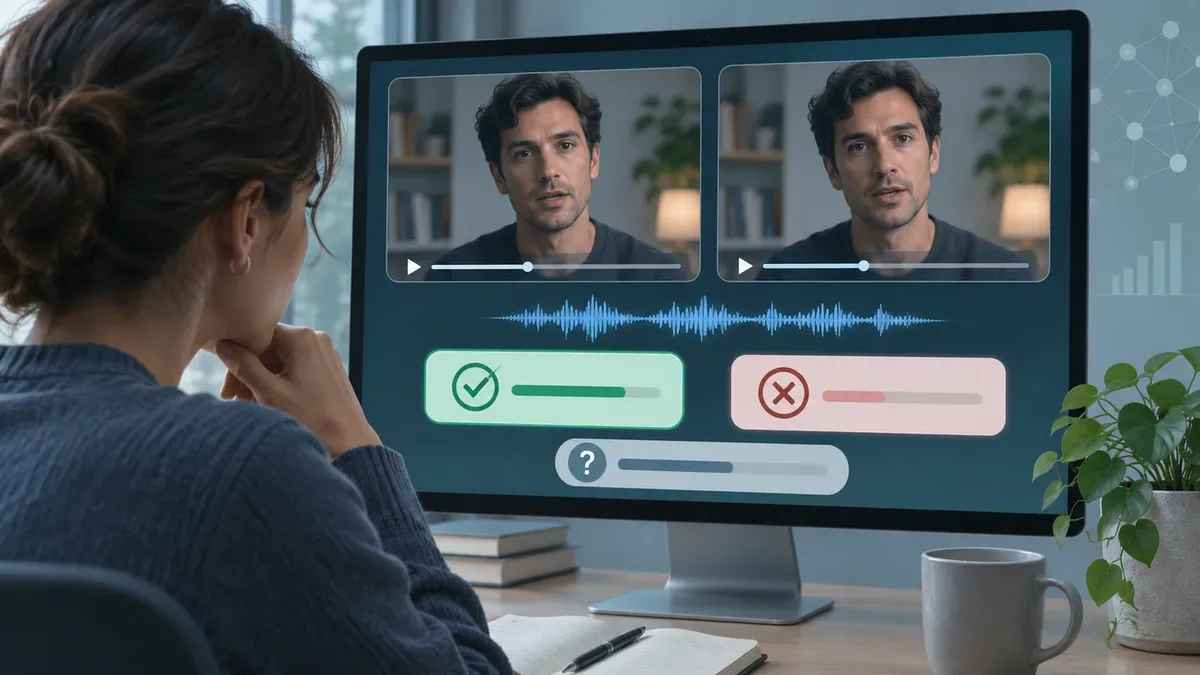
Can seeing a video again—and learning whether an earlier judgment was right—make people better at spotting deepfakes? A study of 110 participants found modest accuracy gains on two video datasets, alongside continued mistakes and overconfidence.
People often have to judge whether a video is genuine using both its images and its sound. But does a second look help, especially if viewers are told whether their first judgment was correct? A study by Ammarah Hashmi and colleagues tested this question using the same videos twice, with corrective feedback after each first-round judgment.
The result is encouraging in one limited sense: participants were more accurate in the second round. But seeing the same material again did not make their judgments dependable. Some errors persisted, some correct answers turned into wrong ones, and participants’ confidence exceeded their measured accuracy.
How the study worked
The researchers recruited 110 English-speaking adults through Amazon Mechanical Turk. Participants watched 40 videos from the FakeAVCeleb dataset—20 real and 20 fake—and classified each as real or fake. After every first-round answer, they saw the correct label. They then judged the same 40 videos again, in a newly randomized order.
The team repeated the procedure with 40 videos from the DFDC dataset. These, too, included 20 real and 20 fake videos. Everyone completed the FakeAVCeleb evaluation before the DFDC one. The researchers compared accuracy between rounds, tracked how judgments changed, and asked participants to rate their overall confidence after each dataset evaluation.
Crucially, this design combined two things: repeated exposure to the same clips and feedback about their labels. It can show what happened under that combined procedure, but cannot tell whether repetition, feedback, remembering labels, or another factor produced the change.
Accuracy rose, but mistakes remained
On FakeAVCeleb, mean accuracy increased from 63.30% in the first round to 67.98% in the second—a rise of 4.68 percentage points. On DFDC, it went from 59.52% to 68.16%, a rise of 8.64 points. The researchers’ statistical tests supported an increase on both datasets.
The gains mainly reflected fewer false negatives: fake videos that participants mistakenly called real. Those errors became less frequent in the second round. False positives—real videos called fake—did not change significantly on either dataset. In other words, the procedure helped participants catch more fakes without showing a clear reduction in mistaken accusations against real videos.
Even after reassessment, mean accuracy remained below 70% on both datasets. So the improvement did not amount to reliable detection.
A second judgment can correct—or create—an error
Participants did not always give the same answer twice. Their real-or-fake response changed in 27.55% of participant-video pairs for FakeAVCeleb and 32.91% for DFDC. A changed answer is not necessarily a better one: some first-round mistakes were corrected, but some initially correct answers became incorrect.
For FakeAVCeleb, 16.11% of pairs went from incorrect to correct, while 11.43% went from correct to incorrect. For DFDC, the corresponding figures were 20.77% and 12.14%. Around one in five pairs remained incorrect in both rounds on each dataset. Overall accuracy could rise even as individual judgments remained unstable, because corrections outnumbered newly formed errors.
Participants also rated their confidence higher than their observed pooled accuracy, by an average of 11.99 percentage points for FakeAVCeleb and 12.82 points for DFDC. Confidence was measured once after the two rounds, however, so the study cannot show whether it changed after feedback or how confident people were about individual judgments.
What the results can—and cannot—tell us
The findings apply to this study’s participants, selected videos, and procedure. The researchers used only 40 videos per dataset, and all participants assessed FakeAVCeleb before DFDC. The larger gain on DFDC therefore cannot be pinned on the dataset itself: practice, transfer, fatigue, or order effects could also matter.
Because participants saw the same clips twice, better second-round scores do not establish that they learned a general skill that would transfer to new videos. The study also did not separately test feedback and repetition, directly measure memory or attention, or evaluate whether automated detection tools improve human decisions. Its authors note that accuracy and error rates alone cannot distinguish improved visual or audio discrimination from a greater tendency to answer “fake.”
The paper says it was submitted to the IEEE for possible publication. It should therefore be treated as a preprint rather than as evidence of peer-reviewed publication. The results suggest that reassessment with item-specific feedback can improve performance on familiar videos, but not that viewers can safely verify unfamiliar deepfakes by looking twice. The authors call for studies that separate repetition from feedback and test performance on new material.
- deepfakes
- human perception
- corrective feedback
- audiovisual media
- media literacy
- research preprint
Related reading
Automatically matched by shared topic keywords. These links do not imply that the sources agree or establish a consensus.