TRANSMISSION // 2611.27079v1
How a tiny particle exposed a flaw in a physics AI
Source published
A jet-classifying model mistook very soft neutral particles for clues about which dataset a jet came from. Researchers traced the shortcut and tested targeted weight edits to reduce it.
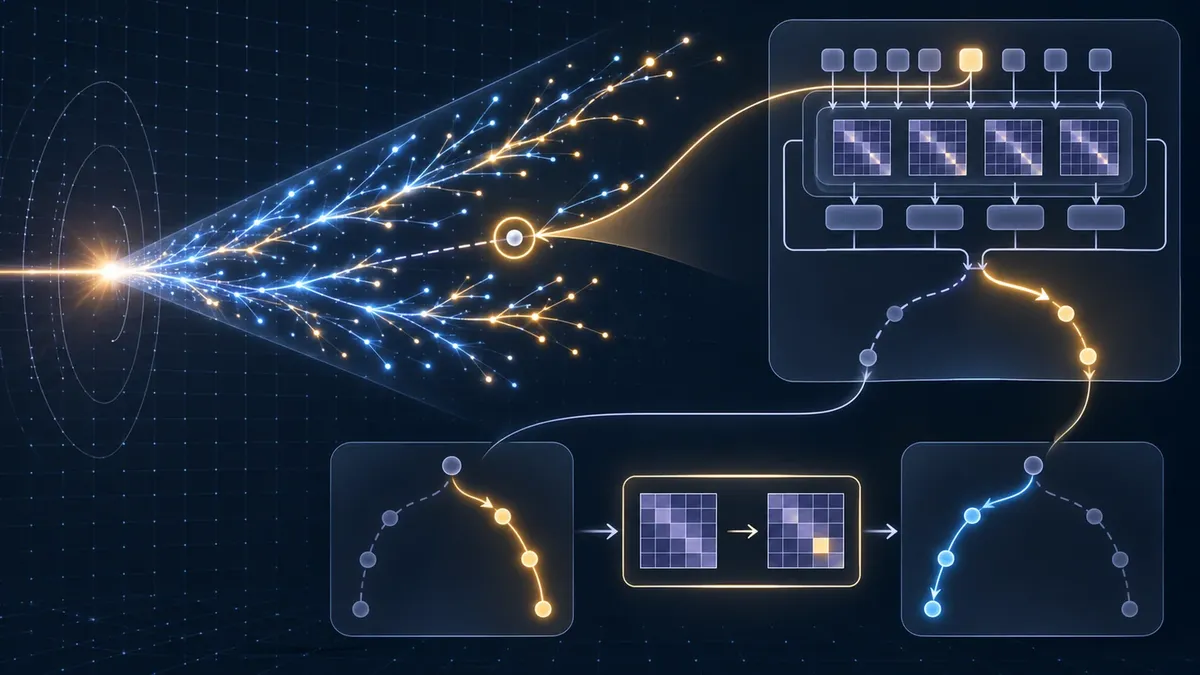
A particle too soft to matter much to a jet’s physical properties could dramatically change an AI model’s classification. Researchers traced this unexpected sensitivity to differences between the datasets used to pretrain the model—and tested ways to correct it without broadly retraining the system.
A particle-physics AI should not radically change its view of a jet just because an almost imperceptibly soft particle is added. Yet that is what researchers found in OmniLearned, a pretrained model used to classify particle “jets” produced in high-energy collisions. Their study asks two linked questions: What had the model learned that made it respond this way, and could that behavior be repaired with limited changes to its internal weights?
Jets are sprays of particles produced when energetic quarks or gluons emerge from a collision. Physicists use jet taggers to distinguish jets associated with particular particles, such as W bosons, from background jets. A useful tagger should be insensitive to adding a particle whose energy becomes vanishingly small—a property known as infrared safety. Neural networks do not automatically obey this requirement, so it must be tested.
The team tested OmniLearned by adding a soft particle at a random position near a jet and measuring changes in the model’s outputs. In the smallest model, adding a photon carrying 0.1% of the jet’s transverse momentum reduced the W-tagging efficiency from 80% to 54% at the study’s chosen selection threshold. The researchers also examined how information moved through the network. Attention analysis and tests that replaced individual attention-head outputs helped identify components involved in the response. They used probes of internal representations to investigate what the model appeared to infer about the altered jets.
The proposed explanation is a dataset shortcut. OmniLearned was pretrained on several datasets with different particle-reconstruction thresholds. A very soft neutral particle below one dataset’s threshold could be present in another dataset, making it a clue to dataset origin rather than to the jet’s underlying physics. The team’s analyses indicate that the model used this clue: an added soft neutral particle could make a jet’s internal representation resemble one from a different dataset. The authors describe this as a hypothesis supported by their tests, not a universal explanation for model failures.
They compared three repair strategies. Fine-tuning used a designed objective to reduce sensitivity to soft-particle additions while preserving predictions on ordinary jets and responses to selected physical changes. A sparse autoencoder—a method for separating patterns in a model’s internal activity—identified three directions associated with the problematic particles. The researchers then edited weights so that attention mechanisms became less responsive to those directions. A third approach let a language-model agent inspect and edit weights directly, without gradient-based training. Each agent run had a limit of 50 evaluation queries; the study tested three independent runs for each setup and model size.
All three strategies substantially reduced the flaw for the smallest model on the tested cases. After repair, W-tagging efficiency with an added soft photon returned to 78–79%, compared with 54% before repair. The weight-space edits changed fewer parameters than the fine-tuning approach in that model, while the sparse-autoencoder edit changed fewer still. These methods did not preserve every measured response equally well: the sparse-autoencoder edit, for example, reduced the model’s response to some tested physical changes. The agent’s results also varied across runs, and the paper cautions that edit size alone did not predict repair quality.
The researchers tested whether the changes carried beyond the original W-tagging example. In the small model, repairs improved results across the other tested signal-class taggers and reduced the soft-particle response of a generator and a newly trained jet-mass regression head. But transfer was not uniform: generator behavior varied between agent runs, and the sparse-autoencoder approach was less effective in larger models, where the sensitivity was spread across more attention heads.
There is an important distinction between reducing a measured flaw and proving infrared safety. The repaired models still showed nonzero responses as particle energy was lowered. The authors therefore say the interventions reduce the excess sensitivity linked to the dataset shortcut; they do not establish formal infrared safety. Their conclusions are also based on one model family and simulated jet datasets, with selected tests of model sizes, tasks and particle changes. The agent experiments used a constrained setup, and the authors say how performance changes with different agents or evaluation budgets remains open.
The work is an arXiv preprint, not evidence of peer review or independent replication. Its code, agent records and edited weights are reported as publicly available, which may help others examine the results. For now, the study offers a focused demonstration: mechanistic analysis can help identify an unwanted learned shortcut, and targeted edits can reduce it—but each repair still needs testing across the behaviors and tasks that matter.
- particle physics
- jet tagging
- infrared safety
- mechanistic interpretability
- sparse autoencoders
- weight-space programming
- machine learning
Reviewed cross-references
These connections were reviewed by a model, not independently fact-checked by a human. Similarity does not imply agreement; consult the original papers and the evidence below.
Inside a neutrino AI, useful physics can sit unused
Shared method: Both studies use sparse autoencoders to identify internal features and test interventions. The jet study reports removing three latent directions to reduce sensitivity to soft neutral particles; the neutrino study validates physical read-outs and tests their causal use by downstream heads. Their models and goals differ, so this methodological overlap does not show that either result transfers across domains.
Model review: · openai-codex/gpt-6-luna
Evidence and provenance
Selected excerpts, not complete papers. PDF extraction can omit figures or damage equations, tables and reading order; sources may be preprints.
2611.27079v1 — Original paper
Excerpt reference:
static/papers/2611.27079v1.md:13-35
Basis: Paper text
Source SHA-256:115b9dc6070fe9172c2022581ac06e3ba49d50beb55d2f1274edde4bc3624b452608.26090v2 — Original paper
Excerpt reference:
static/papers/2608.26090v2.md:27-42
Basis: Paper text
Source SHA-256:6025ccb240a3ff5ded62675c5cc4b7922801c946a96f57a2198e1a58f3ff3356
A tiny weight edit improves an AI model—but finding it is unreliable
Shared method: Both studies examine language-model agents making direct weight edits without gradients under a budget of up to 50 model queries or forward-tool requests. The jet study applies this to a physics foundation model; the broader WSP study evaluates other models and benchmarks. Its abstract reports substantial variation across editing trajectories, so these results do not independently validate the jet-model repair.
Model review: · openai-codex/gpt-6-luna
Evidence and provenance
Selected excerpts, not complete papers. PDF extraction can omit figures or damage equations, tables and reading order; sources may be preprints.
2611.27079v1 — Original paper
Excerpt reference:
static/papers/2611.27079v1.md:110-139
Basis: Paper text
Source SHA-256:115b9dc6070fe9172c2022581ac06e3ba49d50beb55d2f1274edde4bc3624b452611.09382v1 — Original paper
Excerpt reference:
static/papers/2611.09382v1.md:176-217
Basis: Paper text
Source SHA-256:1d39db642c5f82932aec72f60cf22e07475f819babec1561a1a4123da6ca43252611.09382v1 — Original paper
Excerpt reference:
static/papers/2611.09382v1.md:13-125
Basis: Paper text
Source SHA-256:1d39db642c5f82932aec72f60cf22e07475f819babec1561a1a4123da6ca4325
Related reading
Automatically matched by shared topic keywords. These links do not imply that the sources agree or establish a consensus.
Inside a neutrino AI, useful physics can sit unused
Source published
Shared keywords: mechanistic interpretability, particle physics, sparse autoencoders
When one dominant signal distorts sparse autoencoder scores
Source published
Shared keywords: mechanistic interpretability, sparse autoencoders
Tracing the Internal Signals Behind Language Model Reasoning
Source published
Shared keywords: mechanistic interpretability, sparse autoencoders
Tracing and Editing Visual Skills Inside Multimodal AI
Source published
Shared keywords: mechanistic interpretability, sparse autoencoders
Editing a Robot Model’s Hidden Goal Without Changing Its Instructions
Source published
Shared keywords: mechanistic interpretability, sparse autoencoders