TRANSMISSION // 2611.27071v1
How Ultraviolet Observations Illuminate Solar Activity
Source published
P. F. Chen and colleagues describe how ultraviolet observations can help investigate solar jets, flares, eruptions and elemental fractionation—and may inform studies of other stars.
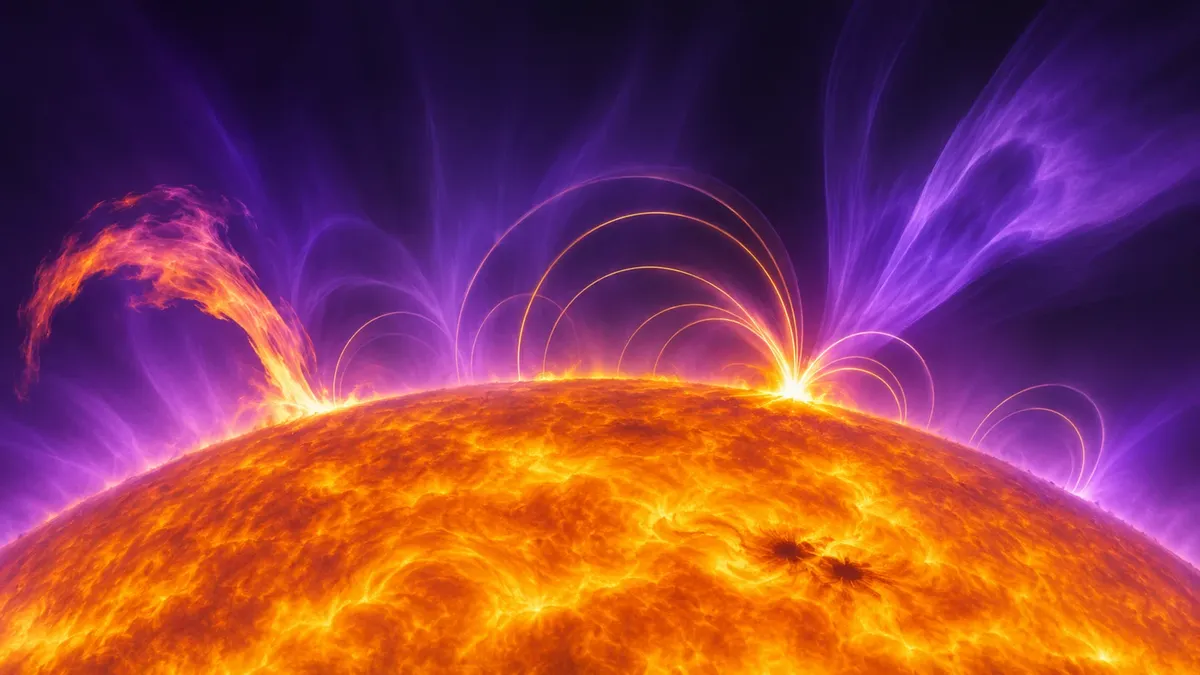
Ultraviolet observations can provide clues about activity in the Sun’s atmosphere, from the chromosphere to the corona. P. F. Chen and colleagues describe several phenomena these observations help researchers investigate, along with possible applications to other stars.
Ultraviolet observations are used to investigate activity in the Sun’s atmosphere, from the chromosphere to the corona. P. F. Chen and colleagues discuss how such observations relate to jets, flares, large-scale eruptions and chemical elements. The available abstract presents these topics but does not specify the paper’s method or whether it reports original observations.
The authors describe jets as occurring throughout the solar atmosphere and associate them with magnetic reconnection and type III radio bursts. The abstract does not explain the evidence for these associations or detail how the bursts arise, so it provides a broad account rather than enough information to assess the underlying studies.
The paper also discusses sporadic flares in the corona. The abstract describes them as a release of accumulated magnetic energy, while new magnetic flux enters the solar atmosphere and motions at the solar surface shuffle it. It does not give measurements or case studies that would allow readers to assess this account in detail.
Large-scale eruptions can send magnetized plasma into interplanetary space. According to the abstract, they are accompanied by globally propagating waves and subsequent dimmings. The authors describe the waves as a tool for diagnosing the coronal magnetic field, which cannot be measured directly. They also say dimmings can be used to estimate the mass expelled in eruptions and magnetic connectivity. These are indirect diagnostic uses; the abstract gives no details about their precision or uncertainties.
Ultraviolet spectroscopy is also described as a source of information about the fractionation of chemical elements, particularly those with low first ionization potential. The abstract does not report specific element measurements or explain how these observations are analyzed. It therefore identifies a research application without providing enough detail to evaluate it.
The authors suggest that detailed observations of the Sun may shed light on activity in other stars, which cannot be imaged. This is presented as a potential contribution from solar research. The abstract does not specify which stellar phenomena or comparisons are involved.
There are limits to what can be concluded from the available source. This account is based on the paper’s abstract alone, not its full text. The abstract names topics and diagnostic applications but does not describe instruments, datasets, a method for selecting or evaluating studies, or uncertainty estimates. Those details cannot be assessed here. The source record identifies the item as an arXiv preprint; the supplied information does not establish whether it has been peer reviewed. The claims are best read as the authors’ summary, not as a detailed evaluation of the evidence behind each application.
- ultraviolet astronomy
- Sun
- solar atmosphere
- solar jets
- solar flares
- coronal eruptions
- elemental fractionation
Related reading
Automatically matched by shared topic keywords. These links do not imply that the sources agree or establish a consensus.
Comet Catalina’s ultraviolet excess raises a question about how comets release water
Source published
Shared keywords: ultraviolet astronomy
A solar magnetic-field shortcut has stricter limits than it seems
Source published
Shared keywords: solar atmosphere
Cleaning the View of Earth’s Faint Ultraviolet Halo
Source published
Shared keywords: ultraviolet astronomy
Late solar radio bursts point to particle acceleration after a flare’s peak
Source published
Shared keywords: solar flares
Magnetic field geometry changes the pace of simulated reconnection
Source published
Shared keywords: solar flares