TRANSMISSION // 2611.27061v1
A quadruped that estimates disturbances as it walks
Source published
PACE combines reinforcement learning with online disturbance estimates, using them to adjust joint torques and inform a robot’s policy. In tests reported by the authors, it improved simulated tracking and handled several real-world challenges after flat-ground training. The evidence comes from one robot and a preprint, so how broadly the results apply remains uncertain.
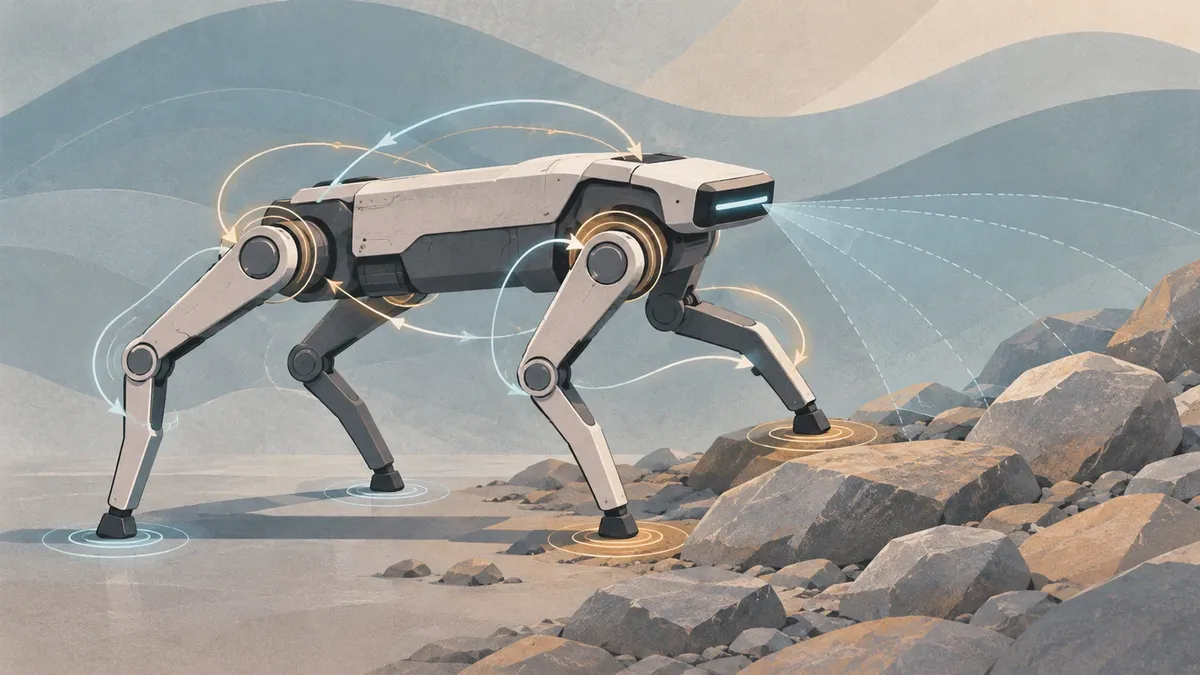
Added payload, weakened motors and pushes can all change how a quadruped moves. A new control framework called PACE estimates some of these effects in real time and uses the estimate both to adjust motor torques and to inform the robot’s learned policy. Its authors tested the approach in simulation and on one robot, including on terrain not used for training.
A quadruped’s movement depends on more than its commands. A payload can change its dynamics, a motor may weaken, and a foot’s contact with the ground can be hard to predict. One common strategy is to train a robot across a range of simulated conditions. But maintaining precise tracking across varied dynamics—and performing beyond the conditions sampled in training—remains a challenge.
In an arXiv preprint, Shixuan Han and colleagues propose estimating disturbances while a robot moves, then using the estimate to help control it. They call the framework PACE, short for Policy Augmentation and Compensation with Explicit Disturbance Estimation.
Estimating what the model misses
PACE represents effects such as payload changes, shifts in the robot’s center of mass, actuator degradation and external forces together as a joint-space disturbance. This is a term in the robot’s joint-level dynamics model: it collects effects the nominal model does not otherwise represent separately.
A nonlinear observer estimates the disturbance online without requiring joint-acceleration measurements. The estimate has two uses. It supplies a feedforward torque correction to the low-level controller, and it is added to the observations given to the learned policy. The policy can therefore take the estimate into account when choosing actions. The observer is part of the control loop during both training and deployment.
Foot contact presents a separate challenge because contact forces can change quickly. The researchers developed a way to estimate those forces from joint and inertial measurements, without dedicated foot-force sensors. In simulator tests, the pooled vertical-force root-mean-square error was 2.728 newtons. When estimated forces replaced simulator reference forces in the observer, the mean joint-wise error between disturbance estimates was 0.0542 newton-metres. These are results under the tested simulation conditions, not measurements of force-estimation accuracy across all hardware situations.
Tests in simulation and on a robot
The researchers trained controllers in simulation for a DeepRobotics Lite3 quadruped. All compared policies were trained on flat terrain, while the simulation randomized physical properties such as added mass, motor strength and friction. The team compared PACE with two learning-based approaches and with a PACE version that applied torque compensation but did not provide the disturbance estimate to the policy.
Across 11 simulated dynamics conditions, full PACE had the lowest reported velocity-tracking error among the four methods. Averaged across those conditions, the authors report reductions of 57.0% relative to BASELINE and 18.1% relative to HIMLOCO. Torque compensation alone also improved on BASELINE; adding the estimate to the policy brought further gains in these tests. In a simulated test with an 80-newton sideways push, PACE reached the study’s defined tracking range 72 milliseconds after the push was removed. The corresponding times were 144 milliseconds for compensation alone, 204 milliseconds for BASELINE and 300 milliseconds for HIMLOCO.
On the physical robot, the team tested selected situations beyond flat-ground training. The Lite3 carried an 11.5-kilogram payload, nearly its reported own mass. It completed all five trials at a 16-centimeter step-down; the paper says this was the maximum successful height observed, and that greater heights were unsuccessful for all methods. On five outdoor terrains—flagstone, lawn, sand, gravel road and large rocks—each method was tested in five traversal trials. PACE’s reported success rates were 100% on the first four terrains and 60% on large rocks. The compensation-only version reached 80% on large rocks. These small trial sets do not establish broad reliability.
What the results do—and don’t—show
The findings suggest that explicit disturbance estimates can complement a learned gait policy. They demonstrate improved tracking in the particular simulations reported and successful hardware trials on one Lite3 under selected conditions. They do not show that PACE will perform equally well on other robot designs or in untested situations.
The authors identify a specific limitation: the observer uses one fixed scalar gain across joints and operating conditions. They propose investigating adaptive or joint-dependent gains to balance response speed against sensitivity to estimation noise. The paper also uses an approximate nominal dynamics model and reconstructed contact forces; its reported results apply to the tested setup, rather than establishing accuracy in every setting.
This article is based on an arXiv preprint, which may not have undergone peer review. The comparisons and demonstrations are the authors’ reported experiments. Evaluation on additional robots and independent replication would help establish how widely the results apply.
- quadruped robots
- robot locomotion
- reinforcement learning
- disturbance estimation
- robot control
- simulation-to-real
Related reading
Automatically matched by shared topic keywords. These links do not imply that the sources agree or establish a consensus.
Traffic-VL learns to recommend traffic-light phases from camera views
Source published
Shared keywords: reinforcement learning
How LiDAR Range Images Help Legged Robots Transfer Skills
Source published
Shared keywords: robot locomotion
OmniPiano tests AI control with up to five virtual piano-playing hands
Source published
Shared keywords: reinforcement learning
Learning chemotherapy schedules from patient records: a small study with major limits
Source published
Shared keywords: reinforcement learning
A value gap may reveal when AI teammates are out of sync
Source published
Shared keywords: reinforcement learning