TRANSMISSION // 2611.27051v1
How Much Light Comes from Gas Around Active Black Holes?
Source published
Spectral models of 31 active galaxies estimate a substantial contribution from surrounding gas, while showing how templates and wavelength coverage shape the result.
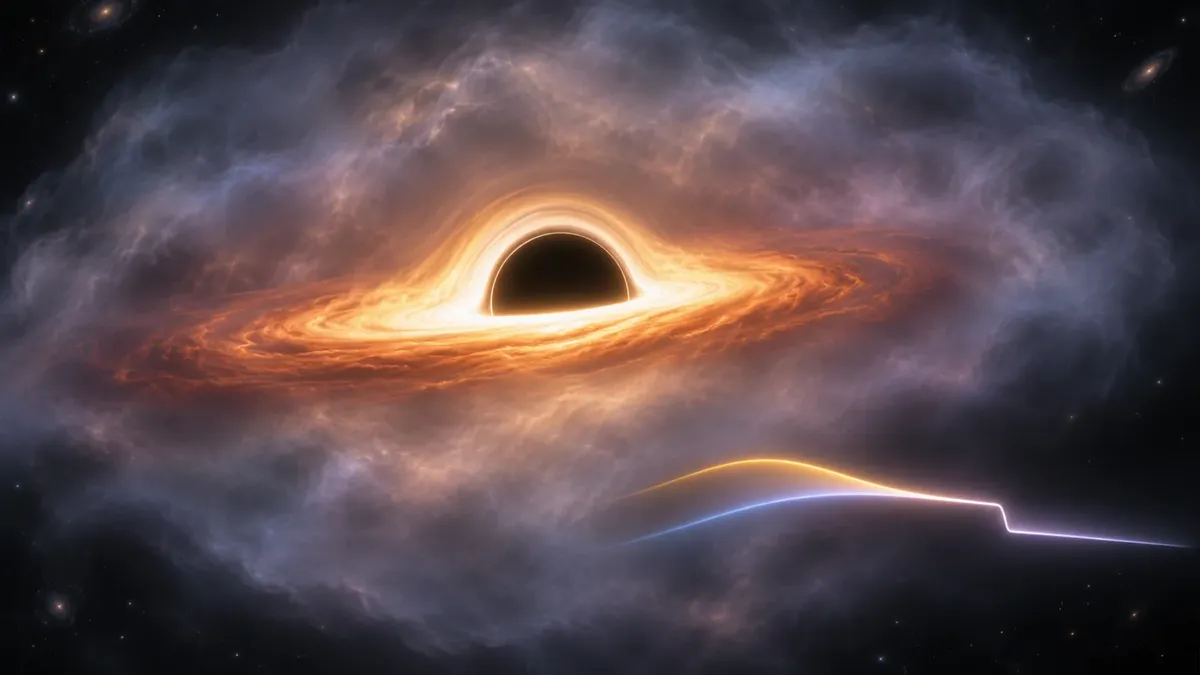
An active galaxy’s light can come both from its accretion disk and from gas around the black hole. A study of 31 galaxies estimates that this diffuse gas light averages about one-third of the combined disk and gas continuum near a distinctive spectral feature called the Balmer jump. The estimate depends on how the spectra are modeled.
An active galactic nucleus (AGN) is a bright central region powered by matter falling toward a supermassive black hole. Its accretion disk emits light, while gas in the surrounding broad-line region (BLR) also produces diffuse continuum radiation. Separating these sources matters because the gas light can affect estimates of the disk’s properties and interpretations of how the system changes over time.
The regions are too small to distinguish directly in most AGNs, so astronomers can use spectra to study their contributions. The BLR’s diffuse continuum has features around the Balmer and Paschen jumps—changes in the spectrum that can help identify it. These features are not a direct measurement of the gas contribution: estimating it requires fitting models to the observed light.
Building tailored spectral models
The researchers analyzed spectra from 31 type 1 AGNs, obtained with the Space Telescope Imaging Spectrograph on the Hubble Space Telescope and X-shooter on the Very Large Telescope. Each spectrum covered at least one of the two jumps; 23 covered both.
For each galaxy, the team used the Cloudy radiative-transfer code and a Locally Optimally-emitting Clouds model to calculate a source-specific BLR diffuse-continuum template. They constrained the templates using measured emission-line ratios, then fitted the spectra with multiple components. These included disk and diffuse-continuum light, iron emission, host-galaxy starlight, hot dust, and high-order Balmer and Paschen line series. The disk continuum was represented by a broken power law, which the authors describe as a simplified model.
This is a model-based separation, not a direct measurement of two spatially resolved sources. The inferred fractions depend on the templates and assumptions used to describe each spectrum.
The estimated contribution changes with wavelength
For the 31 galaxies, the mean diffuse-continuum fraction at 3625 angstroms—just shortward of the Balmer jump at 3646 angstroms—was 33%, with a standard deviation of 14 percentage points. The fraction is measured relative to the combined disk and diffuse continua. For the 30 sources with coverage at 5100 angstroms, the mean was 13%, with a standard deviation of 8 percentage points. Among the 23 spectra covering both jumps, the mean near 8100 angstroms, just shortward of the Paschen jump, was 18%, with a standard deviation of 9 percentage points.
The team tested what happens when only one jump is available by fitting portions of spectra that covered both. Using the Balmer jump alone gave estimates close to those from fitting both jumps. Fits using only the Paschen jump gave higher estimates on average, with substantial variation. The overestimate was especially pronounced when the underlying diffuse contribution was weak. The authors conclude that Balmer-jump coverage gives a more reliable constraint in this test; a Paschen-only fit may not constrain the component well.
The researchers also tested their method with simulated spectra. Using the template matched to the simulated source recovered its input diffuse component well. In a separate test, they fitted mock spectra for Mrk 509 using the NGC 5548 template instead. That mismatch overestimated the contribution at each of three tested wavelengths. This illustrates how a template that does not suit a source can bias an estimate; it does not show that every template mismatch will produce the same bias.
What the results do—and do not—show
The averages describe a selected sample, not all AGNs. The researchers initially identified 38 sources after selection cuts, then excluded seven because too few emission-line ratios were available to constrain their models. The final sample contained 31. The authors also report particularly low estimated contributions for two sources. The study does not establish that the diffuse component is equally strong, or present at the same level, in every active galaxy.
The team explored whether the Balmer-jump fraction might vary with luminosity, but the sample size and scatter were too large for a firm conclusion. Some modeling choices also affect the estimates. In three tested objects, filling a gap in the iron-emission template reduced the inferred diffuse contribution by about 5–15%. In a separate test of one galaxy, Mrk 1048, alternative disk prescriptions produced different fitted fractions. These checks show why the numerical results should be read in the context of the models used.
Overall, the analysis estimates a substantial contribution from diffuse BLR light in this sample, especially near the Balmer jump, and demonstrates that spectral coverage and template choice matter. The source is an arXiv draft dated November 2026. That identifies it as a preprint, but the available evidence does not establish its peer-review status. The authors say future time-resolved spectra could enable more detailed modeling and tighter constraints on the disk and BLR.
- active galactic nuclei
- broad-line region
- diffuse continuum
- spectroscopy
- Balmer jump
- accretion disk
Related reading
Automatically matched by shared topic keywords. These links do not imply that the sources agree or establish a consensus.
How a Black Hole’s Jets Could Disrupt Its Own Fuel Supply
Source published
Shared keywords: active galactic nuclei
What sets the edge of a black hole’s warm corona?
Source published
Shared keywords: active galactic nuclei
Infrared echoes trace dust around lower-mass black holes
Source published
Shared keywords: active galactic nuclei
Could displaced black holes give cosmic rays an extra boost?
Source published
Shared keywords: active galactic nuclei
Two black hole mergers hint at a shared history, but evidence falls short
Source published
Shared keywords: active galactic nuclei