TRANSMISSION // 2611.27046v1
How an AI agent’s browsing can reveal private context
Source published
An arXiv preprint reports that an agent’s web choices can reveal clues about its task when an attacker controls a site the agent visits. It tests an attack and a retrieval defense.
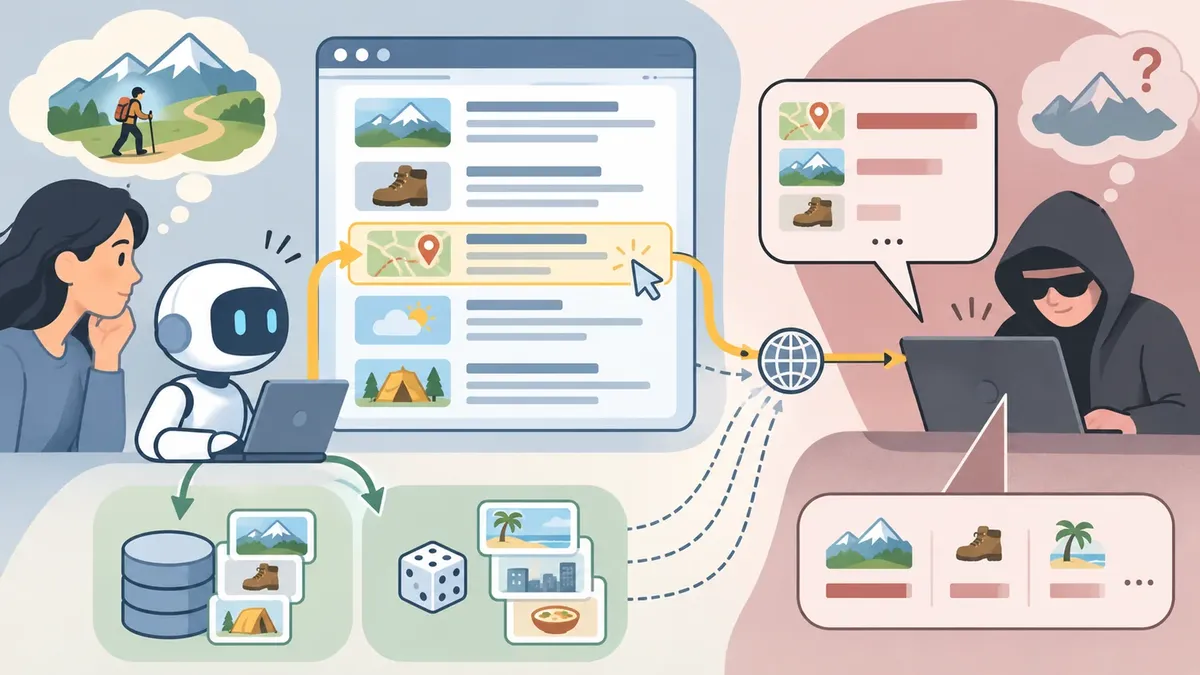
An AI agent might not send a user’s private words to a website, but its browsing decisions can still provide clues. A new arXiv preprint tests how an attacker could exploit those choices—and whether changing web retrieval can reduce the information revealed.
The privacy clues in a browsing path
When an AI agent uses the web, it searches, opens pages and chooses what to read next. Those decisions can depend on the current task and the agent’s other context. In the scenario tested here, an attacker who controls a website or endpoint may infer something from the agent’s choices—but only if the attacker can get a supplementary link onto a page the agent encounters and the agent follows it.
A preprint by Ruichao Liang and colleagues calls this a behavioral covert channel: information inferred from an agent’s observable actions rather than from private text in an outgoing message. The authors investigate whether such actions can reveal query concepts or profile details, and how well existing defenses address the risk. The work is posted on arXiv; the evidence provided here does not establish peer review or independent confirmation.
Turning choices into clues
The researchers tested four web-using agents paired with three language-model backbones. Their datasets comprised 500 StackExchange questions and 378 conversational turns from TREC iKAT, which includes user personas and reference information about their attributes, interests and preferences.
In the experimental setup, an agent following a supplementary link reached a researcher-controlled site. That site offered several apparently relevant resources, each connected to a distinct endpoint. The attacker could observe which endpoint the agent requested. A selected resource might, for example, indicate which aspect of a broader topic matched the agent’s current subtask. The researchers also tested other signals: whether a request occurred, how often requests occurred, their order and timing, and the amount of data transferred.
In a controlled test with four candidate resources, the choice-based channel identified the selected candidate correctly in 93.8% of trials that produced a usable signal. This is accuracy among triggered trials, not all attempts. Other channels were more vulnerable to differences in agent execution or network conditions.
One choice may be ambiguous, so the authors developed SNOOP, a system that records observations and refines a hierarchy of possible topics, from broad categories toward more specific concepts. It can preserve probing progress across intermittent visits. Its aim is to reconstruct query meaning and, across interactions, aspects of a profile—not to recover a prompt’s exact wording.
What the tests found
Across the evaluated settings, SNOOP’s average concept-level F1 was 0.89 for StackExchange queries and 0.79 for iKAT queries; average profile F1 on iKAT was 0.80. These are results under the paper’s evaluation procedures, not uniform rates at which complete queries or profiles were recovered. Concept scoring allows partial matches between related concepts, while profile facts are matched using an LLM judge with human review. Results varied across agents, topics and personas, and some trials produced no decodable path.
The authors evaluated four defenses: Spotlighting, Firewalls, Task Shield and Fides. Across the reported datasets and reconstruction measures, the largest F1 reduction from these defenses was 0.03. Induction rates—the share of trials producing a decodable path—also fell, by up to 0.07 on StackExchange and 0.06 on iKAT. The authors argue that these defenses may leave room for leakage because the observed choices can be legitimate, task-relevant browsing rather than explicit disclosure.
As a countermeasure, they propose Selection-Obfuscated Retrieval, or SOR. The retrieval layer first gathers linked resources without basing that initial acquisition on private context; the agent then selects among local copies. If it needs resources outside the cache, the system fetches task-required resources alongside independently sampled candidates in randomized batches. In the reported tests, SOR lowered StackExchange query-concept F1 from 0.89 to 0.39, iKAT query-concept F1 from 0.79 to 0.30, and iKAT profile F1 from 0.80 to 0.39. Page fetches increased 4.3 times on StackExchange and 4.5 times on iKAT. The authors report no additional LLM inference for the acquisition layer, though the overall method also has retrieval and other measured costs.
What remains uncertain
These experiments do not establish that every deployed agent or website is vulnerable to the same degree. The evaluation used selected agents, datasets and a shared web snapshot, with researcher-inserted links and controlled candidate choices. The attack depends on an attacker having a suitable link or endpoint the agent encounters and follows, and on the resulting requests carrying interpretable signals. The authors’ own results show that recovery varies and depends on observable interactions.
The paper identifies possible uncertainty in query annotation, concept matching and LLM-based profile scoring, and describes human checks intended to reduce these risks. Comparisons with earlier attacks also need care: those methods target different kinds of information and use different evaluation metrics, so their scores are not directly interchangeable.
Because this is an arXiv preprint, the findings should be treated as research claims awaiting scrutiny, not settled evidence about deployed products. The broader lesson is that privacy safeguards may need to consider not only what an agent sends, but also what an attacker can infer from its visible browsing choices.
- AI privacy
- LLM agents
- web browsing
- behavioral side channels
- privacy defense
- SOR
Reviewed cross-references
These connections were reviewed by a model, not independently fact-checked by a human. Similarity does not imply agreement; consult the original papers and the evidence below.
A browser agent’s actions may reveal which AI model is behind it
Supporting evidence: Both studies show that observable web-agent behavior can support inference: Liang et al. report active probing of browsing choices to reconstruct user queries and profiles, while Lugoloobi et al. classify model identity from passively recorded UI actions and timings. The findings support only the bounded point that behavior can reveal information; the targets, observation methods, and experimental settings differ, so the fingerprinting results do not validate SNOOP’s reconstruction scores.
Model review: · openai-codex/gpt-6-luna
Evidence and provenance
Selected excerpts, not complete papers. PDF extraction can omit figures or damage equations, tables and reading order; sources may be preprints.
2611.27046v1 — Original paper
Excerpt reference:
static/papers/2611.27046v1.md:123-177
Basis: Paper text
Source SHA-256:afec9136783854a8ae9165b1f2d6ffa376c922f8b6363eadc08042dfefe239ca2605.14786v2 — Original paper
Excerpt reference:
static/papers/2605.14786v2.md:13-71
Basis: Paper text
Source SHA-256:8577e8c959fd6ee4a10ab6b3decf1574fed093bc8dbd8cea591fd104a4160629
Related reading
Automatically matched by shared topic keywords. These links do not imply that the sources agree or establish a consensus.
When an AI agent forgets, what must be erased?
Source published
Shared keywords: ai privacy
Teaching a visual AI to forget a connection, not a fact
Source published
Shared keywords: ai privacy
A proposal to audit what language models unlearn
Source published
Shared keywords: ai privacy
IDSISA proposes a more selective approach to AI forgetting
Source published
Shared keywords: ai privacy
Why AI Agents Can Agree With Themselves—and Still Fail Each Other
Source published
Shared keywords: llm agents