TRANSMISSION // 2611.27043v1
HypSEE Uses Hypergraphs to Capture Graph Hierarchies
Source published
A new semi-supervised model combines two kinds of hypergraphs and entropy-guided pooling. Its benchmark results are promising, but remain early evidence.
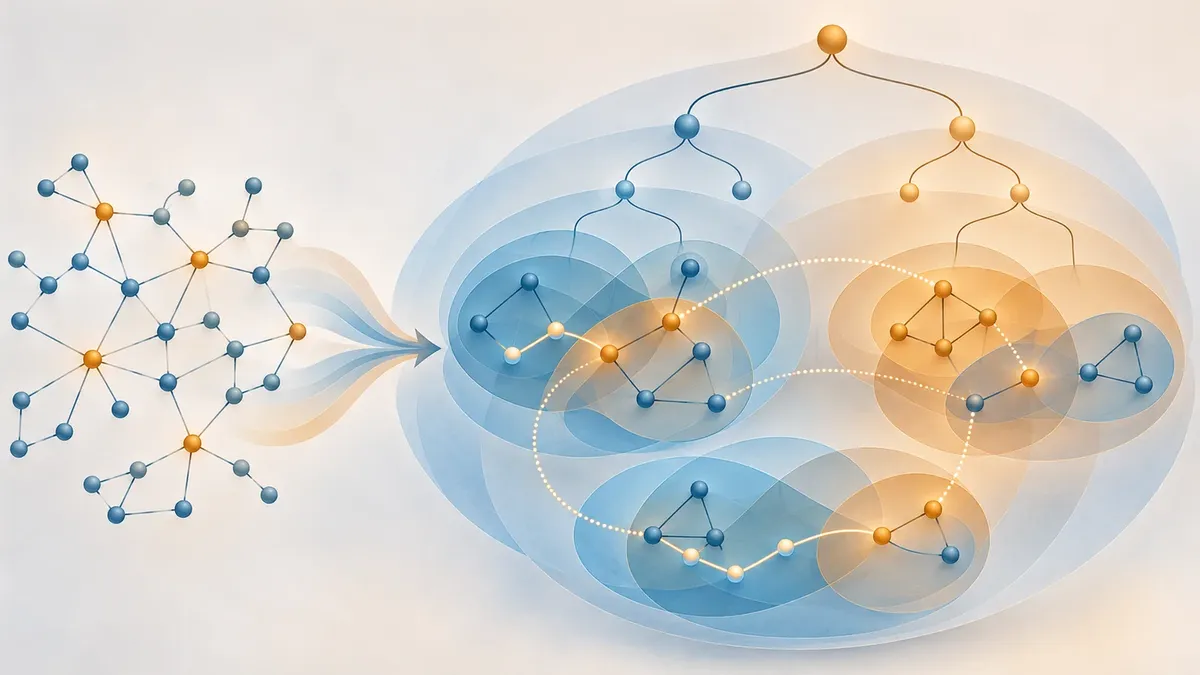
Graphs are often described through pairwise links, even when meaningful patterns involve groups of nodes nested within larger structures. HypSEE, a proposed machine-learning framework, is designed to capture those patterns while learning from many unlabeled graphs and relatively few labeled examples.
The question: how can a model learn from fewer labels?
A graph is a set of points, or nodes, connected by links. Graph classification asks a model to assign a label to an entire graph—for example, to classify a molecular structure or a social network. In semi-supervised learning, only some training graphs have known labels; the rest are unlabeled and must still help the model learn.
Many graph-learning methods build on pairwise links. But important patterns may involve several nodes together, or a hierarchy of groups within groups. In a molecule, for instance, a group of atoms can form a functional structure whose role differs from that of any single atom. The authors argue that overlooking these relationships can limit graph-level predictions.
Their proposed system, called HypSEE, aims to represent both multi-node relationships and hierarchy, then use unlabeled examples to improve learning. The paper reports tests on benchmark datasets, but the evidence should be read as a study of model performance on those tasks—not as proof that the method will work equally well in other settings.
Two views of each graph
HypSEE turns each input graph into two hypergraphs. Unlike an ordinary link, a hyperedge can connect more than two nodes, making it possible to represent a group relationship directly.
The first view is built from random walks through a graph. Walks of different lengths provide a way to represent local patterns at different scales. The second view is derived from node embeddings: a graph neural network creates representations of nodes, which are then used to form trainable hyperedges intended to capture longer-range relationships. The two views are meant to complement one another, rather than encode exactly the same structure.
The model then repeatedly groups nodes into smaller, coarser representations. This is called pooling. HypSEE guides the grouping with hypergraph structural entropy (HSE), an information-based measure the authors formulate for hypergraphs. In accessible terms, the model uses this measure to help organize the graph into levels, rather than treating all nodes as a single flat collection. The authors also provide a theoretical connection between their HSE definition and classic structural entropy for ordinary graphs, and relate normalized HSE to hypergraph conductance, a measure associated with graph partitioning.
Finally, HypSEE uses a consistency strategy to make the two views agree in how they represent unlabeled graphs. It compares each unlabeled graph’s representations with a memory bank of labeled examples, called anchors, and aligns the resulting similarity distributions across the two views. A classifier is trained using the known labels, alongside losses for consistency and entropy-guided pooling.
What the experiments report
The authors evaluate the method on eight established graph-classification benchmarks covering bioinformatics, social networks and computer vision. Their training setup uses only 10% of each dataset’s graphs as labeled training examples; the remaining data are divided into unlabeled training, validation and test sets. The main accuracy table reports averages and standard deviations across five runs.
On those eight benchmarks, the paper reports that HypSEE had the highest accuracy on seven datasets and the second-highest on the remaining one, IMDB-BINARY. The table’s results also show variation across runs, so a leading average does not mean the outcome is identical every time. In an additional experiment on two larger molecular datasets, the authors report that HypSEE had the highest test ROC-AUC in three of four dataset-and-label-rate settings. The reported result on MUV with 1% labeled data was close to the comparison method’s result, rather than a clear lead.
A component-removal study tests versions without one hypergraph view, hierarchical pooling, the HSE loss or the cross-view consistency loss. On the four datasets included in that study, the full model generally performs better than those variants, though differences vary by dataset. This supports the authors’ view that the components can contribute to the combined system; it does not establish that each part is necessary in every application.
What remains uncertain
These findings are benchmark results, not evidence of real-world deployment or improved outcomes in a specific scientific or social application. The experiments cover a limited set of datasets, and the supplied paper text does not establish how the method would perform across other data sources, label distributions or graph types. Accuracy and ROC-AUC also measure different aspects of classification and should not be treated as interchangeable.
The source is an arXiv preprint. Its text refers to KDD ’27 and contains publication details that appear unfinished, including placeholder DOI and ISBN information. A preprint can be useful early evidence, but it should not be presented as independently peer-reviewed based on this record. The paper reports that source code is available, but this article does not independently verify the code or reproduce the experiments. The appropriate takeaway is that HypSEE offers a structured approach to combining higher-order graph relationships, hierarchy and unlabeled data—and that its reported benchmark performance merits further scrutiny and testing.
- graph classification
- hypergraphs
- semi-supervised learning
- structural entropy
- machine learning
Reviewed cross-references
These connections were reviewed by a model, not independently fact-checked by a human. Similarity does not imply agreement; consult the original papers and the evidence below.
MMGraph-Agent: helping AI search documents and the web without overflowing its working context
Shared method: Both papers use hypergraphs to represent higher-order relationships: HypSEE builds walk-induced and embedding-derived hypergraphs for graph classification, while MMGraph-Agent organizes multimodal knowledge in hypergraphs for retrieval. Their tasks and hypergraph mechanisms differ, so this is a connection in representation choice, not evidence that one method improves the other.
Model review: · openai-codex/gpt-6-luna
Evidence and provenance
Selected excerpts, not complete papers. PDF extraction can omit figures or damage equations, tables and reading order; sources may be preprints.
2611.27043v1 — Original paper
Excerpt reference:
static/papers/2611.27043v1.md:214-264
Basis: Paper text
Source SHA-256:b998bb2ca5579d5e814146fa2c4577e369e1050f4d7b0e0468399d86c372187e2611.10657v1 — Original paper
Excerpt reference:
static/papers/2611.10657v1.md:215-287
Basis: Paper text
Source SHA-256:060d7b8ef9f04f7df9b9acfac77e567aeb61e1ca1a60c05d85480fb54a811fdd
Related reading
Automatically matched by shared topic keywords. These links do not imply that the sources agree or establish a consensus.
When does quantum-informed graph learning help?
Source published
Shared keywords: semi supervised learning
A graph-learning method updates its view as connections appear
Source published
Shared keywords: graph classification
LandslideFM pairs landslide mapping with image-based descriptions
Source published
Shared keywords: semi supervised learning
Two AI Teachers Take on the Problem of Learning from Mistakes
Source published
Shared keywords: semi supervised learning
One Energy Lens for Many Kinds of Machine Learning
Source published
Shared keywords: machine learning