TRANSMISSION // 2611.27031v1
Four stars put stellar models to the test
Source published
Interferometric measurements of four stars in two wide binaries broadly support several stellar-evolution models, while a selected eclipsing-binary comparison shows a tendency toward larger stars.
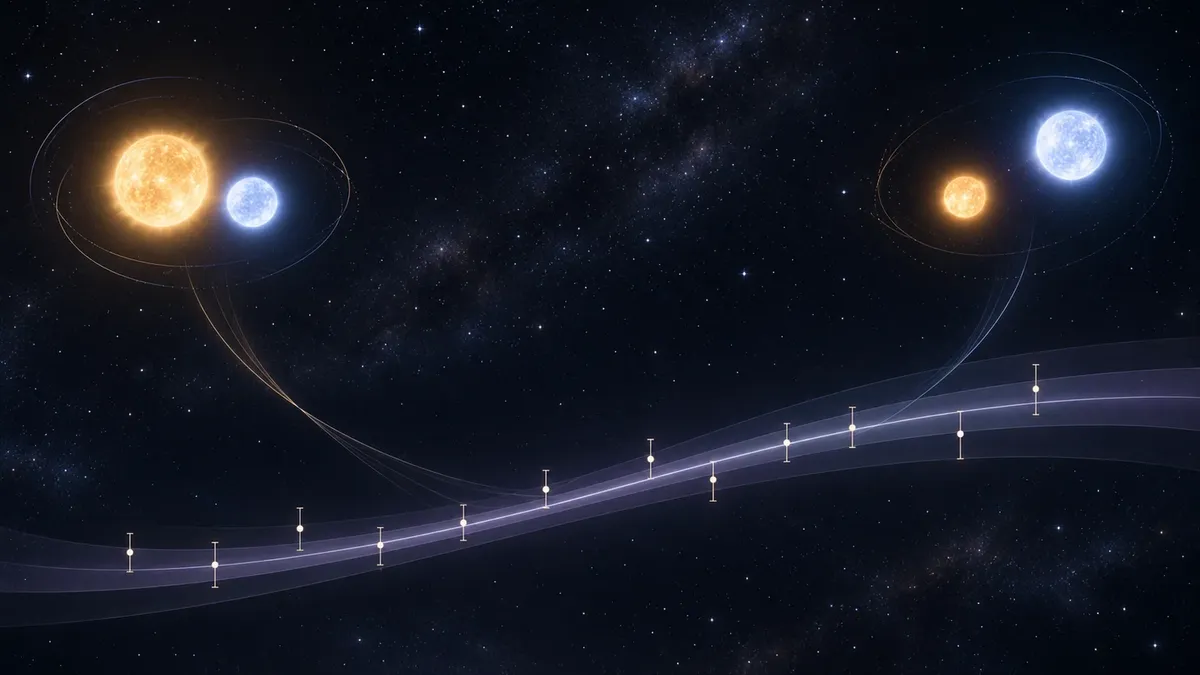
Some stars in eclipsing binaries have been reported to be larger and cooler than models predict. To test stellar models with a different kind of system, researchers measured four stars in two wide visual binaries and compared model-inferred masses with masses derived from their orbits.
A different kind of stellar benchmark
Astronomers test models of stellar evolution by comparing predictions with measured properties of real stars. Earlier studies have reported that some stars in close eclipsing binaries—pairs whose orbits carry them across each other in our view—are larger and sometimes cooler than models predict. The size of this mismatch can vary, and factors such as metallicity and orbital period may complicate comparisons. One proposed explanation involves rapid rotation and magnetic activity, but the cause is not settled.
A team led by Becky E. Flores examined four stars in two nearby visual binaries: ξ Bootis (GJ 566 AB) and 70 Ophiuchi (GJ 702 AB). Their components are generally far enough apart in the sky to study separately, although the paper notes that the fainter companions could be challenging to observe. The researchers asked how the stars’ measured sizes and temperatures compare with predictions from stellar-evolution models, using precise dynamical masses as an independent check.
Measuring the stars
The team used the CHARA Array, which combines light from six separated telescopes. This interferometry technique lets astronomers estimate a star’s apparent diameter even when the star cannot be resolved as a disk in an ordinary telescope image. MIRC-X and MYSTIC observations of each component spanned three observing nights between 2022 and 2025. The researchers fitted models to the interferometric measurements to derive angular diameters.
They combined those diameters with Gaia distance measurements to calculate physical radii. Bolometric flux—the total energy received across the star’s output—was used with the diameters to estimate effective temperatures. The dynamical masses came from orbital solutions using astrometric measurements and radial-velocity data: the study presents a new solution for ξ Bootis and uses a recently revised one for 70 Ophiuchi. The reported mass precision is about 0.4%.
The radii are measured to a precision of at most 2.4%, and the effective temperatures to at most 1.7%. The authors compared the stars with four model families: Lyon (BHAC15), Dartmouth, PARSEC and MIST, using solar-metallicity models consistent with available metallicity measurements.
Rather than treating the exercise as a simple direct fit of every observed property, the researchers used each star’s measured radius and temperature to infer the mass and age that best match its position along a model’s evolutionary track. They then compared the model-inferred masses with the independently determined dynamical masses.
What the study found
For these stars, whose masses range from about 0.67 to 0.91 times the Sun’s, the model-inferred masses are within 3.1 standard deviations of the dynamical values. The authors find no overall systematic offset across the four stars and do not identify one model family as consistently superior. This supports the models for this small sample; it does not establish that every model accurately describes all stars in this mass range.
The models also give ages broadly consistent with earlier estimates and suggest that each pair is coeval—that its two stars formed at roughly the same time. These are model-based inferences, not precise age measurements. In particular, age uncertainties are substantial for ξ Bootis, whose inferred youth is compatible with its proposed association with the Ursa Major Moving Group.
None of the four stars shows evidence of being larger than predicted, despite reported chromospheric emission or activity. That is relevant to ideas linking magnetic activity with radius inflation, but it does not show that activity has no effect on stellar size: four stars cannot settle that question.
The authors also compared their stars with a selected set of eclipsing-binary stars chosen to have masses within 3% of the visual-binary components. The paper’s detailed analysis describes 20 unique comparison stars, while its abstract and summary refer to 21; the exact count therefore depends on the sample description, and is best treated cautiously. Most comparison stars are larger, and often cooler, than model predictions. Some lack measured metallicities, for which the researchers assumed solar values, and the comparison measurements come from different studies. Even among the 12 stars with near-solar metallicities, the discrepancy remains, according to the paper.
This contrast suggests that binary context may matter, but it does not establish that short orbital periods cause radius inflation. The detailed analysis reports no clear relationship between orbital period and the degree of inflation within its relatively small comparison sample. The authors caution that the selected eclipsing-binary stars are not uniform in their measured properties, limiting how firmly the samples can be compared.
Limits and context
The visual-binary result rests on four stars. The paper describes observational challenges for some faint companions and accounts for instrument and night-to-night variation in its diameter uncertainties. The inferred ages are less precise than the radii and temperatures, and model comparisons depend on assumptions including metallicity and the adopted evolutionary tracks.
This is an arXiv preprint, not a final verdict on the question. The authors’ ξ Bootis orbital solution also draws on work they describe as in preparation. For now, their analysis finds that four stars in wide visual binaries broadly match several stellar models, while most stars in a selected eclipsing-binary comparison appear larger than predicted. Larger, consistently characterized samples will be needed to clarify how age, composition and binary properties relate to these differences.
- stellar evolution
- visual binary stars
- stellar radii
- interferometry
- CHARA Array
- eclipsing binaries
- radius inflation
Reviewed cross-references
These connections were reviewed by a model, not independently fact-checked by a human. Similarity does not imply agreement; consult the original papers and the evidence below.
Measuring stars more directly sharpens the sizes of their planets
Shared method: Both studies use CHARA long-baseline interferometry to measure stellar angular diameters and combine them with Gaia parallaxes to derive radii. Flores et al. apply MIRC-X and MYSTIC to four components of two visual binaries with dynamical masses; Nowacki et al. use multi-band CHARA observations of exoplanet hosts and report a 5.9% median radius precision, so their samples and reported precision are not directly equivalent.
Model review: · openai-codex/gpt-6-luna
Evidence and provenance
Selected excerpts, not complete papers. PDF extraction can omit figures or damage equations, tables and reading order; sources may be preprints.
2611.27031v1 — Original paper
Excerpt reference:
static/papers/2611.27031v1.md:45-100
Basis: Paper text
Source SHA-256:53a835254a679c72df5644950fc80e48082010df7e7c14eaab73c5f0131fb82c2611.08824v1 — Original paper
Excerpt reference:
static/papers/2611.08824v1.md:18-60
Basis: Paper text
Source SHA-256:53f68d3cc9edcd371a9fc0f404b829a916a508f4d84df43eb07bde3ef47ba246
Related reading
Automatically matched by shared topic keywords. These links do not imply that the sources agree or establish a consensus.
Measuring stars more directly sharpens the sizes of their planets
Source published
Shared keywords: chara array, stellar radii
A binary star in Sagittarius’s Teapot reveals its orbit—and a distance problem
Source published
Shared keywords: stellar evolution
Three kinds of observations refine the orbit and masses of V819 Herculis
Source published
Shared keywords: eclipsing binaries
How a star feeds a black-hole binary
Source published
Shared keywords: stellar evolution
What dead stars reveal about matter, gravity and the early Universe
Source published
Shared keywords: stellar evolution