TRANSMISSION // 2611.27026v1
A shared software toolkit for gravitational-wave analysis
Source published
RIOPlus brings modular data, signal-processing and machine-learning tools into ROOT for gravitational-wave workflows; glitch classification is an intended application, not a reported result.
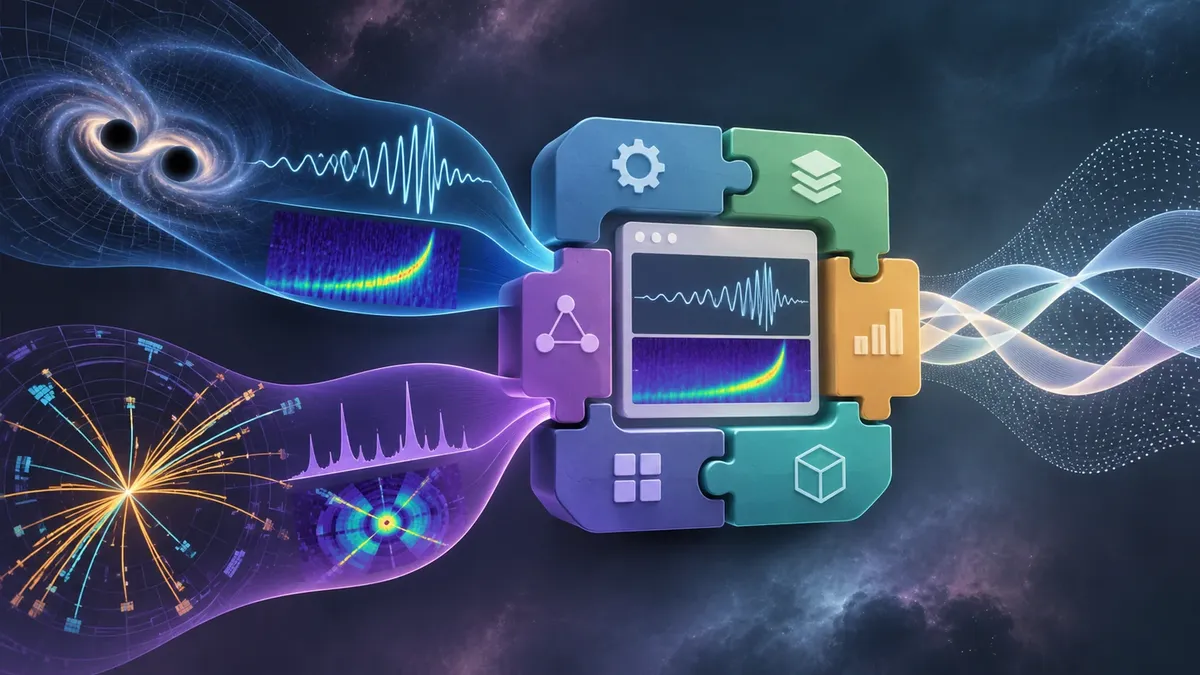
Gravitational-wave observatories must analyse data quickly, while high-energy physics experiments face many of the same software challenges, including distributed data and complex analysis pipelines. A new modular extension to CERN’s ROOT framework aims to connect tools from these fields. Its proposed use for glitch classification remains an application outlined by the authors, not a demonstrated scientific finding.
Why connect two fields through software?
Gravitational-wave (GW) astronomy and high-energy physics (HEP) investigate different questions, but researchers in both fields face overlapping computing challenges: data can be distributed across sites, analysis pipelines combine different tools, and machine-learning models need to fit into existing workflows.
The emphasis differs. The paper describes HEP as needing to process very large data volumes, while GW analysis is especially sensitive to latency: relatively small streams of calibrated detector data must be analysed promptly to support rapid alerts and follow-up. The authors ask whether software built around CERN’s ROOT data-analysis framework can help with GW analysis without requiring researchers to replace their existing tools. They cite examples of ROOT already being used alongside other software in GW research.
Their answer is RIOPlus, a freely distributed, modular extension to ROOT. Building on a prototype presented at ACAT 2024, the paper describes the work’s consolidation into a package of optional extensions. Its focus is software infrastructure and design, not a new discovery about gravitational waves.
What does the toolkit include?
RIOPlus has a core library and optional extensions that users load when needed. The design is intended to avoid requiring features—and their additional dependencies—when they are not in use. The extensions cover configuration and file formats, remote data access, display tools, signal processing, and tensors for computation and machine-learning inference.
For data, the package supports formats including Gravitational Wave Frame (GWF) and HDF5, and connections to services such as OSDF/Pelican and S3-compatible storage. It also includes Kafka streaming tools and token-based credentials for accessing distributed resources. These components are designed to bring different kinds of data access into ROOT-like interfaces.
The signal-processing extension wraps the KFR C++ library and provides tools including Fourier transforms, filtering and spectral analysis. The paper reports a benchmark comparing KFR with FFTW for an in-place complex forward transform. This is a comparison under the benchmark described in the paper, not evidence that either library will be faster in every use case.
A separate tensor extension is backed by LibTorch, the C++ API for PyTorch. It includes support for complex-valued tensors, but that does not mean every model or workflow described supports complex inputs. The extension is aimed at applying trained models rather than training them: a model developed in Python can be exported in ONNX format and used in a ROOT-based C++ workflow. The authors also describe GPU acceleration through LibTorch.
Glitches are an intended application, not a result
The motivation includes studying glitches: short instrumental or environmental disturbances that can resemble or obscure astrophysical signals. The paper outlines a possible workflow using several extensions, with an unsupervised method to find clusters among glitch spectrograms, followed by a neural network for classification. In the broader conceptual workflow, incoming data could be processed and passed to machine-learning inference.
These descriptions do not show that RIOPlus has already improved glitch detection or identified detector problems. The authors say scientific results obtained with the software are left to separate publications. They also state that reproducing the existing Omicron transient-search tool is not the purpose of this work and present no comparison with it. Kafka transport for chunked low-latency GWF messages is discussed as a possible use, but is not exercised in the paper. The text does not demonstrate a RIOPlus candidate-detection stage.
What is ready, and what remains uncertain?
The paper reports that the core, configuration, archive and remote-data components have been completed, while the KFR-based signal-processing layer is being finalised. Documentation and tutorials are in preparation for a first tagged release. The authors also point toward column-wise RNTuple storage as a future direction, rather than presenting it as part of the demonstrated workflow.
The paper describes how the extensions could form an end-to-end ROOT-centred workflow, from data ingestion to machine-learning inference, but it does not report a full scientific evaluation of glitch classification using that workflow. As an editorial assessment, the evidence presented here is therefore not enough to establish the performance of a complete scientific pipeline in observatory operations. The paper’s software descriptions and FFT benchmark should not be confused with evidence of improved scientific outcomes.
The source is a contribution to the 23rd International Workshop on Advanced Computing and Analysis Techniques in Physics Research (ACAT2025), described in the paper as “to appear in Proceedings of Science,” and is available as an arXiv preprint. The supplied information does not establish its peer-review status. Nor does the paper establish how widely RIOPlus will be adopted or how it will perform across deployments. Its contribution is a practical effort to bring data access, signal processing and model inference into a set of optional ROOT extensions, with the implementation still developing.
- gravitational waves
- CERN ROOT
- RIOPlus
- scientific computing
- glitch classification
- signal processing
Related reading
Automatically matched by shared topic keywords. These links do not imply that the sources agree or establish a consensus.
QuASAR tests whether AI agents can turn scientific ideas into quantum prototypes
Source published
Shared keywords: scientific computing
Teaching Monte Carlo estimates to correct themselves
Source published
Shared keywords: scientific computing
Targeted AI repairs improve scientific code translation—but simple tests miss errors
Source published
Shared keywords: scientific computing
A Julia toolkit for exploring quantum billiards
Source published
Shared keywords: scientific computing
Can a language model build a neural network from physical laws?
Source published
Shared keywords: scientific computing