TRANSMISSION // 2611.27019v1
A lean new layer could help quantum neural networks learn more
Source published
A proposed all-to-all quantum-circuit layer adds just one trainable parameter per layer. In classical simulations, it improved learning efficiency on two tasks, though hardware performance remains untested.
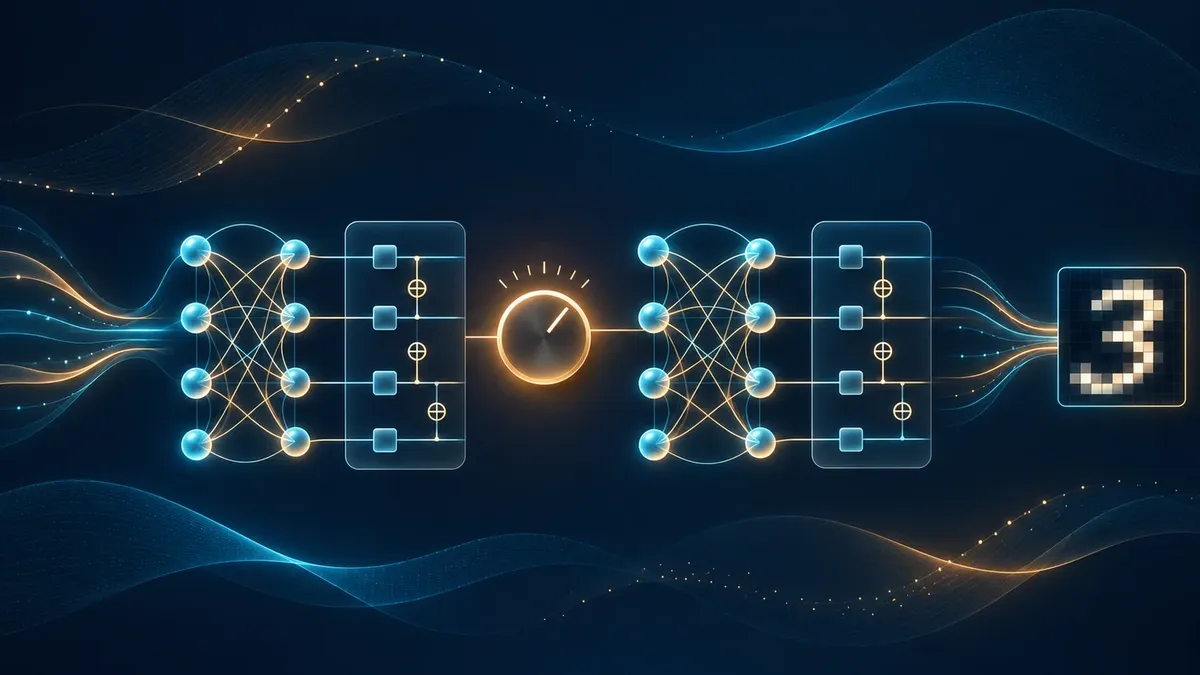
Quantum neural networks are built from adjustable quantum circuits, but making them more expressive often means adding circuit depth and many trainable parameters. Bolin Huang and Pengfei Zhang propose a different building block: a contractive layer that couples all qubits and is controlled by a single adjustable angle. Their simulations suggest it can help a circuit explore useful functions with fewer added parameters.
A quantum neural network can be thought of as a sequence of operations on quantum data, followed by measurements that produce a prediction. The choice of operations shapes what the model can learn. But increasing a circuit’s depth can also increase its training burden, while near-term quantum devices have practical limits on circuit resources. The question Huang and Zhang investigate is whether a new kind of layer can expand a model’s expressive range without requiring many extra adjustable parameters.
Their proposed contractive layer uses an all-to-all coupling: rather than linking only neighboring qubits, it applies a joint operation across the full system. One trainable rotation angle controls the layer. The authors combine it with the more conventional “brick-wall” circuit pattern, in which adjustable two-qubit gates act on neighboring qubits in alternating arrangements. They also use multiple circuit instances operating on copies of the input, with a classical function combining their measurement results.
Testing what the circuits can learn
The study evaluates the design in two computer-simulated tasks. First, in observable learning, a model is trained to predict the expected value of a chosen quantum measurement for a given input state. The authors compare circuits with contractive layers against circuits made only of brick-wall layers, varying circuit depth and the number of parallel instances. They also examine how many independent directions in the space of possible measurement operators can be reached by small changes to the circuit’s parameters. This local dimension serves as a mathematical indicator of the circuit’s local expressivity.
The second test is digit recognition using the Street View House Numbers (SVHN) dataset. The researchers convert images to grayscale, reduce them to 8-by-8 pixels, encode the pixel values into five-qubit states, and train a classical readout to assign each image to one of ten digit classes.
In the observable-learning simulations, adding contractive layers generally produced lower test losses than using brick-wall circuits alone. For depths of two or more, a circuit with contractive layers achieved test losses comparable to a brick-wall-only circuit one layer deeper, according to the paper. The authors note that a brick-wall layer has 60 trainable parameters in their setup, while a contractive layer adds one. Their local-dimension analysis also found that contractive layers increased the number of accessible operator directions more efficiently per parameter in the tested configurations.
The image-recognition simulations showed a similar pattern: circuits with contractive layers generally had lower test losses at comparable parameter counts. The advantage was less consistent in its scaling than in observable learning, and the results concern the particular model and data preparation used here—not image recognition in general.
What the results do—and don’t—show
The proposed layer is motivated in part by possible relevance to reconfigurable Rydberg atom arrays, where flexible atom arrangements may support the required coupling. That is a design rationale, not a demonstration that the layer has been run successfully on such hardware. The paper’s supplementary material states that the experiments were carried out on classical computers, using simulated quantum circuits and directly supplied input states. They did not include physical state preparation, finite-shot measurement, or added label noise in the observable-learning task.
That distinction matters. Simulation can compare circuit designs under controlled conditions, but it does not establish how well the approach will work when hardware imperfections and state-preparation costs are included. The authors identify robustness to gate errors and input noise as open questions. The reported comparisons also cover specific circuit depths, tasks, encodings, and training setups; they do not establish that contractive layers will outperform other designs across quantum machine learning.
The study is a 2026 arXiv preprint by Huang and Zhang. A preprint is a publicly shared research manuscript and should not be treated as proof of peer review. The available source supports a promising simulation result: an all-to-all layer with one adjustable parameter can improve parameter efficiency in the tested quantum neural networks. Whether that advantage survives on real devices remains to be established.
- quantum neural networks
- quantum machine learning
- contractive layers
- quantum circuits
- Rydberg atom arrays
- machine learning
Related reading
Automatically matched by shared topic keywords. These links do not imply that the sources agree or establish a consensus.
Why telling a quantum image model to ignore rotation can help
Source published
Shared keywords: quantum machine learning, quantum neural networks
Does a quantum layer improve stock rankings—or just sit in the model?
Source published
Shared keywords: quantum machine learning, quantum neural networks
Selecting training examples for quantum machine learning
Source published
Shared keywords: quantum circuits, quantum machine learning
Why quantum machine-learning models can lose sensitivity
Source published
Shared keywords: quantum circuits, quantum machine learning
A feature-aware search for quantum data encodings
Source published
Shared keywords: quantum circuits, quantum machine learning