TRANSMISSION // 2611.27015v1
Ruby uses structural AI to predict drug potency
Source published
Ruby combines learned structural representations with potency data to rank compounds across drug-discovery settings. Its abstract reports strong benchmark results, but does not provide enough detail to assess the methods fully.
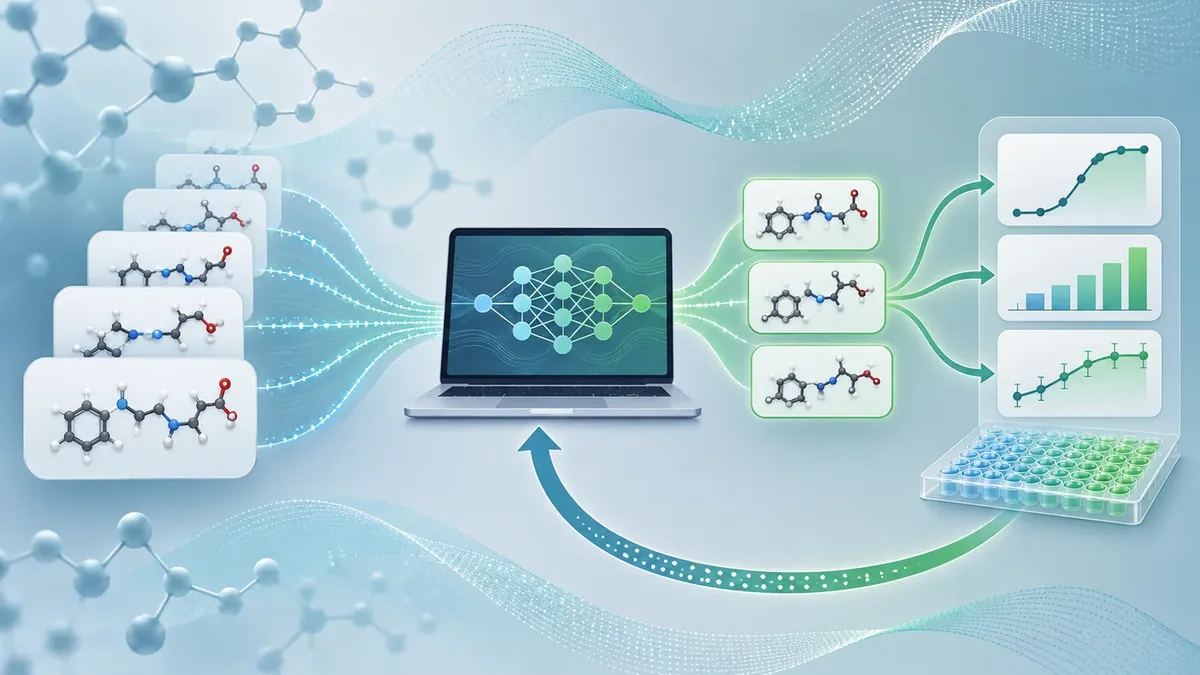
Predicting how strongly a small molecule affects a drug target could help researchers prioritize compounds for testing. A new preprint introduces Ruby, a model intended to predict potency across different stages of drug discovery without requiring an explicit binding pose for every compound.
A prediction problem that changes over time
Drug discovery involves repeated cycles of designing, making and testing compounds. Researchers often seek molecules with strong potency while keeping other properties within ranges needed for a viable candidate. As discovery progresses, computational budgets and the amount of on-target experimental data available can change. That means prediction methods face different demands at different stages.
The authors present Ruby—short for “Robust Universal Binding affinitY”—as a model for predicting small-molecule potency across these settings. Ruby uses intermediate representations from Pearl, a structural foundation model. The abstract says it does not require an explicit binding pose for every compound, but does not explain the model’s mechanics in detail.
Data and evaluation
According to the abstract, Ruby was trained on proprietary data alongside GenesisPotency-2026, a public-source potency training dataset. The authors describe that dataset as audited, with row-level provenance and audit annotations, and say it is released under a CC BY-SA 4.0 license for academic and commercial use.
The authors report testing Ruby in several settings: early enrichment across seven public hit-identification targets; correlations on four public benchmarks—OpenFE, CASP16, FEP+ 4 and OpenBind; and zero-shot prediction across eight biochemical and cellular assays from five ongoing Genesis-Incyte programs. They also compared methods after giving them the opportunity to recalibrate using earlier assay measurements. The abstract does not define “zero-shot” or describe the recalibration procedure, so those details require the full paper.
These evaluation labels indicate distinct kinds of tests, but the abstract does not explain their calculations or protocols. It reports rankings and averages rather than the underlying results in enough detail to assess how large or consistent the differences were.
What the authors report
The authors say Ruby achieved the highest aggregate early enrichment among evaluated methods across the seven public targets. They also report that inference effort can be adjusted, trading enrichment against computational cost over a range of more than two orders of magnitude. On the four public benchmarks, Ruby had the highest average correlations, according to the abstract.
For the eight assays from the ongoing programs, the authors report that Ruby significantly outperformed other methods in zero-shot prediction, with a wider performance advantage than on the public benchmarks. They also say Ruby improved more than the other methods when all were given the opportunity to recalibrate with earlier assay measurements.
The supplied abstract does not include scores, uncertainty intervals, statistical-test details or the full comparison methods. These are matters to check in the complete paper; their absence from the abstract alone does not establish that they are absent from the paper.
What remains uncertain
The reported results concern prediction benchmarks. They do not show that using Ruby improves drug development or produces clinically effective treatments. Potency is one consideration in compound prioritization, and the abstract does not establish how well performance transfers beyond the targets and assays evaluated.
A fuller assessment would require the paper’s detailed methods and results: how the data were assembled, how training and evaluation sets were defined, what comparison methods were used, and how uncertainty and statistical significance were assessed. The abstract does not provide those details, so this account cannot independently evaluate the reported rankings or their practical importance.
This article is based on the paper’s abstract, not a full examination of its methods, figures or supplementary materials. The work is an arXiv preprint and may not have undergone peer review. The authors introduce GenesisPotency-2026 as a training resource, but its quality and suitability cannot be independently assessed from the abstract alone. The findings should therefore be read as the authors’ reported results, pending review of the complete paper and further evaluation.
- drug discovery
- potency prediction
- machine learning
- molecular structure
- Pearl
- drug screening
- preprint
Related reading
Automatically matched by shared topic keywords. These links do not imply that the sources agree or establish a consensus.
Quantum-derived molecule scores change a drug-screening shortlist—not prove an advantage
Source published
Shared keywords: drug discovery, machine learning
Can AI redesign toxic molecules? A benchmark finds uneven results
Source published
Shared keywords: drug discovery
Teaching molecular AI chemistry rules in stages improves 3D generation
Source published
Shared keywords: drug discovery
DrugCoding tests whether AI can keep complex drug-discovery workflows on track
Source published
Shared keywords: drug discovery
Can NMR Track Quantum Information Spreading Through Proteins?
Source published
Shared keywords: molecular structure