TRANSMISSION // 2611.27012v1
Testing a planner for many robot routes in simulation
Source published
MPAO searches for distinct, low-cost trajectories in modeled planning tasks. Simulations show strong results in manipulation, but the study does not test physical robots.
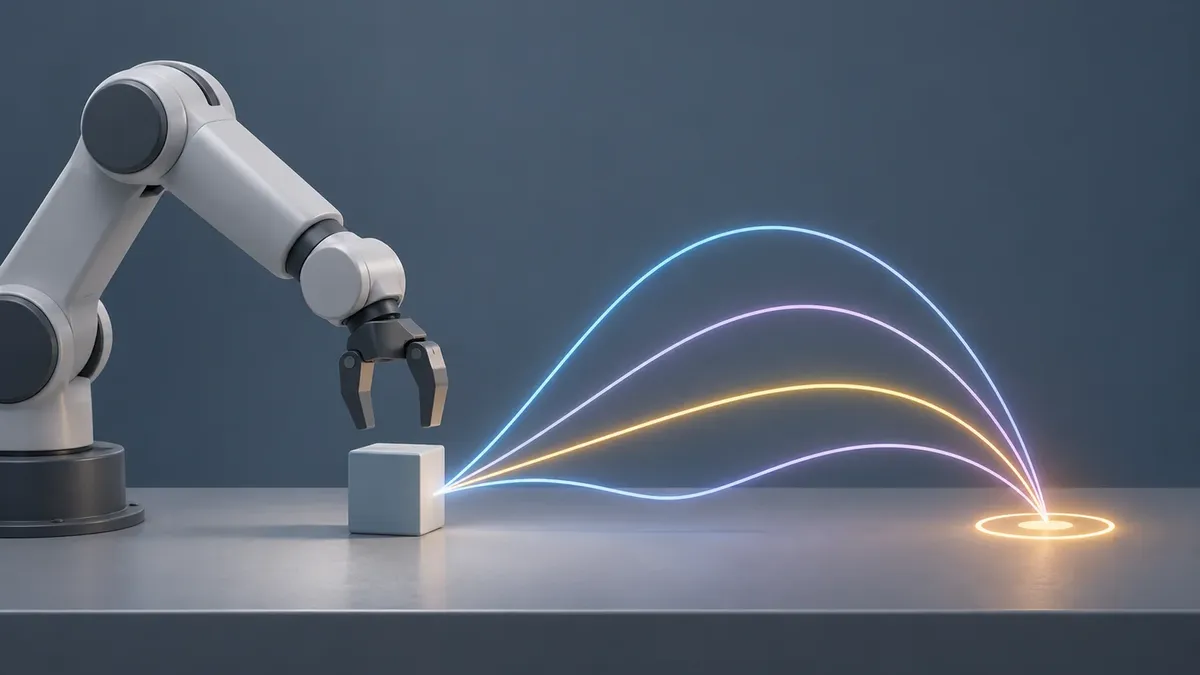
A robot may need an alternative if a planned route is blocked or priorities change. Many Plans at Once (MPAO) is designed to find sets of distinct, relatively inexpensive trajectories ahead of time. Its reported results come from simulations using specified models—not from trials with physical robots.
A motion planner often returns one trajectory: a proposed movement over time that reaches a goal while satisfying constraints. But one route may no longer suit the task if a constraint or preference changes. Having alternatives ready could help, provided they are feasible, reasonably inexpensive and meaningfully different—not just tiny variations on the same path.
That is difficult in continuous time. A trajectory can be shifted by an arbitrarily small amount, creating a near-copy that is still valid. Simply ruling out one route does not rule out all its near-copies. In Many Plans at Once: Diverse Top-Quality Planning in Continuous Time, Mahyar Jahani-nasab and colleagues introduce a method intended to search for sets of distinct, low-cost trajectories.
How MPAO searches
The method, called MPAO, samples neural-network parameters to generate candidate trajectories that satisfy specified boundary conditions, such as start and endpoint, by construction. Neural networks then learn adjustments to reduce constraint violations and cost. Adjustment networks are shared within groups of candidates, allowing improvements for one candidate to carry over to others in its group.
Candidates are checked against the constraints in the mathematical model. The checks include evaluations at selected time points, replay on a finer grid, and an interval-arithmetic certificate that bounds constraints over the full time horizon and rules out violations. This is validation against the modeled dynamics and constraints; it does not establish that a trajectory is safe on a physical robot.
MPAO archives validated plans, treats plans closer than a chosen distance as near-duplicates, and redraws candidates to explore elsewhere. It also adapts its sampling groups as the archive grows. The authors call it “anytime”: more search can add useful options, although the method’s greedy packing of the archive can lose a plan when a cheaper one displaces other plans from the packed set.
The researchers compared MPAO with five other methods under equal time budgets. Tests covered four modeled domains: pursuit–evasion and three robot-arm manipulation tasks, Push, Slide and Pick. Each domain had 10 test instances; separate held-out instances were used to design MPAO and tune the comparison methods. The study’s plan-count measure uses greedy packing: it counts plans within a cost bound that are separated by at least a specified distance.
What the simulations showed
MPAO found at least one validated plan on all 40 test instances. It was the only compared method to solve every instance and the only one to find plans within 25% of the best known cost in every domain. That reference cost was the lowest validated cost pooled across the evaluated methods and seeds, not a proof of the true optimum. Reported counts were based on the same greedy-packing procedure for all methods.
The clearest gains were in manipulation. Within the 25% cost bound, the authors report averages of 13.5 distinct plans per Pick instance, 6.6 for Push and 3.9 for Slide. On Push and Slide, MPAO returned about 10 times as many qualifying plans as the strongest baseline; on Pick, it alone found any plans within the bound. These are results from simulations using the study’s continuous-time models, not physical-robot trials.
Pursuit–evasion was more mixed. At the tighter 10% cost bound, IPOPT and MPPI found more plans than MPAO. At the looser 25% bound and the first distance threshold, IPOPT also returned slightly more plans. MPAO led at the stricter distance threshold. Which method performed better therefore depended on both the cost limit and how far apart plans had to be.
What remains uncertain
The findings suggest MPAO can prepare multiple feasible trajectories in these modeled test settings. They do not show how it performs across other robots, environments or constraints. The study specifies the models and evaluates a limited set of domains; whether real-world effects change the usefulness of the plans was not tested.
There are practical trade-offs, too. Runs took 6 to 38 minutes per instance on a laptop GPU, so the authors propose offline preparation rather than replanning inside a control loop. MPAO favors finding distinct plans over repeatedly refining each one toward the lowest cost. And numerical separation does not necessarily mean different high-level strategies: the authors report that manipulation plans covered a limited number of contact strategies, while many pursuit–evasion plans shared a route.
The paper is an arXiv preprint and may not have undergone peer review, so its findings should be treated as preliminary. The authors list physical-hardware execution and refinement of archived plans toward lower costs as future work.
- robotics
- motion planning
- trajectory optimization
- robot manipulation
- continuous-time planning
- MPAO
- simulation
Related reading
Automatically matched by shared topic keywords. These links do not imply that the sources agree or establish a consensus.
A lazier search helps robots plan complex retrieval tasks
Source published
Shared keywords: motion planning, robot manipulation
Robot-coding agents need better failure diagnosis, not just more feedback
Source published
Shared keywords: robot manipulation
A robot twin built from first-person video
Source published
Shared keywords: robot manipulation
How MAWAM helps robot teams act together
Source published
Shared keywords: robot manipulation
When a robot misses a grasp, force feedback can cue a retry
Source published
Shared keywords: robot manipulation