TRANSMISSION // 2611.27011v1
When a robot misses a grasp, force feedback can cue a retry
Source published
FoRe uses force signals to help vision-language-action robots detect failed grasps, retry, and resume a task. Tests report gains in simulation and on a physical robot, with limits.
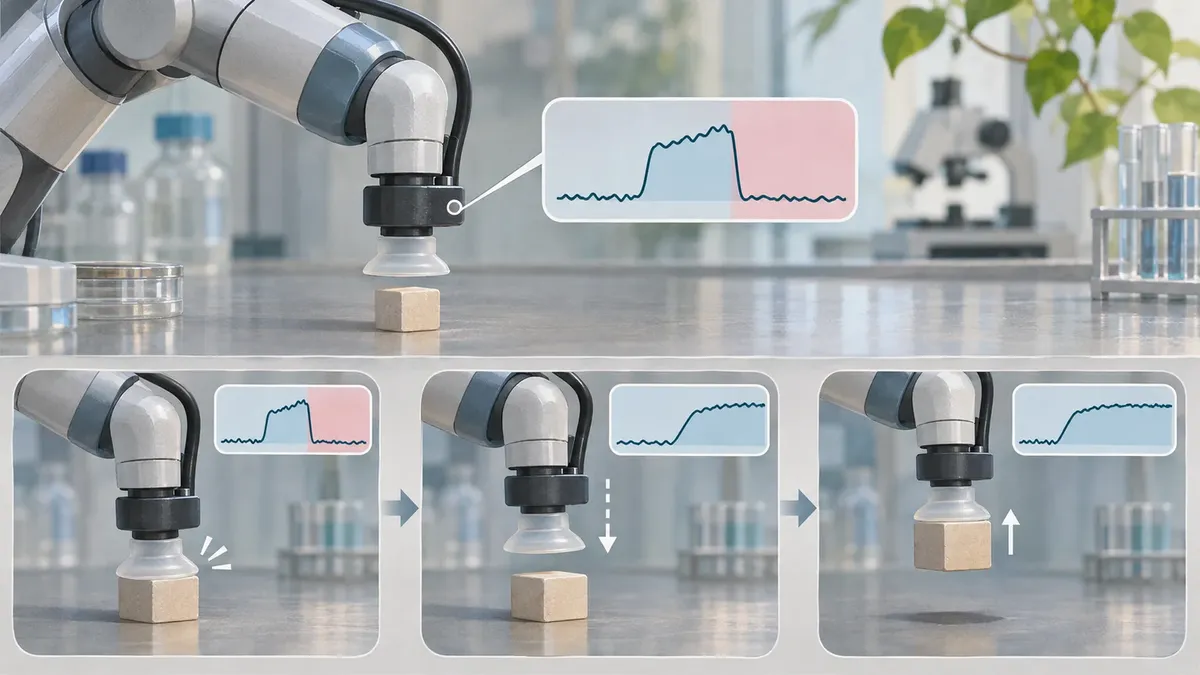
A robot can mistake the motion of a failed pick for a successful one and carry on without the object. FoRe uses force feedback to help detect that error and trigger another grasp attempt. Its reported results are promising, but they come from experiments with specific tasks, robots and models.
A pick-and-place robot needs to know not only what action to take, but whether that action worked. If it closes a suction gripper without securing an object, it may still move into the transport phase—as if the grasp had succeeded. The task then fails for a problem that might have been fixed with a retry.
The authors of Force-guided Recovery (FoRe) propose a framework for vision-language-action (VLA) models: systems that use visual input and language instructions to produce robot actions. Their central idea is to use force feedback as a physical clue about contact, rather than relying on the robot’s estimated pose and motion alone to decide which stage of a task comes next.
Separate policies, coordinated by force
FoRe divides a pick-and-place task into two stages: approach and grasp, then transport and placement. The researchers use force measurements and gripper-command status to label successful demonstrations by stage, and train a separate policy for each. They then initialize a third, retry policy from the approach-and-grasp policy and refine it with local reinforcement learning on states designed to resemble a failed grasp.
During execution, a controller switches among the policies. If the robot is in the transport stage, the gripper is still commanded to hold, and force drops toward the no-contact level, the controller treats this as a possible failed grasp and invokes the retry policy. When contact is restored, it resumes transport. Combining force with gripper status matters: low force can also occur during an intentional release, which should not be mistaken for a failure.
The team also created LIBERO-SUCTION, a force-augmented version of the LIBERO simulation benchmark. It includes 22 tasks and 1,100 demonstration trajectories for training. The researchers tested FoRe with two VLA systems, VLA-Adapter and π₀.₅, in simulations and on a physical robot. The paper reports 50 evaluation episodes per task in the simulation benchmarks; real-world trials used randomized object positions.
Higher reported success, with important qualifications
On LIBERO-SUCTION, average success rose from 69.2% to 87.6% for VLA-Adapter and from 85.9% to 92.4% for π₀.₅—absolute gains of 18.4 and 6.5 percentage points. On LIBERO, the reported average gains were 7.6 and 6.2 points, respectively.
In the real-world experiments, average success increased from 26.7% to 51.7% for VLA-Adapter and from 48.3% to 70.0% for π₀.₅. The paper also reports gains when training with just one demonstration per task on both simulation benchmarks. These results concern the tested tasks, hardware, training setup and model backbones; they do not establish that FoRe will work equally well in other settings.
A component-removal analysis offers clues about the design. On LIBERO-SUCTION with VLA-Adapter, success fell when the researchers disabled retries, removed force-based switching, or used a single policy for both normal stages. This supports the value of the combined framework in that experiment, but does not show that every component will contribute equally across tasks or robots.
There is also a specific boundary to the method: FoRe relies on its approach-and-grasp policy to make contact with the target in the first place. If it repeatedly fails to reach the object, force-guided stage control may not be able to advance or trigger an effective recovery. The authors identify improving reliable contact as future work.
The work is available as an arXiv preprint. The supplied source does not establish its peer-review status. Its results provide evidence from the reported simulation and physical-robot experiments, not a guarantee of general reliability. Further testing would be needed to establish how well the approach transfers to different robots, objects and operating conditions.
- robotics
- vision-language-action models
- grasp recovery
- force feedback
- robot manipulation
- reinforcement learning
Reviewed cross-references
These connections were reviewed by a model, not independently fact-checked by a human. Similarity does not imply agreement; consult the original papers and the evidence below.
Robot-coding agents need better failure diagnosis, not just more feedback
Supporting evidence: Both papers describe manipulation failures that can persist because a policy does not effectively respond to an earlier error: FoRe reports continued transport after failed grasps, while the controlled agentic-robotics study describes difficulty linking downstream failures to earlier grasp choices. This supports only the bounded point that failure diagnosis and recovery can be bottlenecks; the systems, tasks and evaluations differ, so the results are not directly comparable.
Model review: · openai-codex/gpt-6-luna
Evidence and provenance
Selected excerpts, not complete papers. PDF extraction can omit figures or damage equations, tables and reading order; sources may be preprints.
2611.27011v1 — Original paper
Excerpt reference:
static/papers/2611.27011v1.md:83-151
Basis: Paper text
Source SHA-256:8f58f9ea3b73eabc626b4d28024538a4c21254db490963de5128b89585d410452611.09030v1 — Original paper
Excerpt reference:
static/papers/2611.09030v1.md:733-822
Basis: Paper text
Source SHA-256:c6a0598cf7fcdf6b55fd5429102e358e9a23bc01e2396d1f023447d9652fb036
Related reading
Automatically matched by shared topic keywords. These links do not imply that the sources agree or establish a consensus.
Robots may learn more from human corrections when they do not copy them exactly
Source published
Shared keywords: reinforcement learning, robot manipulation, vision language action models
A Robot Memory System That Keeps the Lesson, Not Every Detail
Source published
Shared keywords: vision language action models
MESA tests where robot skills stop generalizing
Source published
Shared keywords: vision language action models
How CHORD helps robot hands learn from human demonstrations
Source published
Shared keywords: reinforcement learning
Teaching robots without demanding an exact copy
Source published
Shared keywords: robot manipulation, vision language action models