TRANSMISSION // 2611.26975v1
ToRA Reuses Model Weights for Streaming Safety Checks
Source published
ToRA adds token-by-token safety monitoring by branching from a language model and reusing its weights and KV cache. In tests on Qwen3-0.6B, it approached a separate guard’s detection rate with less added latency, though the evidence is limited to specific models and test setups.
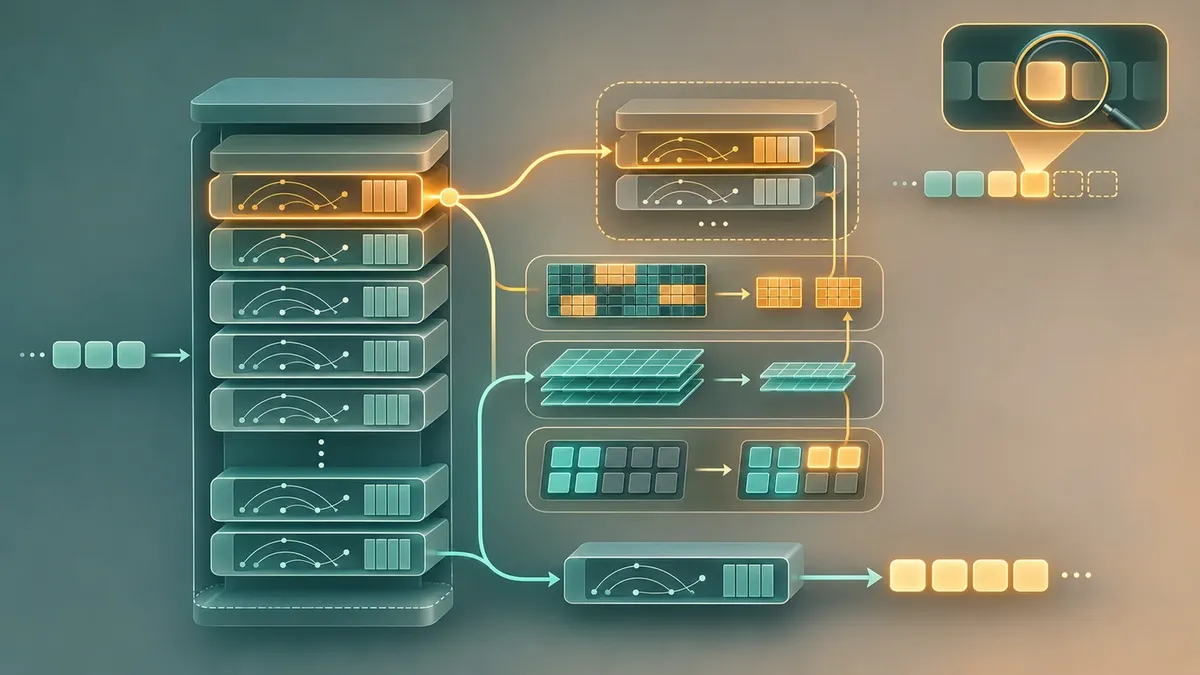
A local AI assistant can be checked for unsafe content as it writes, but a separate guard model adds processing and memory demands. ToRA takes a different approach: it branches from the generating model, reusing weights and cached information while putting some otherwise idle computing capacity to work. Its reported results are promising, but the tests do not establish performance across models or live deployments.
Local AI assistants generate text one token at a time. In the batch-size-one setting studied here, each decoding step reads model weights from memory while leaving some computing capacity unused. A separate safety model can check each new token, but adds latency and memory use. A hidden-state probe—one that classifies the generator’s internal signals—is cheaper, but may be less accurate.
A paper by Soheil Zibakhsh, Pedram Aghazadeh and Farinaz Koushanfar proposes ToRA, short for Tandem of low-Rank Adapters. Rather than running a complete, independent guard model, ToRA branches from the generator partway through its layers. The two paths reuse weights, and the verifier uses the generator’s key-value (KV) cache: stored information that helps the model attend to earlier tokens. Low-rank adapters and a classification head specialize the verifier for safety checks. Custom GPU kernels process generator and verifier rows together, reading shared weight tiles once. The generator’s output is designed to remain unchanged.
The verifier scores safety as tokens arrive. If its score crosses a threshold, a system could flag the response and stop generation. For training, the researchers used existing safety datasets and sampled intermediate response positions. A separate model identified the onset of unsafe content in 88.4% of unsafe training responses. When it could not identify an onset, sampled positions were labeled safe, while the final response token retained its unsafe label.
What the tests found
The main accuracy evaluation used Qwen3-0.6B, a model with 0.6 billion parameters. Across 17 prompt and response benchmarks, ToRA had higher F1 than Qwen3Guard-Stream, a separate streaming guard, on 12. Average response F1 was 81.4 for ToRA and 80.4 for the guard; average prompt F1 was 86.3 and 84.6. F1 combines precision and recall, but does not establish how a system will perform in every setting.
For streaming evaluation, the team replayed recorded responses token by token. They calibrated thresholds using validation data to flag at most 5% of safe responses, then measured false alarms on a separate set of held-out safe BeaverTails responses. At that calibration setting, ToRA detected 83.6% of unsafe responses; the guard detected 84.7%, and SingProbe, a hidden-state probe, detected 71.8%. These results compare systems on this particular evaluation, not across all possible inputs or deployments.
ToRA’s median detection delay was five tokens, compared with seven for each baseline. The timing comparison needs context: Qwen3Guard-Stream requires two consecutive unsafe token scores, while ToRA flags a single threshold crossing. The different decision rules may partly account for the delay difference.
On an RTX A6000 GPU at a 2,000-token context, ToRA added 3.5% latency per token in the reported setup. The separate guard added 85.9%, while SingProbe added 1.6%. Guard overhead varied with context length: 84.3% at 512 tokens and 89.3% at 8,000. ToRA’s overhead also varied, falling from 4.0% at 512 tokens to 2.8% at 8,000. These figures describe the specified hardware and batch-size-one tests; ToRA costs more latency than SingProbe.
Performance was not uniform across benchmarks. On SingStreamBench, SingProbe achieved a higher response-level area under the ROC curve than ToRA. The authors note that this benchmark’s onset annotations were produced by the same model that annotated SingProbe’s unreleased training data, a consideration when interpreting that comparison. ToRA also produced more false alarms than SingProbe on the held-out safe BeaverTails set.
What remains uncertain
The evidence has a narrow base. Safety accuracy was evaluated on Qwen3-0.6B. Efficiency experiments extended to larger models only in more limited ways: end-to-end at 1.7 billion parameters and on feed-forward layers at 8 billion. Latency measurements used one GPU. The authors say ToRA’s advantage may diminish with larger batches or speculative decoding, and their cost comparison uses guard models the same size as the generator.
ToRA results were reported across three random seeds, while baseline results used one released checkpoint. Streaming tests replayed existing responses rather than checking text generated live. The results therefore support an engineering approach under specific benchmark and hardware conditions; they do not show that ToRA will catch every unsafe response or deliver the same trade-off elsewhere.
This is an arXiv preprint. The available source does not establish that it has undergone peer review. Its findings are best treated as preliminary evidence, with broader model and deployment testing still needed.
- ToRA
- language models
- AI safety
- streaming moderation
- GPU inference
- LLM guardrails
Reviewed cross-references
These connections were reviewed by a model, not independently fact-checked by a human. Similarity does not imply agreement; consult the original papers and the evidence below.
TopicScope tracks an AI response’s subject as it is generated
Supporting evidence: Both papers demonstrate token-level monitoring during generation using information from the generating model: ToRA branches from a Qwen3-0.6B model to classify safety, while TopicScope uses Gemma 3 activations to label topics. This supports the bounded point that model-internal information can enable streaming monitors, not that the methods or tasks are interchangeable; the results come from different models and evaluations.
Model review: · openai-codex/gpt-6-luna
Evidence and provenance
Selected excerpts, not complete papers. PDF extraction can omit figures or damage equations, tables and reading order; sources may be preprints.
2611.26975v1 — Original paper
Excerpt reference:
static/papers/2611.26975v1.md:191-268
Basis: Paper text
Source SHA-256:5ce257222c174f4a8b30200c24cc2b09d3e4348ecfaa7e3932eb1617ccc2c6302611.12935v1 — Original paper
Excerpt reference:
static/papers/2611.12935v1.md:84-141
Basis: Paper text
Source SHA-256:ca690665aae75f417f088d3cec338b21e33da23c56f47cc82e7911c972bd6dc92611.12935v1 — Original paper
Excerpt reference:
static/papers/2611.12935v1.md:1073-1110
Basis: Paper text
Source SHA-256:ca690665aae75f417f088d3cec338b21e33da23c56f47cc82e7911c972bd6dc9
Related reading
Automatically matched by shared topic keywords. These links do not imply that the sources agree or establish a consensus.
HybridSpec speeds hybrid language models by checking fewer draft tokens
Source published
Shared keywords: gpu inference, language models
Hybrid Spark combines prediction and copying for AI code editing
Source published
Shared keywords: gpu inference
When Retrieved Text Changes AI Safety Checks
Source published
Shared keywords: ai safety, language models
Can switching off AI safety components make a model harder to jailbreak?
Source published
Shared keywords: ai safety
A weight-editing attack may weaken open AI guardrails
Source published
Shared keywords: ai safety, language models