TRANSMISSION // 2611.26973v1
White dwarf brightness offers clues to AM CVn evolution
Source published
A preprint argues that white dwarf brightness in ultracompact AM CVn binaries may help test how these systems lose orbital angular momentum. Its models favor extra braking, but only with substantial boosts to some proposed prescriptions.
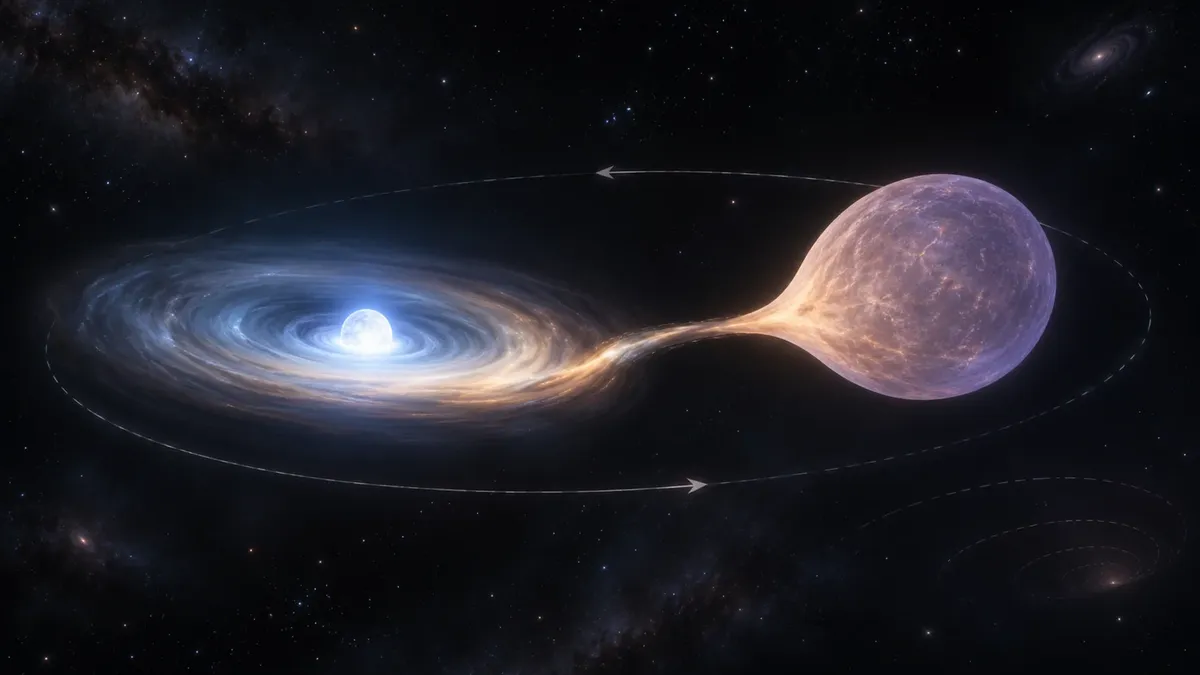
In a tight stellar pair, a white dwarf can accrete helium-rich material from a companion. At longer orbital periods, its cooling luminosity may offer clues to the system’s orbital evolution. A new modeling study asks whether observed brightness fits a picture driven only by gravitational waves—or whether another process is needed.
AM CVn binaries are ultracompact pairs: a white dwarf accretes from a helium-rich, semidegenerate donor, and their orbital periods are generally under about 70 minutes. At very short periods, rapid accretion reheats the white dwarf. As the system widens and mass transfer slows, the accretor follows standard white-dwarf cooling at longer periods. The authors argue that its cooling luminosity can then help probe the binary’s orbital evolution.
The study asks whether gravitational waves alone can account for the observed brightness of these accreting white dwarfs, or whether the orbit loses angular momentum through an additional process. Angular momentum describes orbital motion; losing it can change the orbit and the pace of mass transfer. The authors examine magnetic braking, attributing the proposed additional angular-momentum loss to braking of the donor.
The authors report that accretors at long orbital periods appear brighter—and, in the interpretation used in the study, younger—than models with gravitational-wave losses alone predict. They calculate binary evolution and accretor cooling using several proposed magnetic-braking prescriptions, across three proposed formation pathways: white-dwarf, helium-star, and evolved cataclysmic-variable channels.
In their models, additional angular-momentum loss attributed to donor magnetic braking can better reproduce the observed brightness. But none of the tested prescriptions works in its original form. The authors report satisfactory results when the Rappaport et al. (1983) prescription is strengthened by about a factor of five, or when the saturated Matt et al. (2015) prescription is strengthened by about a factor of 150. They also report that the CARB prescription, recently applied to the evolved-CV pathway, is strongly in tension with the accretor-luminosity observations.
These are results within the authors’ models, not proof that magnetic braking causes the brightness difference. The prescriptions that provide satisfactory fits require substantial boosts, and the abstract does not establish that the observations uniquely favor those choices. Because the supplied material contains only the abstract, details of the datasets, model implementation, statistical comparisons, observational uncertainties, and sensitivity to other assumptions cannot be assessed here. Those are limits of this account’s source material, not additional findings reported by the study.
The authors propose ultraviolet spectroscopy and dedicated atmosphere models for AM CVn accretors as next steps. The abstract does not specify what improvement those efforts would achieve, but presents them as ways to pursue the questions raised by the modeling.
This account is based on the abstract of arXiv preprint 2611.26973v1, by Tin Long Sunny Wong, Peter Scherbak, and Jim Fuller. The full paper was not available in the supplied source material. As a preprint, the work may not have undergone peer review; its conclusions should be understood as the authors’ reported modeling results, not settled evidence that magnetic braking explains AM CVn evolution.
- AM CVn binaries
- white dwarfs
- magnetic braking
- gravitational waves
- binary evolution
- accretion
Related reading
Automatically matched by shared topic keywords. These links do not imply that the sources agree or establish a consensus.
How a star feeds a black-hole binary
Source published
Shared keywords: gravitational waves
A newborn star’s disc moves gas inward and outward in stacked layers
Source published
Shared keywords: magnetic braking
Planetary debris leaves hydrogen behind in white dwarf atmospheres
Source published
Shared keywords: white dwarfs
Changing accretion, similar X-ray temperatures
Source published
Shared keywords: white dwarfs
What shapes black holes from the first stars?
Source published
Shared keywords: gravitational waves