TRANSMISSION // 2611.26966v1
When an AI tool call times out, did it still happen?
Source published
A controlled study tests a runtime that separates AI agents’ proposed tool actions from permission checks, data sharing and supplier choice. It finds that cautious handling of uncertain outcomes can avoid duplicate effects across suppliers in tested scenarios—but the experiments use scripts and synthetic suppliers, not AI agents or real services.
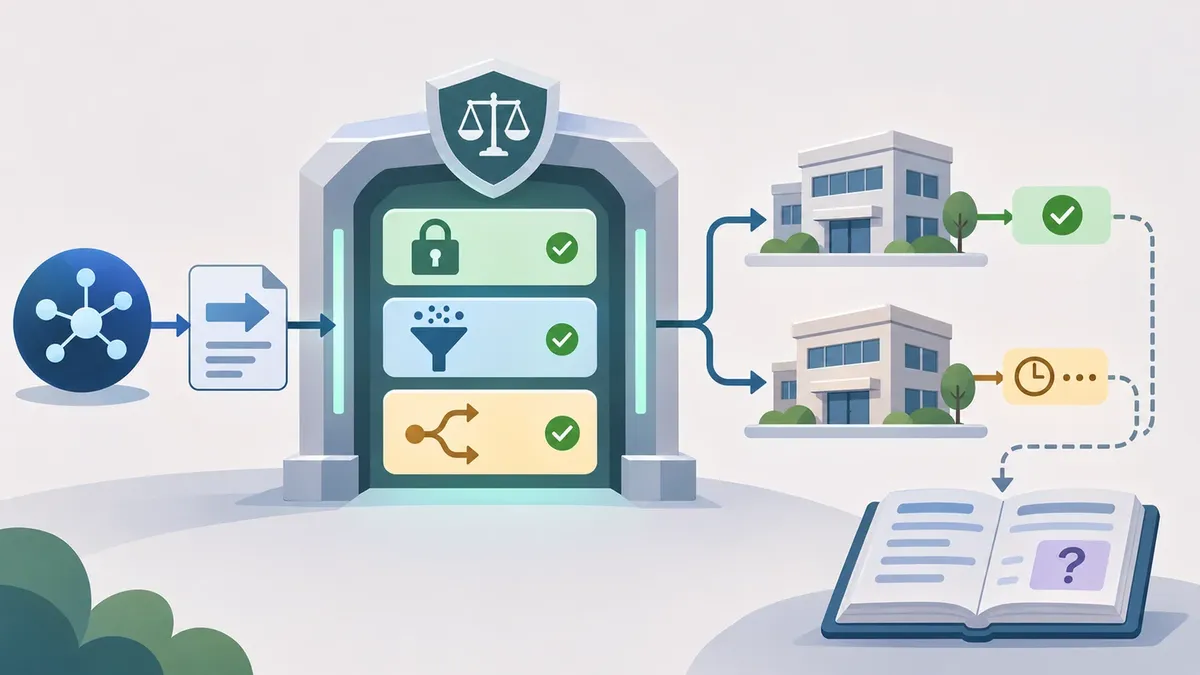
A missing reply does not prove a tool failed: a supplier may have completed an action and lost its response. A preprint examines how an execution layer can manage that uncertainty, enforce business-set rules and support supplier changes.
An AI agent can request that a tool send a message, update a record or perform another consequential action. But if the tool times out, the agent may not know whether the action happened. Trying again could repeat it; refusing to retry could leave the task unfinished. A generated message saying “success” is not, by itself, evidence that the intended effect occurred once.
In Keep the Process, Change the Supplier, Deepak Waghmare and Shaad Sufi study a software layer called the Open Process Control Plane (OPCP), designed to mediate tool calls. Their central question is which execution decisions can be kept outside an agent’s generated output—and what happens when a tool supplier fails or changes.
A control point between proposal and action
OPCP treats the agent’s request as a proposal, not as authorization. Before calling a supplier, the runtime can project the request down to contract-approved fields, check business-defined authority rules, filter suppliers against eligibility conditions, and select an eligible supplier. It can also record requests, decisions, attempts and responses.
A key distinction is between a definite refusal—where the supplier confirms it did not perform the action—and an unknown outcome, such as a lost reply after the supplier may have acted. For an effectful call, OPCP stops cross-supplier failover when the outcome is unknown and records which supplier needs reconciliation. That caution can reduce duplicate actions, but it may delay completion when no action actually took place.
What the researchers tested
The evaluation tested the runtime, not an AI agent. Across 2,400 scripted fault episodes, the researchers compared OPCP with a separately written conservative composition and two diagnostic strategies: retrying another supplier after every error, and stopping after every error. The tests used deterministic local supplier simulations and injected conditions such as refusal, timeout before an effect, and lost or invalid replies after an effect.
Other experiments tested 60 process-termination-and-restart episodes, 19,000 timed calls across 19 configurations, five targeted software mutations against 43 existing fixtures, and 160 possible substitution records. The work ran on one workstation. The authors say the study was not externally preregistered or independently executed; the reported records and scripts are supplied as research artifacts.
What happened—and what did not
OPCP and the conservative composition agreed on every measured fault outcome. Both recovered after definite refusal without duplicating an effect across suppliers in the tested scenarios. By contrast, retry-all duplicated effects across two suppliers in every tested case where a supplier committed an effect but its reply was lost. This is a result of the deliberately constructed scenarios, not an estimate of how often real services fail.
Restart tests highlight two different safeguards. Persistent runtime state helped prevent replay at a different supplier after a restart. But it did not prevent a same-supplier duplicate when that supplier lacked its own idempotency mechanism—a feature that recognizes repeated requests and avoids repeating their effects. In these experiments, preventing duplicates therefore depended on both runtime memory and, in some situations, supplier behavior.
There were costs and gaps, too. With 128 suppliers, best-score routing had a median local latency of about 1.411 milliseconds, compared with 0.261 milliseconds for pinned routing. Larger inputs also increased measured latency. All five selected code mutations were detected by the test fixtures, but that small, targeted set does not establish comprehensive security or correctness. The substitution-record validator accepted a record with no regression cases, showing that an internally consistent record need not contain sufficient evidence.
What the evidence can support
The study supports a limited claim: under its scripted conditions, OPCP implements a conservative execution boundary that separates proposed actions, permission checks, supplier selection and outcome records. It also shows that a timeout can leave the result genuinely uncertain, and that runtime persistence and supplier-side duplicate protection solve different problems.
It does not show that OPCP makes agents more capable, improves task success, resists prompt injection or works seamlessly with real vendors. The authors did not run a language model, autonomous planning loop, real supplier API or production workflow. Complete mediation is also an assumption: a caller with separate supplier credentials could bypass the runtime. Nor can filtering fields prevent a recipient from retaining or inferring information already disclosed.
This is an arXiv preprint, not evidence of peer-reviewed validation. Its controlled experiments describe a particular software implementation and bounded test conditions; real networks, concurrent workloads and business processes may behave differently. The authors themselves identify end-to-end agent tests and comparisons with competent alternative systems as necessary next steps. The result is a mechanism study, not proof that supplier switching is easy or that AI agents are safer in practice.
- AI agents
- runtime governance
- tool use
- software reliability
- supplier substitution
- idempotency
Reviewed cross-references
These connections were reviewed by a model, not independently fact-checked by a human. Similarity does not imply agreement; consult the original papers and the evidence below.
When an AI tool call fails, did it still work?
Supporting evidence: Both studies distinguish preventing duplicate effects from resolving an uncertain tool outcome. Waghmare and Sufi report that OPCP avoids cross-supplier duplication in tested lost-reply cases, while same-supplier protection depends on supplier idempotency; Xu reports zero repeated effects in 200 tested crash-and-replay pairs with the full runtime, but ambiguity when reconciliation is disabled. The evidence is compatible, not a direct replication: OPCP used scripted requests and synthetic suppliers without an agent, whereas Xu used captured model responses and a controlled single-host target; both results are limited to their tested conditions.
Model review: · openai-codex/gpt-6-luna
Evidence and provenance
Selected excerpts, not complete papers. PDF extraction can omit figures or damage equations, tables and reading order; sources may be preprints.
2611.26966v1 — Original paper
Excerpt reference:
static/papers/2611.26966v1.md:513-610
Basis: Paper text
Source SHA-256:ca5db5a13ded0816efc18359a00cb8f9b366fe7433b5c2a7f4bb1145e70296b32611.23353v2 — Original paper
Excerpt reference:
static/papers/2611.23353v2.md:16-79
Basis: Paper text
Source SHA-256:78f8224a1e3a4a65fe507f46562f8cf3617f36095e8a9788d9a437060dc604772611.23353v2 — Original paper
Excerpt reference:
static/papers/2611.23353v2.md:1139-1210
Basis: Paper text
Source SHA-256:78f8224a1e3a4a65fe507f46562f8cf3617f36095e8a9788d9a437060dc60477
Why Successful AI Tool Calls Can Still Break Workflows
Supporting evidence: Both papers identify limited outcome semantics at the agent–tool boundary as a constraint on reliable execution. Trofimov and Novikov report that MCP annotations do not fully express capabilities such as authoritative outcome resolution or idempotency keys; Waghmare and Sufi show in selected fault scenarios that a timeout cannot distinguish no effect from a committed effect with a lost reply, motivating conservative handling and supplier-side assumptions. This is a bounded conceptual connection, not a shared experiment: the former analyzes an effect-history model and an MCP annotation census, while the latter tests a runtime with scripted requests and synthetic suppliers.
Model review: · openai-codex/gpt-6-luna
Evidence and provenance
Selected excerpts, not complete papers. PDF extraction can omit figures or damage equations, tables and reading order; sources may be preprints.
2611.26966v1 — Original paper
Excerpt reference:
static/papers/2611.26966v1.md:221-293
Basis: Paper text
Source SHA-256:ca5db5a13ded0816efc18359a00cb8f9b366fe7433b5c2a7f4bb1145e70296b32609.15397v2 — Original paper
Excerpt reference:
static/papers/2609.15397v2.md:759-797
Basis: Paper text
Source SHA-256:6c57c58fbb38fee0ec83e58393242b50be585977f602263b69e62e267262e1da2609.15397v2 — Original paper
Excerpt reference:
static/papers/2609.15397v2.md:652-707
Basis: Paper text
Source SHA-256:6c57c58fbb38fee0ec83e58393242b50be585977f602263b69e62e267262e1da
Related reading
Automatically matched by shared topic keywords. These links do not imply that the sources agree or establish a consensus.
When an AI tool call fails, did it still work?
Source published
Shared keywords: ai agents
AI agents can resume after failure—but often don’t recover
Source published
Shared keywords: ai agents, software reliability
When AI agents need a workflow—and when they don’t
Source published
Shared keywords: ai agents, tool use
Where GPU Software Fails Beneath Large Language Models
Source published
Shared keywords: software reliability
Can an AI agent remember a correction at the right moment?
Source published
Shared keywords: ai agents, tool use