TRANSMISSION // 2611.26960v1
How Double Barriers Shape Entanglement Between Scattered Electrons
Source published
A theoretical study finds that resonances in a finite-width double barrier control entanglement between reflected and transmitted electron modes—but strongly entangled outcomes may be rare because they are conditional on a particular scattering result.
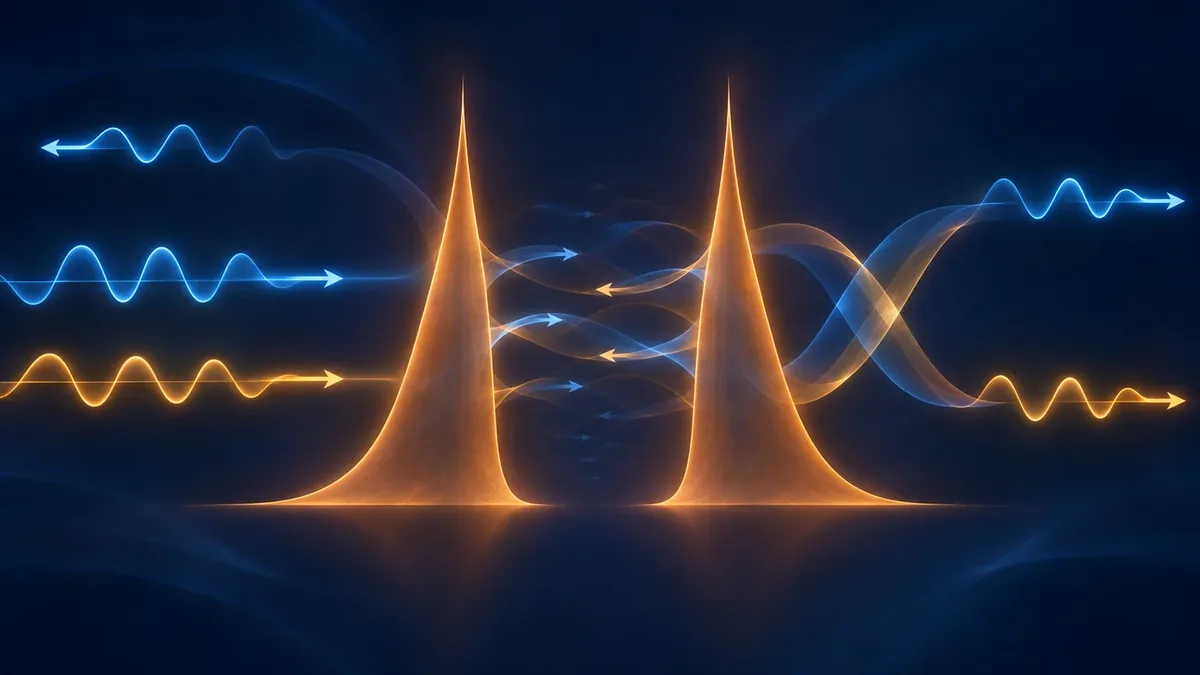
Can two electrons become entangled through scattering even if they arrive independently? A theoretical preprint explores that question using a double barrier with finite-width, exponentially decaying profiles. Its calculations find that resonances govern the entanglement of selected outcomes, while highlighting an important caveat: those outcomes may occur infrequently.
Two electrons can arrive at a barrier independently yet leave in an entangled state. After scattering, one electron may be reflected and the other transmitted, with two possible alternatives for which incoming momentum mode takes each route. If those alternatives have comparable weights, the reflected and transmitted modes can be strongly entangled.
A theoretical study asks whether this effect, previously examined using idealised zero-width barriers, persists when barriers have spatial extent. Víctor M. Villalba models a symmetric pair of exponentially localised, cusp-shaped barriers. Each barrier’s potential has a kink at its peak. The work is an arXiv preprint, not a report of an experiment.
From one barrier to two
The analysis starts with a single cusp barrier. The author derives its reflection and transmission amplitudes, which describe the strength and phase of the reflected and transmitted waves. The solutions use modified Bessel functions. Their probability-current conservation is checked analytically, and the formulas are also compared with an independent numerical integration of the Schrödinger equation.
For two barriers, the author combines the single-barrier results using a Fabry–Pérot method. In plain terms, this accounts for a wave bouncing between the barriers before escaping. Because the cusp barriers have overlapping tails, this construction is an approximation rather than an exact description of the full potential. It is tested against direct numerical calculations for the two-barrier system. In the tested cases, discrepancies in resonance positions and other reported diagnostics increase as the barriers become less separated relative to their width; the approximation is best supported in the well-separated regime.
The two incoming electrons are described by distinct, resolved momentum modes with negligible overlap. They share a fixed spin state, and the barriers do not mix transverse channels. The calculation selects only outcomes with one electron reflected and one transmitted. It then evaluates the concurrence—a measure of entanglement for the selected two-mode state—and separately calculates the probability of obtaining that outcome. The electrons remain identical fermions; the entanglement discussed is between output modes, not between particle labels.
Resonances shape conditional entanglement
The calculations show that transmission resonances control where the selected state’s concurrence vanishes. In the two-barrier approximation, resonances occur when the reflection phase and the phase accumulated during travel between the barriers satisfy an integer-phase condition. If exactly one incoming momentum is at a perfect-transmission resonance, one of the two alternatives in the selected outcome disappears. Provided the one-reflected, one-transmitted sector still has nonzero probability, its conditional concurrence is then zero. If both momenta are resonant, that sector has zero probability and there is no conditional state for which to define concurrence.
Away from resonances, the two alternatives can become more balanced, producing high concurrence. The resonance-related pattern persists for the finite-width barriers studied, rather than relying solely on the point-barrier idealisation. Finite width can shift the locations of entanglement maxima and, for some choices of the first momentum, reduce their attainable height. It does not uniformly lower every maximum: in other tested cases, high concurrence remains possible, with the main change being where the maximum occurs.
Concurrence describes entanglement given that the selected event occurred; it does not say how often it happens. The paper reports that, in its weak-barrier examples, the probability of the selected sector can be small. A highly entangled conditional outcome is therefore not the same as a high-yield source of entangled electron pairs. When both momenta are at perfect-transmission resonances, the selected event is absent altogether.
What the result does—and doesn’t—establish
The central finding is theoretical: in the model and parameter ranges studied, resonance-controlled conditional entanglement survives replacing idealised point barriers with finite-width cusp barriers. Numerical checks support the separated-barrier approximation in the well-separated regime; they do not establish that every barrier shape or device will behave the same way.
The assumptions matter. The calculation uses narrow, resolved momentum modes, a common fixed spin state, elastic scattering and barriers that do not mix channels. Finite-width wave packets, different spin states, channel mixing and thermal effects can require a mixed-state entanglement calculation. Electron–electron interactions and inelastic scattering are also outside the analysis. These are possible extensions, not effects the study measures or resolves.
ArXiv preprints are shared for discussion and are not necessarily peer reviewed. This study presents a mathematical and numerical test of a scattering model, not evidence that a practical entangled-electron device has been built. Its central message is narrower: resonances can organize entanglement in selected scattering events, but the probability of those events must be considered alongside their conditional entanglement.
- quantum entanglement
- electron scattering
- resonant tunnelling
- double barriers
- concurrence
- quantum transport
Related reading
Automatically matched by shared topic keywords. These links do not imply that the sources agree or establish a consensus.
Reading spin entanglement in a tunneling microscope’s spectra
Source published
Shared keywords: quantum entanglement
A response-based way to bound noise in quantum transport
Source published
Shared keywords: quantum transport
Periodic driving reshapes mobility edges in a quasiperiodic model
Source published
Shared keywords: quantum transport
Bright supernovae reveal how surrounding gas shapes their light
Source published
Shared keywords: electron scattering
Uneven ion spacing changes how a quantum of vibration travels
Source published
Shared keywords: quantum transport