TRANSMISSION // 2611.26936v1
SecretAgent tests a quieter way to shield images from AI
Source published
A multi-agent system adds subtle image changes to make private details harder for vision-language models to infer, while checking that the changes are not visibly distracting.
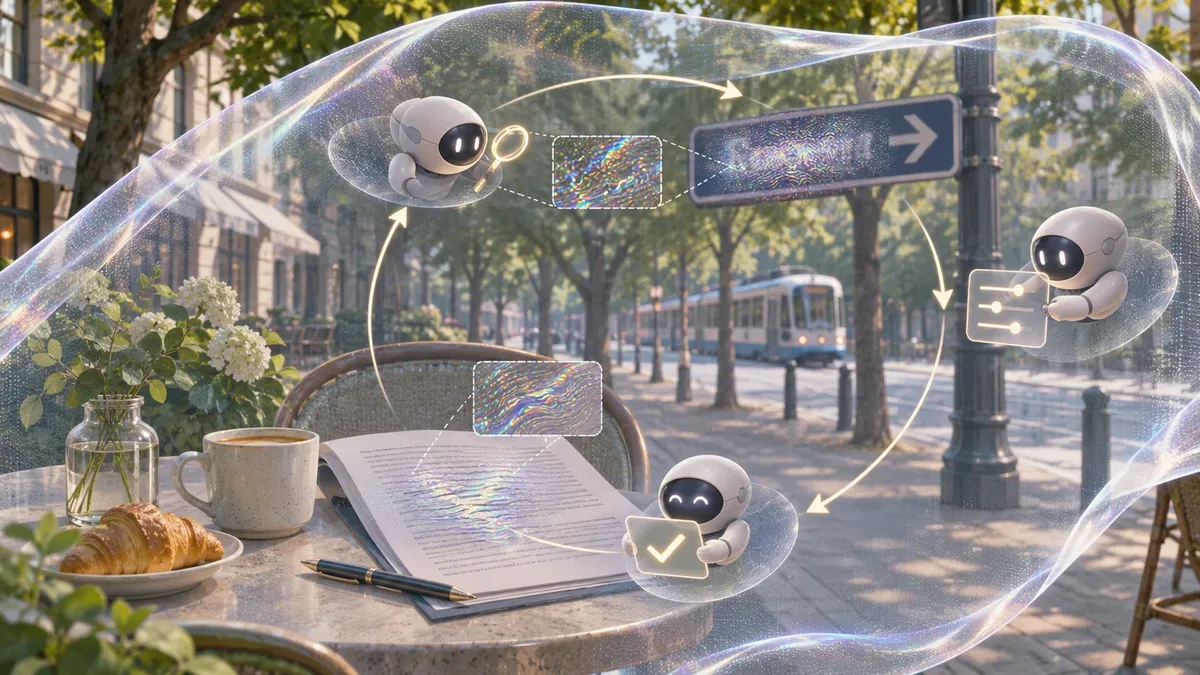
A photo can reveal more than its subject: signs may expose a location, documents may contain identifiers, and faces or medical images may carry personal attributes. SecretAgent is a proposed method for making those clues harder for vision-language models to read without visibly altering the image. Its tests are promising, but the protection is not a guarantee against every model or against information pieced together from multiple images.
Vision-language models (VLMs) can answer questions about images, including questions that reveal where a picture was taken or what personal information it contains. That creates a privacy problem for people who want to share an image but do not want automated systems to infer everything it shows. A common technical defense is to add a small, carefully designed change, or perturbation, to the image. But a defense that leaves conspicuous visual noise may undermine the reason for sharing the picture in the first place.
The authors of SecretAgent ask whether image perturbations can make private details harder for VLMs to recover while keeping the image looking much the same to a person. Their central idea is to use several language-model agents in a feedback loop: assess what information the target model can still extract, plan where to make changes, and reject candidate images that an appearance reviewer judges visibly altered.
A feedback loop for targeted changes
SecretAgent has four roles. A Privacy Assessor queries the target VLM about specified private details and records its answers and the visual clues it cites. A Planner uses this history to choose regions for protection, while a Configurator sets numerical parameters for the changes. An Appearance Reviewer checks each candidate and rejects those with visible artifacts. After a fixed number of rounds, the system selects the most protective candidate that passed review—or returns the original image if none qualifies.
The study evaluates two ways to make those changes. SecretAgent-Gradient uses six frozen image encoders as surrogates, optimizing a perturbation to encourage transfer to models whose internal weights are unavailable. SecretAgent-Tool does not use gradients to construct the perturbation; it combines procedural noise patterns and adjusts their parameters. Both variants are constrained by a perturbation budget, limiting how much pixel values can change.
Tests covered four privacy applications—geolocation, personally identifiable information (PII), facial attributes, and medical-image attributes—across five datasets. The researchers evaluated privacy against six VLMs and visual fidelity using four image-comparison measures and an AI-based appearance judge. For medical images, they used a separately fine-tuned MedGemma model as a stronger adversary because the unadapted model recovered some attributes poorly.
Promising results, with important qualifications
The paper reports that SecretAgent ranked first on 14 of 15 privacy metrics for the defended model, and that its two variants performed best on several visual-fidelity measures across the five datasets. The authors also report that the protection transferred to other tested VLMs. The results support the idea that targeting clues identified by a model can be more effective than applying changes without feedback about what evidence the model uses.
The variants involve a trade-off. SecretAgent-Gradient is designed to transfer across models using surrogate encoders; SecretAgent-Tool avoids gradient-based construction and achieved the best perceptual fidelity on three of the five datasets, according to the abstract. The paper also reports that increasing the perturbation budget strengthened protection in one ablation while increasing measured image change. That is a reminder that privacy and appearance are competing goals, not a single score that can be maximized without compromise.
These findings should be read as benchmark results, not proof that images are private in general. The system protects images one at a time. The authors explicitly leave open whether an adversary could combine clues across multiple images or videos of the same person. It also uses a fixed number of search rounds for every image, even though some may need more work than others, and the process requires repeated model queries. A passing appearance review does not establish that every viewer will find a change invisible.
The evaluation covers particular datasets, questions, models, and settings; success against those tests cannot establish protection against all future VLMs or other ways of analyzing images. Some reported results also differ by task: for example, the supplementary material says no method reduced gender accuracy on the facial dataset below 95%. The paper’s broad claims should therefore be understood alongside task-specific results and limits.
SecretAgent is described in an arXiv preprint, a research manuscript that may not have undergone peer review. The findings are the authors’ reported experimental results, not independent confirmation. For now, the work offers a useful research direction: make privacy protection responsive to the clues an AI actually uses, while measuring the visual cost rather than treating it as an afterthought.
- vision-language models
- image privacy
- adversarial perturbations
- multi-agent AI
- visual fidelity
- privacy protection
Related reading
Automatically matched by shared topic keywords. These links do not imply that the sources agree or establish a consensus.
When AI Rebuilds a Document, Looking Right Is Not the Same as Being Right
Source published
Shared keywords: visual fidelity
EvoWorld tests whether AI-generated worlds can change while the camera looks away
Source published
Shared keywords: vision language models
Can Rewritten Captions Make an AI Stop Recognizing a Face?
Source published
Shared keywords: vision language models
A New Way to Keep AI Agent Teams on Task
Source published
Shared keywords: multi agent ai
AI agents organize thermoelectric research records—and reveal why traceability matters
Source published
Shared keywords: multi agent ai