TRANSMISSION // 2611.26925v1
A fairer way to compare quantum-key hardware
Source published
A proposed pair of metrics separates QKD equipment performance from fibre loss and channel noise, tested against published experiments and measurements from four systems.
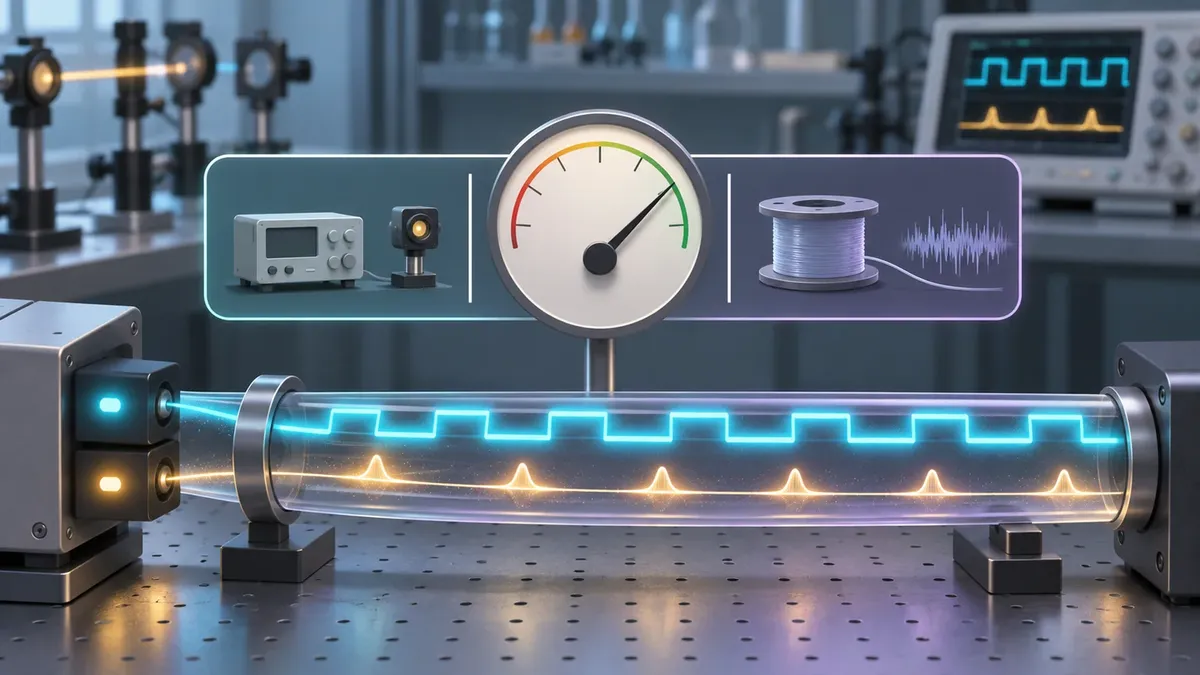
A high secret-key rate can reflect good hardware—or simply a shorter, quieter link. Researchers propose metrics to help distinguish the two, while showing where those metrics stop being reliable.
Quantum key distribution (QKD) uses quantum signals to help two parties create a shared secret key. Its reported secret-key rate (SKR), usually measured in bits per second, is important for a working link—but comparisons between systems can be misleading. A high rate may come from a fast transmitter or capable equipment, but also from lower fibre loss or less interference from classical data traffic sharing the fibre.
A paper by Jerry Horgan and colleagues proposes two metrics to separate these influences. Their central question is practical: can researchers compare QKD hardware more fairly when experiments use different links, wavelengths, traffic loads and transmitter speeds?
Taking the link conditions into account
The authors write the SKR as the product of three factors: the transmitter’s pulse rate, the fraction of light that survives the channel, and a third term called the noise-normalised key rate (NNKR). In plain language, NNKR estimates how much secret key the system extracts per pulse that makes it through the fibre. It can be calculated from the SKR, transmitter clock rate and channel loss—four reported quantities in total when loss is specified by fibre attenuation and length.
The metric is designed to stay roughly constant as fibre loss changes, but only when a system is in a loss-limited operating range: the key rate must fall in proportion to the light surviving the channel. At low loss, detector saturation or processing limits can cap the rate. At very high loss, dark counts, detector afterpulses and noise from classical traffic can become significant compared with the arriving quantum signal. In either case, NNKR may no longer be flat. The paper develops a model linking the width of the flat range to detector noise and dead time.
A companion measure, implementation efficiency (IE), compares the observed key rate with the rate expected from ideal equipment on the same lossy, noisy channel. That makes it a different kind of comparison: unlike NNKR, IE includes a model of channel noise, including noise associated with classical traffic.
Testing the metrics
The researchers applied the metrics to ten published experiments in which quantum and classical signals shared fibre. They also analysed 42,115 measurements collected during attenuation sweeps across four QKD systems from two vendors, plus data from four high-rate laboratory systems. For one production system, they compared measurements with and without classical traffic injected into the fibre.
The main testbed result was a 17-decibel range of attenuation over which one production system’s NNKR varied little: its coefficient of variation was 6.9%. Its value also agreed within 0.7 dB with three of four published deployments of the same platform. These checks support the idea that, within the measured loss-limited range, NNKR captures a relatively stable property of the implementation rather than the link’s changing loss.
For that platform, the coexistence measurements found NNKR and IE within 0.5 dB of their standalone values over the tested conditions. This is evidence about this system and experiment, not a general guarantee that classical traffic never affects QKD. The authors also report that the model reproduces measured curves for two systems with residual errors of 0.28–0.33 dB, and that a component-by-component estimate for one laboratory system agrees with its measured secure fraction within 0.3 dB.
What the numbers do—and do not—say
The metrics offer a useful way to separate equipment performance from channel conditions, and the authors present NNKR in decibels as a sum of component penalties, much like a conventional optical link budget. But neither number replaces the SKR: operators still need to know how many secret bits a particular link delivers. The paper also notes that NNKR’s loss-normalisation depends on how a protocol’s key rate scales with transmission; the usual version is not flat for every QKD protocol. IE, meanwhile, depends on the chosen noise model and reference assumptions. For example, the paper’s comparison uses a single-mode reference receiver, while real receivers may collect more modes.
These results come from a research paper posted as an arXiv preprint. The manuscript says it is under review at the IEEE Journal of Lightwave Technology; that is not the same as having completed peer review. The reported testbed data and analysis support the authors’ proposed approach, but broader independent tests across systems, protocols and operating conditions would help establish how consistently the metrics work in practice.
- quantum key distribution
- QKD benchmarking
- quantum communication
- optical fibre
- secret-key rate
- classical-quantum coexistence
Related reading
Automatically matched by shared topic keywords. These links do not imply that the sources agree or establish a consensus.
Before quantum keys, Sweden’s fiber links need a checkup
Source published
Shared keywords: quantum communication, quantum key distribution
Quantum grid codes could extend direct secure messaging beyond 1,000 kilometres
Source published
Shared keywords: optical fibre, quantum communication
Frequency-bin experiment tests fast secret-sharing correlations
Source published
Shared keywords: quantum communication
When a quantum key begins with incomplete clues
Source published
Shared keywords: quantum communication, quantum key distribution
A quantum-key proposal puts the difficult measurement in the middle
Source published
Shared keywords: quantum communication, quantum key distribution