TRANSMISSION // 2611.26919v1
A way to change search models without rebuilding the index
Source published
ERA maps queries from one embedding model into another model’s existing search index, with selected queries sent to the index’s original encoder. Five BEIR benchmarks test the approach, with mixed results and clear limits.
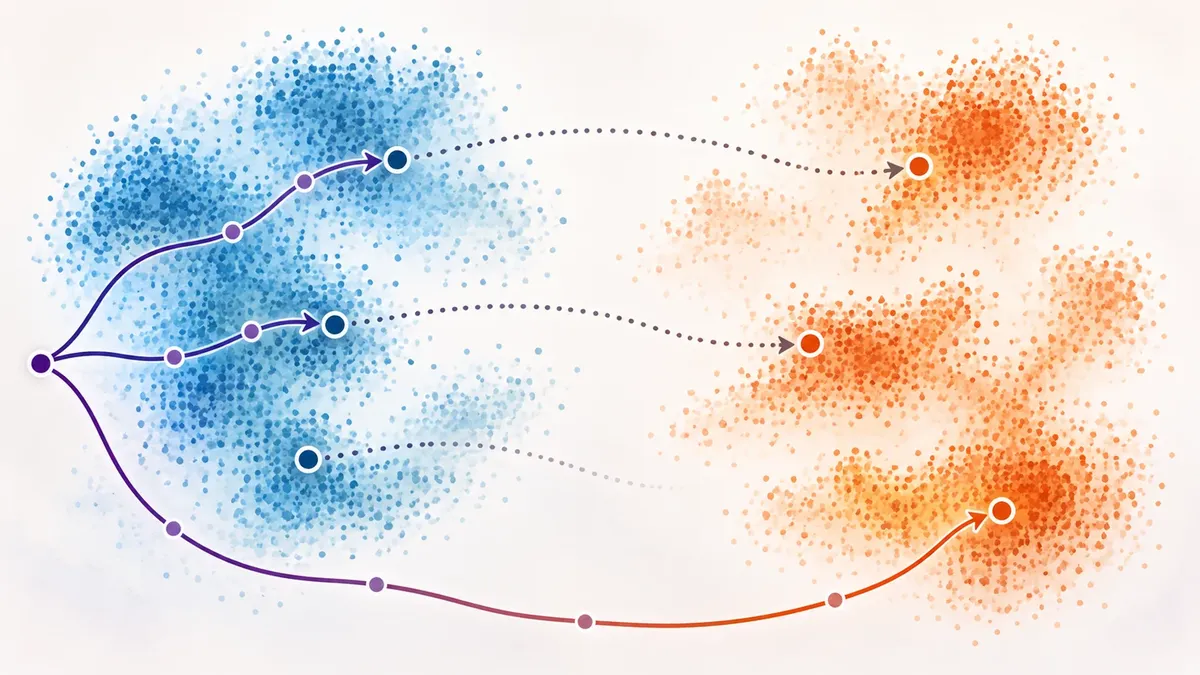
Changing a search system’s embedding model can require rebuilding its index. ERA tries a different route: learn an approximate mapping between the models’ vector spaces, then send some queries directly to the index’s original encoder. Tests on five benchmarks show potential, but leave questions about performance beyond the tested settings.
A search system built with text embeddings uses vectors to match queries with documents. For meaningful inner-product retrieval, query and document vectors need to be in a compatible space. Change the model that encodes queries, and the existing document vectors may no longer work well with them. Re-embedding a large corpus can be costly or impossible, for example when the documents are inaccessible or the index is managed by someone else.
A paper by Venkata Chivukula, Zifeng Wang and Jinsung Yoon presents ERA, short for Embed, Route, Adapt. It is designed to let a new query encoder search an existing index without rebuilding it. The focus is “cold start”: a setting with no query logs or relevance labels to guide learning.
Choose anchors, align vectors, route queries
ERA starts with anchors: documents selected from the existing index and embedded by both the index’s model and the new query model. The paired vectors provide examples of how the two spaces relate. To choose them, the authors use Cosine Farthest Point Sampling (FPS), which iteratively selects documents far from those already chosen in cosine similarity. It aims to cover distinct regions of the index with a limited budget, but does not guarantee that the selection is best for every corpus: the authors report cases where FPS spends a small budget on outliers and uniform sampling does better.
Next, an adapter projects vectors from the new model into the index’s space. The reported adapter is a two-layer multilayer perceptron (MLP) with a hidden dimension of 4096. Its training objective aligns the directions of paired vectors while discouraging projected vectors from collapsing into a narrow region. That spread matters because a projection that makes many vectors too similar could harm search rankings.
A router estimates which queries may be poorly represented after projection. It sends selected queries directly to the target model—the encoder associated with the existing index—while the rest use the projection. At cold start, the router is trained with anchor documents as stand-ins for queries. As unlabeled queries become available, ERA can adapt using them too.
Results depend on the comparison
The authors tested ERA on five English-language BEIR retrieval datasets: SciFact, FiQA, NFCorpus, Arguana and SciDocs. The experiments included two source query encoders mapped to an index built with Gemini’s embedding model. Retrieval quality was measured with nDCG@10, which rewards relevant documents appearing near the top of a ranked list.
In one specific comparison—after the Cold and Foundation adaptation phases, with routing turned off, for text-embedding-004 mapped to gemini-embedding-001—ERA’s alignment objective matched or exceeded a point-wise L2 baseline on all five datasets in ground-truth nDCG@10. The reported relative gains in this comparison included 35% on Arguana, 11.8% on FiQA and 5.4% on NFCorpus. These figures describe that setup, not a general improvement across every ERA configuration. The evaluation also compares how closely results match the target encoder’s rankings, a different measure from agreement with human relevance judgments.
An anchor-efficiency experiment compared FPS and uniform sampling at several budgets. Results were mixed across datasets and budgets: FPS improved some scores, while uniform sampling led in others, including SciDocs and some FiQA settings. The experiment used a single random seed, so it does not establish that either sampling strategy will consistently win across other corpora.
Routing also varied by dataset. At a nominal 20% escalation budget, the router selected a larger share of the highest-disagreement queries than a difficulty-agnostic allocation on SciFact and SciDocs. But those “huge-gap” groups were small: SciFact had eight such queries and SciDocs had 25. Arguana showed no improved capture of its huge-gap queries, and on FiQA the router captured fewer than the random allocation. The authors describe the router as a safety net for some settings, not as a reliably calibrated difficulty detector.
Latency estimates and limits
For one setup, the paper estimates query latency at about 38–86 milliseconds with a local source encoder and a nominal 20% escalation budget. The comparison point is a measured target-API round trip of about 160 milliseconds when calling that API for every query. This is not a like-for-like measurement of complete production systems: the ERA figures combine profiled local components with observed API round trips, and the actual escalation fraction varied by dataset.
The evidence comes from five English benchmarks, particular embedding models and tested configurations. The authors note that a projection cannot restore distinctions missing from the source encoder, that router calibration may drift when query distributions shift, and that multilingual retrieval and larger-scale corpora remain to be tested. The paper is an arXiv preprint; its benchmark results should be read as preliminary evidence, not proof that model changes can be made without loss in every real-world search system.
- information retrieval
- text embeddings
- vector search
- cold start
- BEIR benchmarks
- machine learning
Reviewed cross-references
These connections were reviewed by a model, not independently fact-checked by a human. Similarity does not imply agreement; consult the original papers and the evidence below.
More AI compute does not always make better recommendations
Shared method: Both systems use a lightweight routing stage to decide when to invoke a more costly path: ERA routes retrieval queries to the target encoder, while CascadeRec escalates recommendation requests to a more expensive reranking procedure. The routing targets and tasks differ, so this connection does not imply comparable performance or that either routing policy transfers to the other setting.
Model review: · openai-codex/gpt-6-luna
Evidence and provenance
Selected excerpts, not complete papers. PDF extraction can omit figures or damage equations, tables and reading order; sources may be preprints.
2611.26919v1 — Original paper
Excerpt reference:
static/papers/2611.26919v1.md:285-439
Basis: Paper text
Source SHA-256:c7f873771a952b24a5329bf635ce3b05b32653ae171c95f8874e9e018d5f5c392611.08566v1 — Original paper
Excerpt reference:
static/papers/2611.08566v1.md:77-128
Basis: Paper text
Source SHA-256:4b6c2f79881e30624b0da4d5bc2590a8da54d8343d9efab0ed867fcd17316e6f
Related reading
Automatically matched by shared topic keywords. These links do not imply that the sources agree or establish a consensus.
SpectRAG Connects the Dots Before an AI Writes an Answer
Source published
Shared keywords: information retrieval
An AI memory proposal would preserve organizational judgments, not just records
Source published
Shared keywords: information retrieval
Changing positional signals helps AI models retrieve overlooked evidence
Source published
Shared keywords: information retrieval
A Readable Index for Matching and Search
Source published
Shared keywords: information retrieval
One Energy Lens for Many Kinds of Machine Learning
Source published
Shared keywords: machine learning