TRANSMISSION // 2611.26918v1
A galaxy’s broad-line signal remains uncertain
Source published
A 20-year comparison of spectra from Seyfert galaxy IC 1495 finds a possible broad hydrogen line in 2024, but cannot show that the line appeared or changed since 2004.
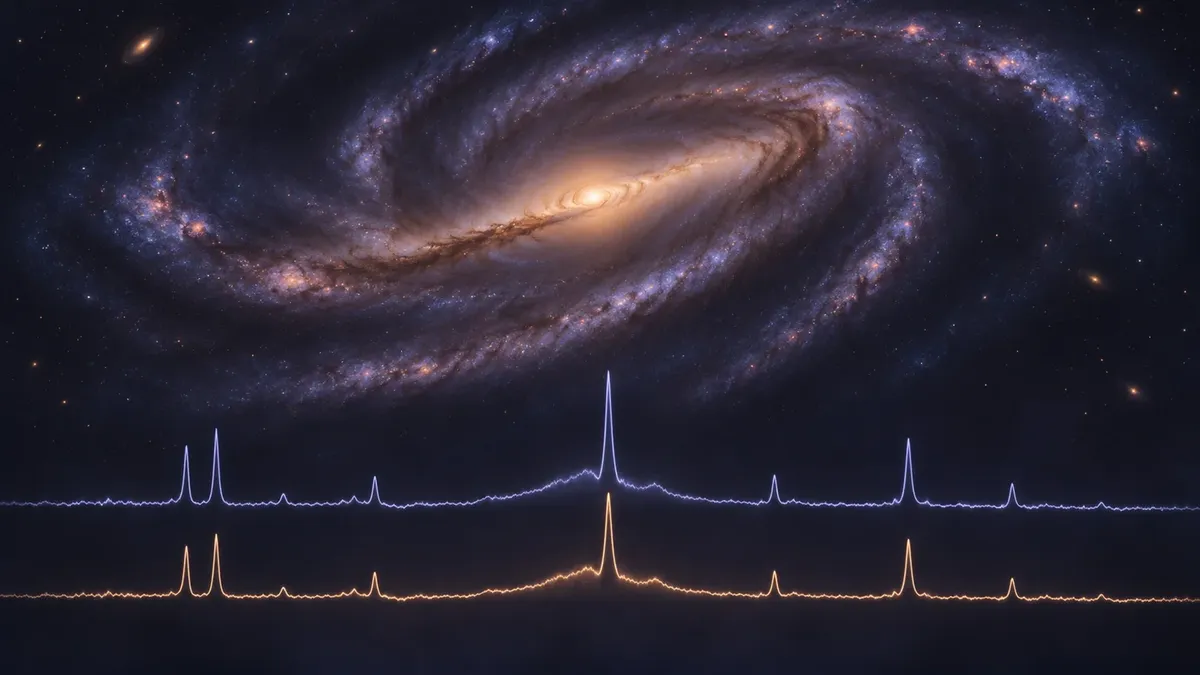
Two spectra of the same galaxy, taken nearly 20 years apart, seem to offer a test of whether its active nucleus changed. But the answer depends on how astronomers separate overlapping signals—and on what the older spectrum could have detected.
A disputed signal in IC 1495
At the centre of IC 1495, a barred spiral galaxy, an active galactic nucleus (AGN) produces radiation that can excite gas around it. Some of that gas emits hydrogen-alpha, or H-alpha, light. Gas close to the nucleus moves rapidly, making its emission line broad; more distant gas produces narrower lines. Detecting broad H-alpha can help astronomers classify a Seyfert galaxy and, if the signal changes over time, may reveal changes in its nucleus or the material obscuring it.
But published analyses of IC 1495’s 2004 spectrum disagree: one reported broad H-alpha, while another classified the same spectrum as lacking it. The new study revisits that observation and compares it with a spectrum taken in 2024. Its central question is whether either spectrum requires a broad-line component—and whether the observations establish a change in its visibility.
Testing different explanations
The researchers analysed the 2004 6dFGS and 2024 SDSS-V/BOSS spectra separately, accounting for their instrumental resolution and fitting the galaxy’s stellar light before measuring emission lines. In the newer spectrum, they first examined forbidden lines such as [O III], [S II] and [O I]. These can reveal how the narrower gas is moving and help test whether structure in the H-alpha region might be explained without a broad hydrogen line.
For the blended H-alpha and [N II] features, the team compared six models. The models differed in how they treated the motion of narrow-line gas and whether they included an additional broad H-alpha component. They used the Bayesian information criterion (BIC), which balances how well a model fits the data against the number of parameters it uses. They also simulated spectra: some contained no broad line, to test false detections; others contained a line of specified width and strength, to see how often the analysis recovered it.
Evidence for a candidate, not a verdict
The 2024 [O III] profile favoured a blueshifted wing, with an intrinsic width of about 640 kilometres per second. Single-component fits were preferred for [S II] and [O I] at the available sensitivity. This suggests that different emission lines need not share the same gas motions—a relevant complication when modelling the overlapping H-alpha and [N II] features.
Among six H-alpha models with freely fitted narrow-line motions, the lowest-BIC fit included broad H-alpha, with an intrinsic width near 2,000 kilometres per second. Yet the result was not robust to every modelling choice. When H-alpha and [N II] were instead allowed two narrow components that shared their motions, adding broad H-alpha worsened the BIC. The authors therefore describe the 2024 feature as a candidate, not a secure detection.
The 2004 spectrum did not meet the study’s criterion for detecting broad H-alpha. That alone does not show the line was absent. In baseline simulations, a reference line—about 1,930 kilometres per second wide and with broad-to-narrow H-alpha flux of 0.82—was recovered in 27–35% of trials. Across the tested configurations, recovery ranged from 11% to 55%. A stronger injected line was recovered more often in baseline tests, but even the tested signals could escape detection.
Why the comparison stays open
The spectra were collected through fibres of different sizes, which capture different amounts of the galaxy’s starlight and surrounding narrow-line emission. The 2004 spectrum also has flux-calibration limitations. These factors complicate comparisons of absolute line strength, while the simulations estimate detectability only for specified line profiles, model choices and noise assumptions. They cannot prove what the nucleus was doing between the two observing dates.
Other evidence supports the presence of an absorbed, variable Seyfert nucleus independently of the disputed broad line: the narrow-line excitation, an X-ray spectrum consistent with substantial absorption in the study’s fiducial model, and long-term optical and infrared variability. This context does not settle whether broad H-alpha was visible in either spectrum.
The authors conclude that the available data do not establish a change in broad-line visibility, or a “changing-look” transition. The work is a preprint, and its model-dependent result should be read with that status in mind. Repeat spectroscopy with better-matched apertures, resolution and flux calibration could test whether the 2024 candidate persists.
- IC 1495
- Seyfert galaxy
- broad H-alpha
- active galactic nuclei
- spectroscopy
- changing-look AGN
Reviewed cross-references
These connections were reviewed by a model, not independently fact-checked by a human. Similarity does not imply agreement; consult the original papers and the evidence below.
Ansky’s galaxy shows signs of black-hole activity before its 2019 brightening
Shared method: Both studies use optical emission-line ratios in BPT diagnostics to assess nuclear gas excitation: IC 1495’s 2004 ratios place it in the AGN/Seyfert regions, while the Ansky study uses spatially resolved BPT diagrams to distinguish excitation zones. The comparison is methodological, not evidence about broad H-alpha; the measurements differ in spatial resolution and target.
Model review: · openai-codex/gpt-6-luna
Evidence and provenance
Selected excerpts, not complete papers. PDF extraction can omit figures or damage equations, tables and reading order; sources may be preprints.
2611.26918v1 — Original paper
Excerpt reference:
static/papers/2611.26918v1.md:463-530
Basis: Paper text
Source SHA-256:7083a16d46d4575da45c9b05d4e2df76f7a4dc30838b1958d59ead8dd881b5b12607.00921v2 — Original paper
Excerpt reference:
static/papers/2607.00921v2.md:726-841
Basis: Paper text
Source SHA-256:6d2ec604f966f99117f8f151455919ee8e2977a8d85de2fb25b86cdbdb2bd7e7
Related reading
Automatically matched by shared topic keywords. These links do not imply that the sources agree or establish a consensus.
What sets the edge of a black hole’s warm corona?
Source published
Shared keywords: active galactic nuclei
Which galaxies could a global neutrino network reveal next?
Source published
Shared keywords: active galactic nuclei
How Much Light Comes from Gas Around Active Black Holes?
Source published
Shared keywords: active galactic nuclei
Quasar winds reach across galaxies—and may contain several distinct flows
Source published
Shared keywords: active galactic nuclei
Galactic Gas May Preserve Traces of Fading Black Hole Activity
Source published
Shared keywords: active galactic nuclei