TRANSMISSION // 2611.26912v1
Can AI scripting agents learn from their own EDA mistakes?
Source published
ZhuLong-SE stores lessons from earlier electronic-design scripting tasks and checks them before reuse. In one benchmark, its self-evolving version modestly exceeded a human-written-knowledge baseline, but the evidence is limited.
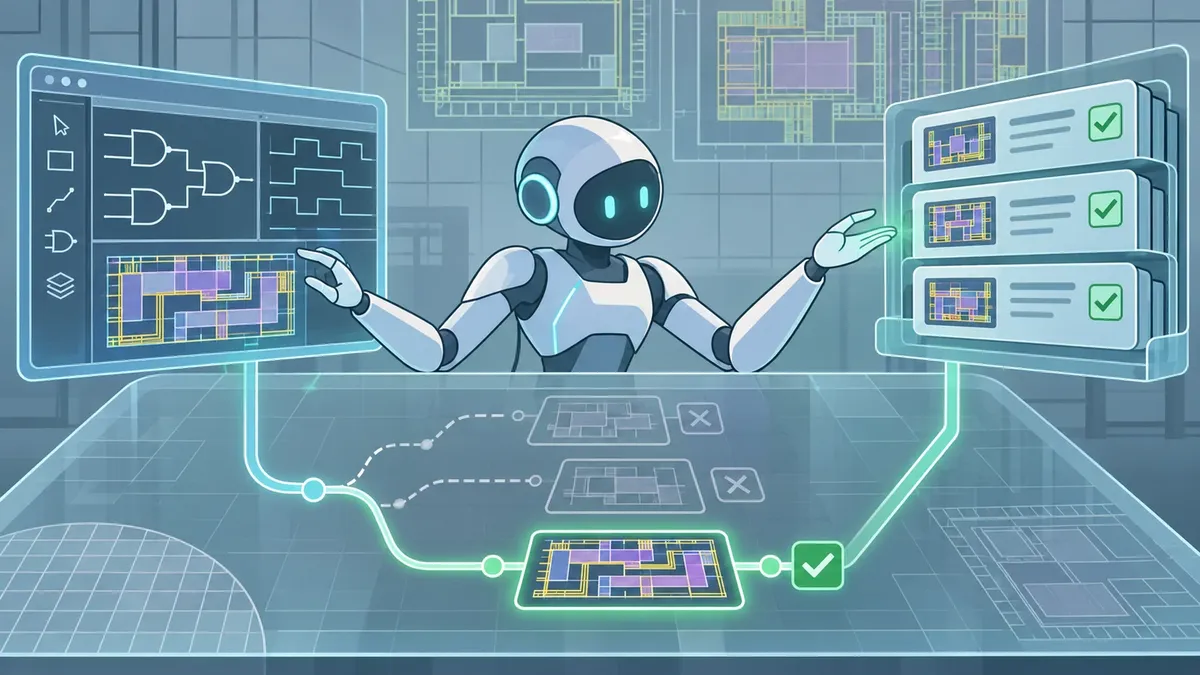
Electronic-design tools can be difficult to script: their APIs may be poorly documented, and mistakes can fail silently. A preprint introduces ZhuLong-SE, an AI agent that tries to turn past task attempts into reusable, checked guidance. Its results suggest promise on a particular benchmark—not yet a general solution for EDA scripting.
Writing scripts for electronic-design-automation (EDA) tools can be a surprisingly fragile part of designing chips and other electronic systems. Tool APIs may be proprietary or sparsely documented, and a script can fail through a cryptic exception—or appear to run while producing the wrong result. Hand-written tips can help, but they take effort to maintain as tools change.
A new preprint asks whether an AI agent can learn useful guidance from its own earlier attempts. The authors present ZhuLong-SE, a large-language-model (LLM) agent for scripting PyAether, an EDA tool interface. Rather than updating the underlying language model, the system collects execution records, distills selected lessons into a memory store, and makes those lessons available on later tasks.
From task attempts to checked memory
The system combines two kinds of improvement. Its task-level harness helps the agent solve an individual scripting problem: it retrieves API information, provides documentation, runs code in an isolated sandbox, and applies static checks for certain coding mistakes. The researchers also add a self-evolution layer that processes earlier task traces into a three-tier memory: raw records, aggregated patterns, and more general skills.
The memory is governed by checks because a plausible lesson can still be wrong. The system anchors reflection to the benchmark evaluator’s pass-or-fail result, filters some disconfirmed entries, and tests updated memory on held-out validation tasks. If a new round reduces validation performance beyond a set tolerance, the system rolls it back. To reduce the chance that memory simply supplies answers to similar held-out questions, it limits what is retrieved: for example, it can provide API names without reproducing a full sequence of calls.
The team evaluated the system on EDA-Eval-PyAether, a benchmark of 158 scripting tasks. A task counted as passed when the submitted code satisfied a hidden test in the sandbox. In comparisons across five language-model backbones, the enhanced task-level harness—without self-evolution—outperformed the earlier ZhuLong system on each tested backbone. On the primary model, its pass@1 was 92.4%, meaning the first attempt passed on that share of tasks in the reported run. These gains reflect the combined harness changes, not learned memory alone.
To test self-evolution separately, the researchers used an instance-disjoint challenge split: training, validation, and test tasks were separated, with 40 tasks in the test set. Starting without either learned memory or human-written experience, the agent reached a mean test pass@1 of 80.0% after two rounds of evolution, compared with 77.5% for a baseline equipped with experience written by an EDA engineer. The bare starting configuration scored 66.0%. A third evolution round fell to 75.5%, and the validation-based gate rejected it. The authors report averages across five runs for this challenge evaluation; the 2.5-percentage-point difference between the two final baselines is therefore a result on this particular split, not evidence that self-evolution will generally beat expert guidance.
The failures and ablations also reveal limits. Across harness runs, many remaining failures involved results that violated hidden test properties even when execution reached the verifier; the static checker targets certain API misuse, not general functional correctness. In a validation ablation, injecting pitfalls before the agent encountered a relevant error reduced pass@1 by 8 percentage points. The study’s frozen-trace analysis could not establish the value of every memory safeguard: for example, its design did not test multi-round disconfirmation, and entry counts could not assess some changes in the content of lessons.
These findings are promising but narrow. The evaluation centers on one scripting interface and benchmark, and the authors say they obtained the benchmark from its creators. The strongest self-evolution comparison uses only 40 test tasks, and the difference from the human-crafted baseline is modest. The article is a preprint, which may not have undergone peer review; benchmark results also cannot establish how the method would perform with different EDA tools, languages, or real design workflows. The work shows a carefully governed way to reuse scripting experience—and why such memory needs testing—not that an agent can independently design reliable chips.
- electronic design automation
- EDA scripting
- AI agents
- large language models
- self-evolving systems
- software testing
Reviewed cross-references
These connections were reviewed by a model, not independently fact-checked by a human. Similarity does not imply agreement; consult the original papers and the evidence below.
Can AI agents improve chip designs after synthesis has done its work?
Shared method: Both systems reuse knowledge from prior tool-grounded task traces without describing model-parameter updates: ZhuLong-SE distills execution traces into gated memory for future EDA scripting, while Dr. RTL distills optimization experiences into reusable skills for later RTL searches. Their tasks and evaluation signals differ—hidden-test pass/fail versus implementation metrics with sequential-equivalence checks—so this connection does not imply comparable performance.
Model review: · openai-codex/gpt-6-luna
Evidence and provenance
Selected excerpts, not complete papers. PDF extraction can omit figures or damage equations, tables and reading order; sources may be preprints.
2611.26912v1 — Original paper
Excerpt reference:
static/papers/2611.26912v1.md:66-130
Basis: Paper text
Source SHA-256:38a3e6308fb64b591f4d72f16087b320f3f2c32762e4622323060e27285e296d2611.13713v1 — Original paper
Excerpt reference:
static/papers/2611.13713v1.md:333-431
Basis: Paper text
Source SHA-256:2b9629e949ed0fa13ef9d1066ba920b53fe2c28c3a036d6395e76593a81d13ce2611.13713v1 — Original paper
Excerpt reference:
static/papers/2611.13713v1.md:432-482
Basis: Paper text
Source SHA-256:2b9629e949ed0fa13ef9d1066ba920b53fe2c28c3a036d6395e76593a81d13ce
Related reading
Automatically matched by shared topic keywords. These links do not imply that the sources agree or establish a consensus.
ChipOmni uses engineering checks to guide AI chip design
Source published
Shared keywords: ai agents, electronic design automation
Can AI agents improve chip designs after synthesis has done its work?
Source published
Shared keywords: ai agents, electronic design automation
An AI agent helps design a sub-terahertz transmitter—with human oversight
Source published
Shared keywords: ai agents, electronic design automation
Can AI Agents Design a Working Chip Layout? A New Benchmark Tests the Hard Part
Source published
Shared keywords: ai agents, electronic design automation
AgentTrustCI checks the paths AI agents take, not just their answers
Source published
Shared keywords: ai agents, software testing