TRANSMISSION // 2611.26909v1
Can AI help choose the right moment to pit in Formula 1?
Source published
Researchers compared reinforcement-learning agents with a mathematical optimizer for Formula 1 pit-stop strategy. In their abstract, PPO performed best in race simulations and replays, but the results depend on the evaluation setup.
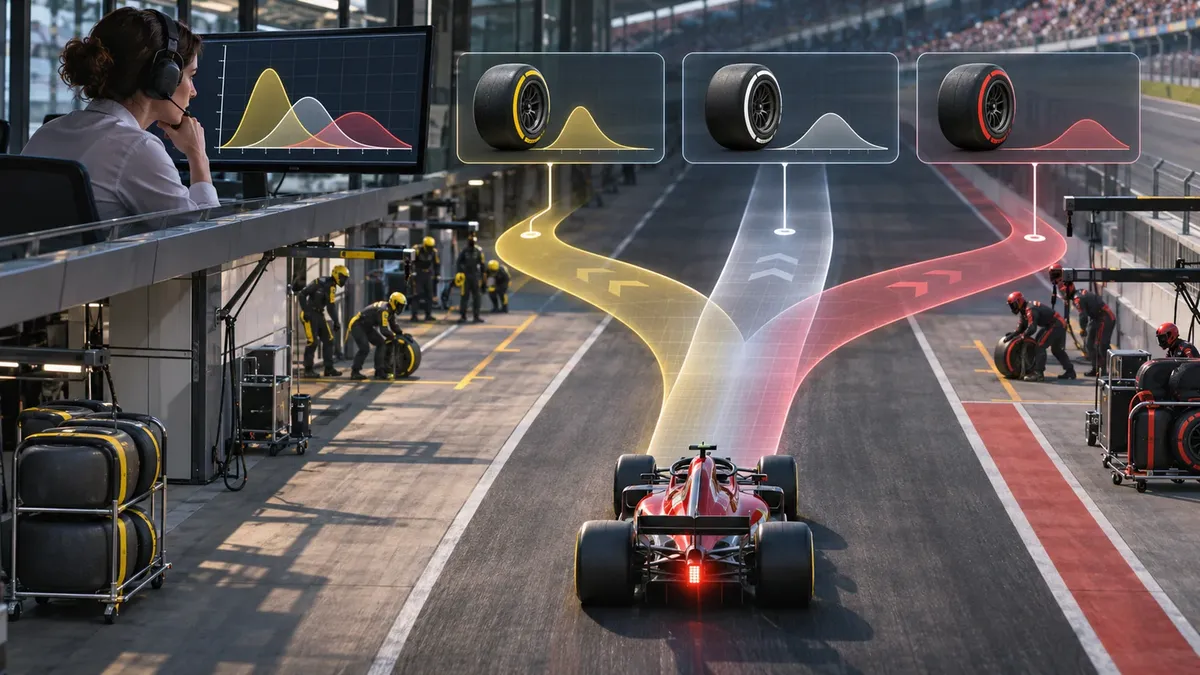
A Formula 1 pit stop is a decision made amid changing tires, rivals and race events. A new preprint tests whether reinforcement-learning systems can help strategists choose when to pit and which tire compound to use—and whether they can outperform a mathematical optimization approach.
In Formula 1, a pit stop is more than a quick tire change. Choosing when to stop, and which compound to fit, can shape a driver’s position as tires wear, competitors make their own stops and unpredictable events disrupt the race. The researchers frame this as a sequential decision problem: at each lap, a strategy must account for what has happened and what may happen next.
Felipe Méndez and Charles Thraves describe a data-driven simulator calibrated with historical race data. According to the paper’s abstract, it represents tire degradation, recent driver performance, overtaking, yellow-flag events and rival pit-stop decisions. The researchers trained agents using five deep reinforcement-learning algorithms. They also compared those agents with a quadratic mixed-integer programming (QMIP) formulation, a mathematical optimization method that they describe as optimal in deterministic, single-driver settings.
That distinction matters. A mathematically optimal strategy for a simplified, predictable situation is not necessarily best when a full grid and uncertain events are involved. The study evaluates the approaches under both conditions: without uncertainty or competition, and with competitors and stochastic race events. It also reports replaying actual 2024 races, using those races as test scenarios.
What the abstract reports
In the simplified setting, all the tested reinforcement-learning methods except TRPO achieved near-optimal performance, the authors report. In the more complex evaluations, however, the ranking depended on the setting. Proximal Policy Optimization (PPO) and its recurrent variant were the only methods said to improve on QMIP both in fully simulated races and in replays of actual 2024 races.
Across eight circuits, the abstract reports that PPO improved on QMIP by an average of 0.33 positions in fully simulated races and 0.49 positions in race replays. Recurrent PPO improved by less. In the replay evaluation, PPO also finished 0.66 positions ahead of the drivers’ actual strategies as simulated in those same races. These are average position differences reported by the authors, not guarantees about the result of any particular race.
The authors note that QMIP performed similarly to other methods despite being unable to anticipate yellow-flag events. That finding is a reminder that the more elaborate learning approach did not dominate every comparison. The abstract does not provide enough detail to assess how sensitive these results are to simulator assumptions, training choices or the range of race conditions tested.
A tool for strategists, not just a single answer
The researchers also describe using the trained PPO policy as a “look-ahead” decision-support tool. Rather than simply naming one recommended action, it presents a distribution of possible race outcomes for each candidate pit-stop action. In principle, that could help a strategist compare options while retaining human judgment. Applied retrospectively to eight 2024 races, the tool identified laps where the actual decision, its recommendation or a third option was preferable, according to the abstract.
This is retrospective analysis, not evidence that the tool has been used successfully in live race operations. Race outcomes are uncertain, and a simulator can only represent the factors and interactions built into it. The abstract does not report whether recommendations were tested in real time or how they would perform under conditions that differ from the historical data.
There are other limits to what can be concluded from the available evidence. This article is based on the preprint’s abstract, not a full-paper review; details about the experiments, definitions and statistical uncertainty are therefore unavailable here. The authors’ reported averages should be read as results of their stated evaluations, not as proof that AI will generally outperform race strategists. The work is an arXiv preprint, which may not have been peer reviewed. Its central contribution, as described in the abstract, is a comparison of decision methods and a possible way to show strategists the range of outcomes associated with different pit-stop choices—not an autonomous replacement for them.
- Formula 1
- pit-stop strategy
- reinforcement learning
- PPO
- race simulation
- decision support
Reviewed cross-references
These connections were reviewed by a model, not independently fact-checked by a human. Similarity does not imply agreement; consult the original papers and the evidence below.
When fewer missed deadlines is the wrong goal for an AI scheduler
Shared method: Both studies benchmark reinforcement-learning policies against an exact optimization solution: the Formula 1 study uses a QMIP benchmark, while the offloading study uses dynamic programming. This is a shared evaluation approach, not evidence that their results transfer across domains; the systems, objectives, and benchmark methods differ.
Model review: · openai-codex/gpt-6-luna
Evidence and provenance
Selected excerpts, not complete papers. PDF extraction can omit figures or damage equations, tables and reading order; sources may be preprints.
2611.26909v1 — Original paper
Excerpt reference:
static/papers/2611.26909v1.md:13-53
Basis: Paper text
Source SHA-256:a38463dcb2509b73b7fa1abc9491167d6ce24908e95facb6fbe613ec14a1d20b2611.10638v1 — Original paper
Excerpt reference:
static/papers/2611.10638v1.md:15-49
Basis: Paper text
Source SHA-256:f633fb9a7e610b7ca3344188f2674f8cf2a0dfef4fd38635ef957179c19a3534
Related reading
Automatically matched by shared topic keywords. These links do not imply that the sources agree or establish a consensus.
When fewer missed deadlines is the wrong goal for an AI scheduler
Source published
Shared keywords: reinforcement learning
A different way to steady reinforcement learning updates
Source published
Shared keywords: reinforcement learning
Learning chemotherapy schedules from patient records: a small study with major limits
Source published
Shared keywords: reinforcement learning
Teaching a jamming detector to act without hindsight
Source published
Shared keywords: reinforcement learning
A Better Timetable for Training Reasoning AI
Source published
Shared keywords: reinforcement learning