TRANSMISSION // 2611.26902v1
Can a large vision model use a smaller model’s visual memory?
Source published
Baton maps a smaller vision-language model’s cached video history into a form a larger model can use. In benchmark tests, this handoff approached rewatching accuracy with less compute, though results depend on the setup.
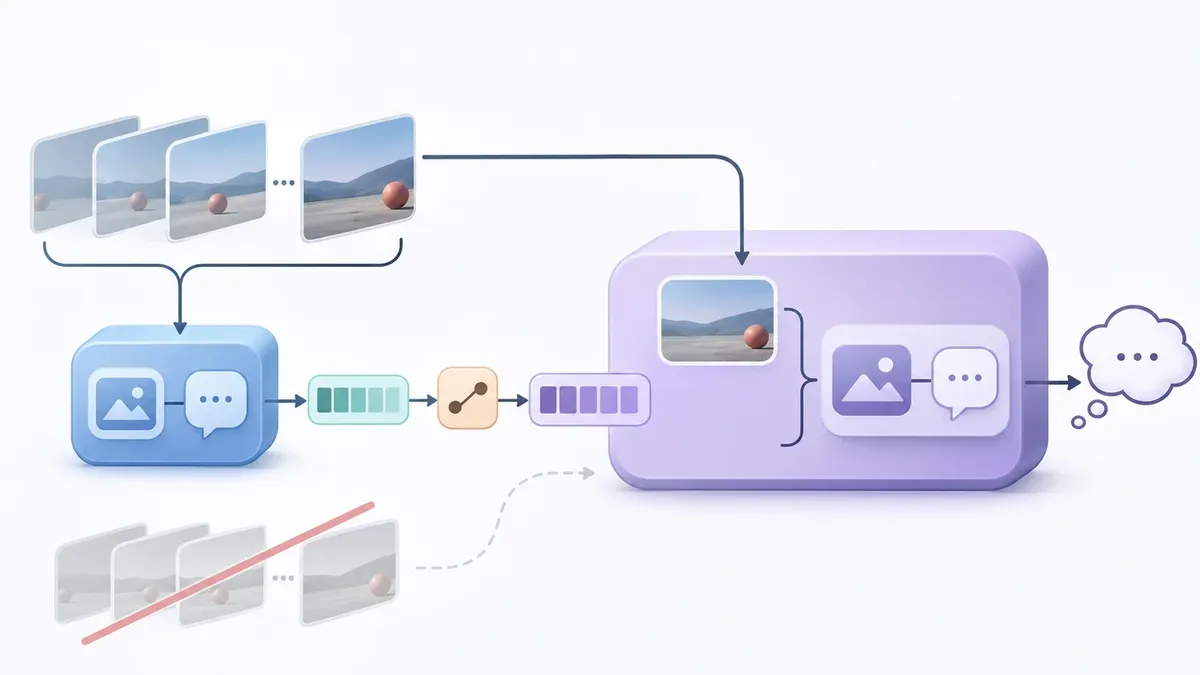
When a robot asks a larger AI model for help, that model may have to process the video history all over again. Baton attempts to pass along the smaller model’s existing visual memory instead.
A robot moving through a scene may need to remember where it last saw an object or how things changed. One approach is a cascade: a smaller vision-language model (VLM) processes video continuously, and a larger model steps in when the smaller one seems uncertain. But the larger model ordinarily has to process the history again. The paper reports that, at 64 frames, re-encoding accounts for most of an escalation’s compute cost.
The researchers ask whether the larger model can instead use the smaller model’s existing memory. A transformer’s key-value (KV) cache is a set of cached keys and values that later tokens use to attend to earlier inputs. Baton maps the smaller model’s cached representation into a form the larger model can read. The larger model still processes the current view itself, but need not re-encode the full history.
How that mapping is trained matters. A straightforward approach makes the smaller model’s cache resemble the cache the larger model would have built from the same video. In the reported tests, this close match did not improve on the smaller model’s answers. Baton instead trains a per-layer linear map using the larger model’s own responses as a signal. The models remain frozen, and no answer labels are used to train the map.
The main experiments used RoboMME, a benchmark of robot-manipulation tasks involving spatial, object, temporal and procedural memory. The researchers tested choices about what action to take and points indicating where to apply an action. In the main 2B-to-8B setup, on 16-frame histories, Baton improved over the smaller model alone by 2.9 percentage points for action choices and 1.9 points for pointing accuracy. The point result had a 95% interval of 0.2 to 4.1 points, and varied more across training runs: the reported mean gain was 1.0 point. Across four runs, the mean choice gain was 3.0 points.
Comparisons with alternatives depend on the measure and setup. For example, Table 2 reports that, on 16-frame histories, one method keeping half the visual tokens scored 88.0% on choice and 80.0% on pointing. Those results cannot be directly compared with Baton’s four-run mean scores: Table 1 reports a different test comparison, with Baton at 86.8–87.1% for choice and 80.6–82.4% for pointing across runs. The paper also evaluates shortened-video and text-memory approaches, among others. Taken together, the results are not a claim that Baton wins on every measure against every alternative; they show trade-offs that depend on the method and metric.
In a simulated cascade, the smaller model handled routine decisions and the larger one answered selected cases. For an 8B reader, the paper reports that Baton’s cascade used 72% of rewatching’s compute on 16-frame histories and 63% on 64-frame histories—28% and 37% less, respectively—while remaining within 0.5–1.0 accuracy points. For a 32B reader, it used 53% of rewatching’s compute, or 47% less, and was within 0.7 choice points; the point result was 1.3 points lower. Separately, for the Qwen3-VL 8B comparison, one escalation at 64 frames used eight times less compute than rewatching. These are benchmark measurements, not evidence that real robots will achieve the same savings in everyday use.
The authors tested additional model families and OpenEQA, a benchmark of questions about indoor scenes. They report transfer to OpenEQA without training on its questions. Their analysis suggests that the most useful mapping is not necessarily the one closest to the larger model’s own cache: changes in the middle third of its layers mattered especially to the answers. This is evidence about the tested models and tasks, not a universal account of how VLMs use memory.
There are important limits. The tested histories extend up to 64 frames, and each writer–reader pair needs its own trained map within a model family. The paper identifies longer streams, maps shared across readers and improved localization as open questions. Results depend on the benchmarks, models and configurations studied; lower measured compute does not by itself establish lower total deployment costs or better real-world task success.
The work is an arXiv preprint, which may not have undergone peer review. The source supports claims about the experiments reported, not a guarantee that Baton will work across robots, models or video tasks.
- vision-language models
- robotics
- video memory
- KV cache
- AI efficiency
- embodied AI
Reviewed cross-references
These connections were reviewed by a model, not independently fact-checked by a human. Similarity does not imply agreement; consult the original papers and the evidence below.
Teaching video models to write a better memory
Supporting evidence: Both studies report benefits from shaping a KV memory for its downstream use rather than simply preserving a model’s usual representation: Zhou et al. train a handoff map from a larger VLM’s answers, while Li and Zhu train a separate writer using gradients from later video segments. This is a bounded conceptual parallel, not a direct comparison: one concerns cross-model visual-history question answering on RoboMME, the other causal video generation with Wan2.1-1.3B.
Model review: · openai-codex/gpt-6-luna
Evidence and provenance
Selected excerpts, not complete papers. PDF extraction can omit figures or damage equations, tables and reading order; sources may be preprints.
2611.26902v1 — Original paper
Excerpt reference:
static/papers/2611.26902v1.md:134-258
Basis: Paper text
Source SHA-256:42ff4e64df66ba6f0d43bbc19f7c783ca350971c977943fe34aa3405b4a462792611.01648v2 — Original paper
Excerpt reference:
static/papers/2611.01648v2.md:89-149
Basis: Paper text
Source SHA-256:b55a8fe9998cae0d8c7980514f183391777fc186bd9431a699567ffd119158ea
Related reading
Automatically matched by shared topic keywords. These links do not imply that the sources agree or establish a consensus.
VoluCompose compresses medical scans for AI while preserving benchmark performance
Source published
Shared keywords: ai efficiency, vision language models
ScopeAct divides smartphone tasks between AI models
Source published
Shared keywords: ai efficiency, vision language models
AI coding agents build a robotics simulation benchmark
Source published
Shared keywords: embodied ai
WorldFlow predicts motion in both pixels and 3D
Source published
Shared keywords: embodied ai
Can a drone help a ground robot find the right vehicle?
Source published
Shared keywords: embodied ai