TRANSMISSION // 2611.26901v1
When Periodic Boundaries Complicate Magnetic Helicity
Source published
A mathematical analysis maps when magnetic vector potentials exist in periodic domains and explains why magnetic helicity can be difficult to interpret when net flux is present.
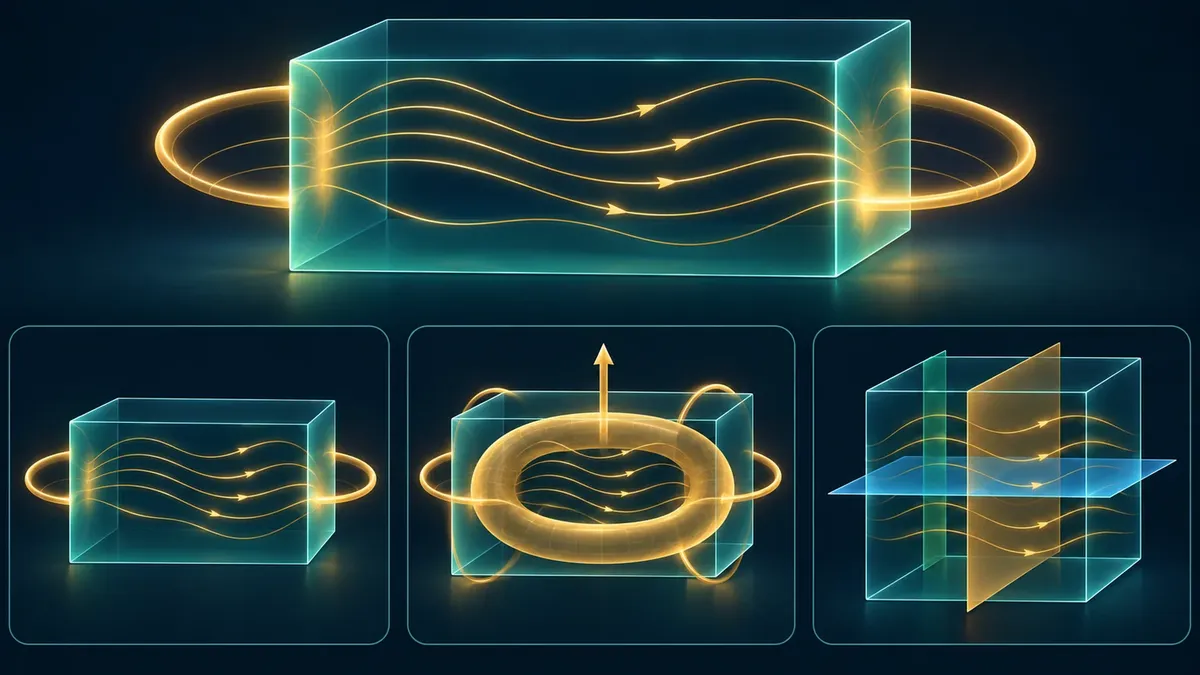
Periodic boundaries let a simulation treat one side of a box as connected to the opposite side. But the topology this creates can affect whether a magnetic field has a global vector potential—and what magnetic helicity calculated from that potential means. Simon Candelaresi’s theoretical study examines how the answer depends on the number of periodic directions and the field’s net flux.
Why ask whether a vector potential exists?
Magnetic fields are often represented as the curl of a vector potential, B = ∇ × A. The potential is a useful mathematical tool, and it appears in the standard magnetic-helicity integral, often used to describe features such as the winding and linking of magnetic field lines.
A divergence-free field does not necessarily have a global vector potential in every domain. Candelaresi asks how existence depends on a three-dimensional cuboid whose boundaries are periodic in one, two or three directions, and on the net magnetic flux through the domain. The question matters for calculations using periodic boxes and for understanding helicity in solar-related settings, though the paper does not claim periodic boundaries are common in solar studies.
Two ways to examine the problem
The author first pictures periodic domains as torus-like shapes and considers the electric currents needed to produce particular mean magnetic fields. The paper then uses differential forms, a mathematical framework that expresses the issue in terms of domain topology. In this description, a magnetic field corresponds to a closed form; a global potential exists when that form can be expressed as the derivative of another form.
The study also develops thought experiments about magnetic helicity and reports numerical calculations for specific magnetic-field configurations in a triply periodic box. These examples illustrate the mathematical issues. They are not observations of the Sun or laboratory measurements, nor do they establish that all periodic-box calculations are invalid.
The flux conditions depend on geometry
For the global potentials considered on the specified domains, the paper reports three results:
- With one periodic direction, a vector potential exists for any divergence-free magnetic field in the domain.
- With two periodic directions, a potential exists only if the net magnetic flux through the non-periodic direction is zero.
- With three periodic directions, the net flux must vanish through all three independent periodic planes.
The restrictions arise because periodic domains contain closed surfaces that cannot be smoothly shrunk to a point while remaining within the domain. Flux through the relevant surfaces determines whether a global potential can be defined. In the doubly periodic case, the relevant closed surface is a torus surrounding the domain’s inner cavity; its normal points along the remaining, non-periodic direction. In the triply periodic case, the conditions apply to each independent periodic plane.
The physical discussion gives another perspective: in the doubly periodic geometry, a mean field through the non-periodic direction would require a magnetic-monopole distribution in the torus-like representation. The paper treats this as an unphysical source. This argument motivates the mathematical restriction; it is not a report of monopoles being observed.
Why helicity can be ambiguous
When a vector potential does not exist, the usual helicity integral based on it cannot be defined as intended. But existence alone does not settle the interpretation. In examples with periodic boundaries and mean magnetic flux, the paper shows that freedom in choosing the potential can make calculated helicity values ambiguous. It also presents configurations related by a topology-preserving construction for which numerical calculations give different values. The author uses these examples to illustrate difficulties in assigning a straightforward field-line-linking interpretation to the calculated number, not to establish a general rule that such rearrangements change helicity.
The paper discusses the winding gauge as an alternative in the cases examined. In that framework, helicity has a geometric interpretation as flux-averaged magnetic-field-line winding. This is a qualified result for the settings considered, not a claim that every helicity definition or domain has this interpretation.
A further example concerns a non-periodic domain relevant to solar-field modeling. Magnetic flux can be nonzero at individual points on the boundaries even while the integrated flux is zero. The paper shows that an appropriate gauge transformation can make the usual magnetic helicity vanish; winding helicity is nonzero in the example when the field has twist. This illustrates sensitivity to the definition and boundary conditions—it does not show that solar helicity measurements generally vanish.
Scope and limitations
This is a theoretical analysis supported by constructed examples and numerical calculations, not an observational test or a survey of how researchers use periodic boundaries. Applying its conclusions to a particular simulation requires checking the domain, flux conditions and helicity definition. The supplied source is an arXiv preprint; journal-style formatting and an acknowledgment of referee comments do not by themselves establish publication or review status. Readers should check the source record for current status. This summary is based on the supplied paper text and does not independently reproduce the calculations.
- magnetic helicity
- vector potential
- periodic boundary conditions
- magnetic fields
- solar physics
- differential geometry
Related reading
Automatically matched by shared topic keywords. These links do not imply that the sources agree or establish a consensus.
Could axions reshape magnetic turbulence? A theoretical study links field-line geometry to energy spectra
Source published
Shared keywords: magnetic helicity, solar physics
Could a hypothetical gauge field help explain why matter survived?
Source published
Shared keywords: magnetic helicity
Listening to stellar pulses puts new limits on hidden magnetism
Source published
Shared keywords: magnetic fields
ALMA probes magnetic forces in a massive stellar nursery
Source published
Shared keywords: magnetic fields
How strong magnetic fields reshape electron screening
Source published
Shared keywords: magnetic fields