TRANSMISSION // 2611.26889v1
A Circuit That Models a Qubit’s Measurement
Source published
Researchers built an electrical analog computer to test a deterministic model of single-qubit measurement. It approximated Born-rule statistics, but the rule was built into the model—not derived—and the work does not resolve the measurement problem.
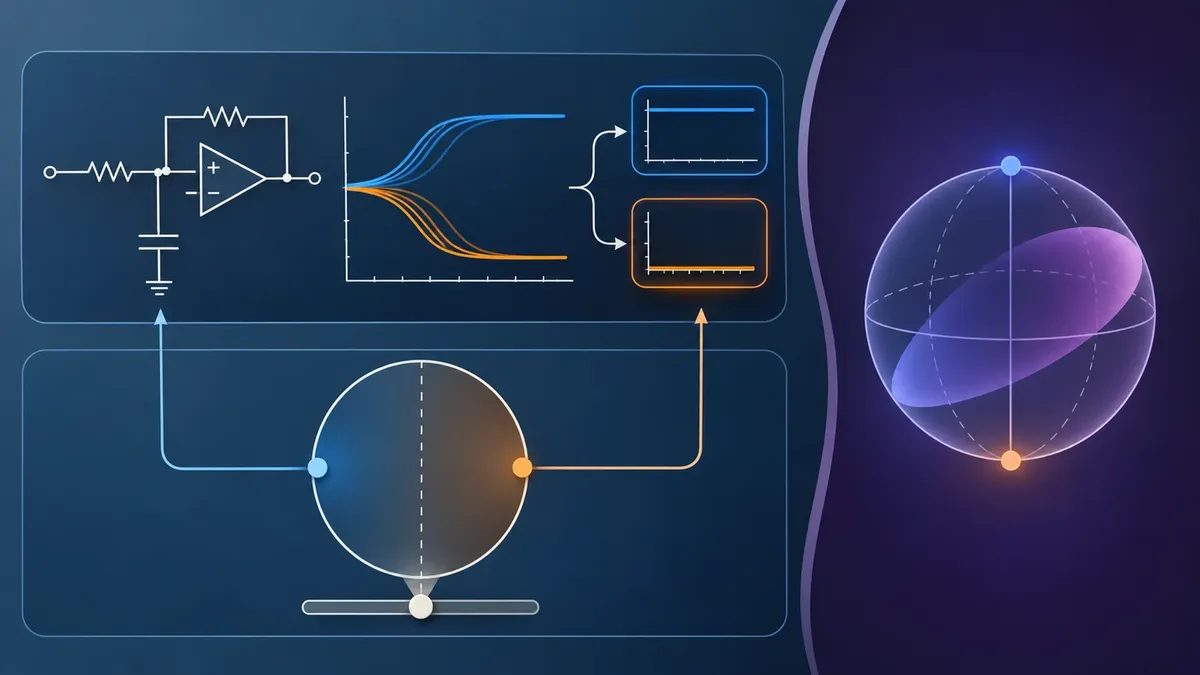
Quantum theory describes smooth evolution between measurements but gives measurement a separate, probabilistic rule. Benjamin Krawciw and James P. Crutchfield explore whether deterministic nonlinear dynamics can model that change, using an electrical circuit to simulate an ideal measurement of a single qubit.
Quantum mechanics gives two different descriptions of a qubit’s behavior. Between measurements, its state evolves according to the Schrödinger equation. When measured, it yields a definite result, with probabilities given by the Born rule. How these descriptions fit together is a long-running foundational question.
Benjamin Krawciw and James P. Crutchfield investigate one possible bridge: a deterministic system whose dynamics change when measurement begins. They designed equations for an ideal projective measurement of a single qubit, then built an analog computer that implements those equations using voltages in an electrical circuit.
This is a demonstration of a model, not evidence that quantum particles literally follow the circuit’s dynamics. The model is deliberately constructed to produce Born-rule frequencies. The authors do not derive the Born rule or identify a physical source for the hidden variable in their scheme.
A hidden variable sets the outcome
In the model, the qubit’s state is represented by two variables corresponding to circuit voltages. When measurement is off, a normalized state at rest is a special case in which the model reproduces stationary Schrödinger evolution. When measurement is switched on, nonlinear forces drive the state toward one of two possible outcomes.
Which outcome occurs depends on a hidden variable, called phi, that the observer is assumed not to know. For any given value of phi, the equations determine the outcome. The apparent randomness comes from uncertainty about phi. The model is set up so that a uniformly distributed phi makes the fraction of trials yielding each result match the Born-rule probability.
That uniform distribution is an assumption, not a result of the equations. If phi were distributed differently, outcome frequencies could differ from the Born rule. The authors also do not propose a specific quantum degree of freedom that phi represents.
To implement the equations, the team used circuit components to add, multiply, scale and integrate voltages. A microcontroller set the measurement axis and phi, switched the measurement force on and off, and recorded the circuit’s state. The model restricts the qubit to a particular family of states: those with real-valued amplitudes, pictured as points on a circle rather than the full space of possible qubit states.
What the circuit did
The authors ran 300 trials, varying the initial state relative to the measurement axis and the hidden-variable setting. They checked whether the circuit followed the proposed equations and whether its outcome frequencies matched the Born rule.
Individual circuit outcomes agreed with the ideal model’s predictions in 296 of the 300 trials. The four disagreements occurred very close to the model’s decision threshold, where a small deviation could change the selected outcome. The authors report that circuit decisions were reproduced to within about one percent of that threshold.
Across the tested settings, outcome frequencies matched the Born rule to within about 0.02 in probability. In the authors’ analysis, most of the remaining difference from the Born-rule probabilities came from finite sampling of phi: they used 30 values for each tested relative angle. Their analysis also accounts for circuit threshold effects and an ambiguous trial that did not complete its collapse within the allotted time.
The results show that a deterministic model with no intrinsic noise can be implemented in a physical circuit and reproduce Born-rule statistics under the conditions tested. That does not mean the physical circuit itself was noise-free: the paper reports drift, offsets, threshold jitter and finite resolution. Nor do the results show that the circuit is a quantum system, that the Born rule follows from deeper physics, or that measurement in nature works this way.
A narrow test, with open questions
The work covers ideal projective measurements on a single qubit. It does not address weak measurements or more general kinds of measurement. The authors note that their equations were chosen partly because they are practical to build from circuit components.
A single-qubit demonstration cannot establish whether the approach can handle entangled systems. Extending nonlinear measurement dynamics raises questions about causality and whether distant observers could use the model to signal. These issues remain open; the authors describe a Bell-test model as future work. Scaling the analog simulation is another challenge: their current method requires a number of circuit elements that grows exponentially with the number of qubits.
There is also a source-record discrepancy to resolve before publication. The supplied source record identifies the work as arXiv:2611.26889v1 and lists November 19, 2026, while the extracted paper text labels itself arXiv:2610.XXXXX and is dated November 23, 2026. The correct paper version and date could not be verified from the supplied materials.
The authors present the circuit as a small step toward exploring deterministic measurement models and analog machines for simulating quantum behavior—not as a resolution of the measurement problem. The work is described as an arXiv preprint; preprints may not yet have undergone peer review.
- quantum measurement
- Born rule
- analog computing
- qubit
- quantum foundations
- deterministic dynamics
Related reading
Automatically matched by shared topic keywords. These links do not imply that the sources agree or establish a consensus.
Quantum circuits give Wigner’s “friends” a job to do
Source published
Shared keywords: quantum foundations, quantum measurement
Can one principle explain why quantum theory works?
Source published
Shared keywords: born rule, quantum foundations
A deterministic machine draws quantum states as trajectories
Source published
Shared keywords: deterministic dynamics
Why quantum observers can disagree about the same system
Source published
Shared keywords: quantum foundations
How extra copies change the way we read three-qubit entanglement
Source published
Shared keywords: quantum measurement