TRANSMISSION // 2611.26885v1
How gas may speed black hole seed formation in star clusters
Source published
Simulations suggest gas can hasten core collapse and boost the growth of a central massive object in dense star clusters—but important physics remains unresolved.
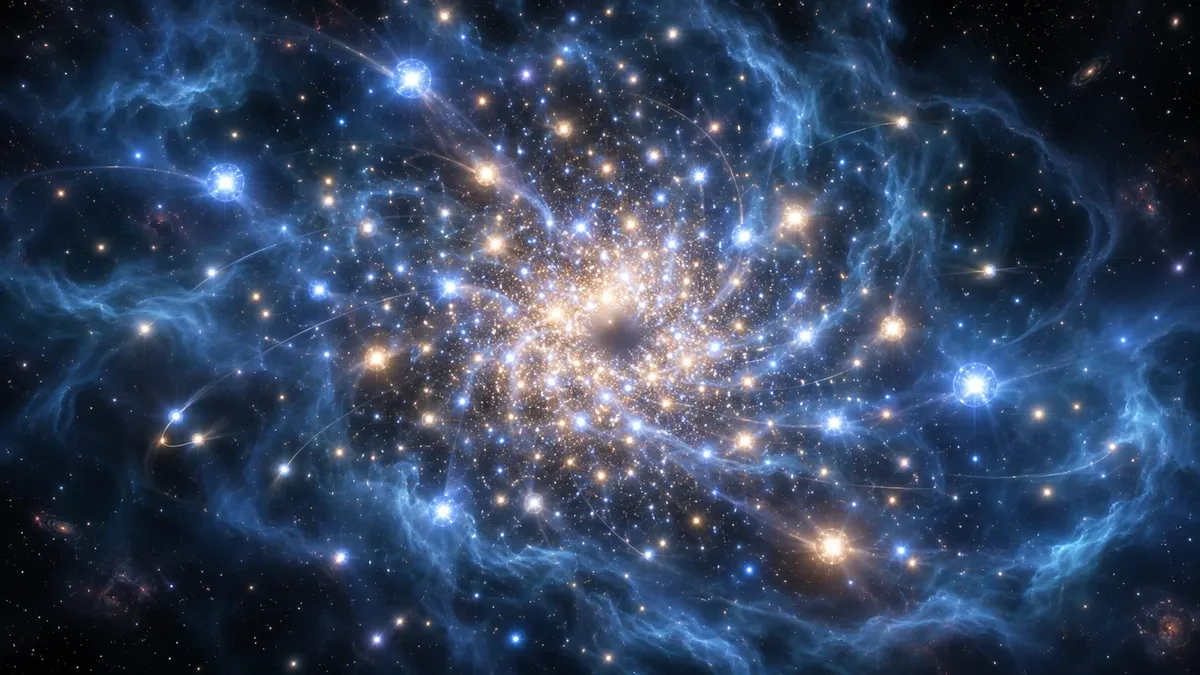
Could gas help tightly packed stars collide often enough to build the beginnings of a supermassive black hole? In simulations of idealised clusters, adding gas generally brought core collapse forward and increased the mass of the largest object. The results point to a possible route for making black hole seeds, not a demonstration that the process explains the supermassive black holes seen in the early Universe.
Supermassive black holes appear surprisingly early in cosmic history, but how their first seeds formed remains an open question. One proposed route begins in an exceptionally dense star cluster: stars sink toward its centre, collide and merge, and may build a massive central object that later becomes a black hole. A new set of simulations asks whether gas mixed into such a cluster could help that chain of events along.
The researchers modelled 12 idealised star-cluster setups, each with stars of a single mass and a Plummer-shaped distribution. The clusters varied in total stellar mass, size and stellar mass. For each setup, they ran four versions: without gas and with gas equal to 5%, 10% or 20% of the stellar mass. That made 48 simulations in all. Stars were followed with an N-body code, while the gas was modelled using smoothed-particle hydrodynamics (SPH); the two components interacted gravitationally.
The simulations generally showed earlier core collapse when gas was present. Core collapse is a contraction of a cluster’s central region, which can make stellar encounters and collisions more frequent. Across the models that reached core collapse, the average time was about 6% shorter with 5% gas, 16% shorter with 10% gas, and 27% shorter with 20% gas, compared with matching gas-free runs. The smallest gas fraction’s effect was less robust across the simulations.
The team also estimated the mass of the most massive object (MMO) in each cluster and treated it as a black-hole candidate. Averaged across the models, its mass was about 8%, 23% and 44% higher in the 5%, 10% and 20% gas runs, respectively, than in gas-free counterparts. These are averages over a varied set of simulations, not a promise that every cluster responds the same way. The authors report that gas-related differences were most pronounced in some of the denser, more collision-prone models.
The proposed explanation is that interactions between gas and stars dissipate some stellar motion, helping stars move inward and collisions become more common. In principle, gravitational drag from gas—often called dynamical friction—can be especially effective when stars move through gas at speeds near its sound speed. But an important qualification changes how strongly to interpret that explanation: the simulations did not fully resolve gas dynamical friction. The authors identify gas–star interactions more broadly as the main mechanism behind the enhancement in their models, while noting that higher-resolution work is needed to quantify dynamical friction properly.
The simulated clusters are simplified. Their stars all have the same mass, their initial distributions are idealised, and the models are substantially denser and more compact than observed nuclear star clusters. The gas has no radiative cooling or heating, and the simulations omit stellar evolution, stellar feedback and supernovae. Those processes could affect whether gas remains in a cluster long enough to influence collisions. The study also does not model stars collapsing into black holes: the MMO is used as a proxy for a possible black-hole precursor. The simulations therefore support a claim about growth of a central massive object under the model assumptions, not direct observation of a black hole forming.
The authors suggest that sufficiently massive, compact real clusters might build promising black-hole seeds through this route. But extending the simulated results to observed clusters—and then to the supermassive black holes found in the early Universe—requires additional modelling. The work is a preprint, so its claims should also be read as research findings that have not necessarily completed peer review. The results make gas an important ingredient to test in future cluster simulations; they do not settle how the first supermassive black holes formed.
- black hole seeds
- supermassive black holes
- stellar clusters
- stellar collisions
- gas dynamics
- astrophysics
Reviewed cross-references
These connections were reviewed by a model, not independently fact-checked by a human. Similarity does not imply agreement; consult the original papers and the evidence below.
Gas disks could steer stars into growing black holes
Shared method: Both studies use N-body simulations to investigate stellar dynamics relevant to black-hole growth. Cuevas et al. couple N-body and SPH calculations for gas-embedded clusters; Wang et al. use direct star-by-star N-body simulations with analytic prescriptions for star–disk interactions. The shared N-body approach does not make their gas treatments or growth mechanisms equivalent.
Model review: · openai-codex/gpt-6-luna
Evidence and provenance
Selected excerpts, not complete papers. PDF extraction can omit figures or damage equations, tables and reading order; sources may be preprints.
2611.26885v1 — Original paper
Excerpt reference:
static/papers/2611.26885v1.md:16-71
Basis: Paper text
Source SHA-256:de584ffc1aec9acac6f8d83db33e54d8d963476e57d0fbc9367428b40f35f3362609.03701v3 — Original paper
Excerpt reference:
static/papers/2609.03701v3.md:120-186
Basis: Paper text
Source SHA-256:f8f85536c27ace8c665b9bc40e41695f1f840f6841ed3364b72f803f2c744b64
Related reading
Automatically matched by shared topic keywords. These links do not imply that the sources agree or establish a consensus.
Gas disks could steer stars into growing black holes
Source published
Shared keywords: black hole seeds, stellar clusters
How a Black Hole’s Jets Could Disrupt Its Own Fuel Supply
Source published
Shared keywords: supermassive black holes
Black hole spin alone may not keep massive galaxies from making stars
Source published
Shared keywords: supermassive black holes
A billion-star search maps the Milky Way’s nested structures
Source published
Shared keywords: stellar clusters
How JWST Could Trace the Seeds of the First Massive Black Holes
Source published
Shared keywords: black hole seeds