TRANSMISSION // 2611.26880v1
A white dwarf’s two clocks in 47 Tuc
Source published
Chandra X-ray data suggest that the binary X10 contains a white dwarf spinning every 4.27 hours while its orbit lasts 4.68 hours. Pole-switching complicates the signal.
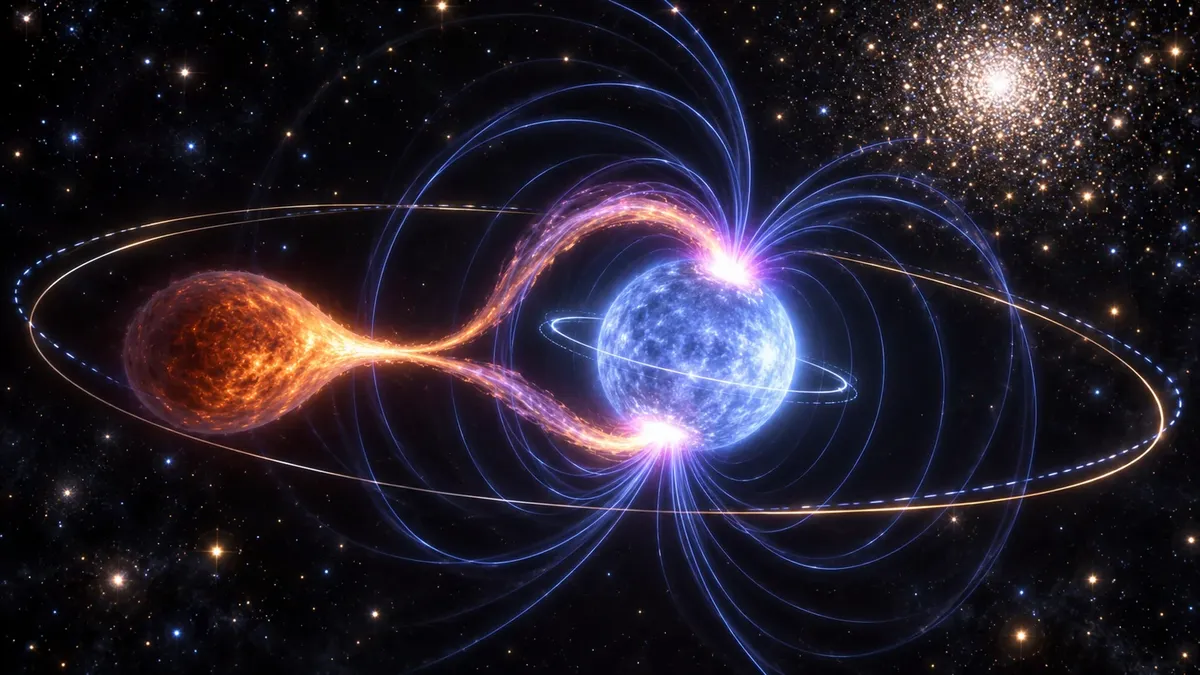
In the globular cluster 47 Tucanae, an X-ray-bright binary called X10 appears to have two slightly different rhythms: the rotation of its white dwarf and the orbit of its companion. A new analysis argues that earlier timing signals may have obscured the star’s true spin.
Cataclysmic variables are pairs of stars in which a compact white dwarf pulls gas from a smaller companion. In some systems, the white dwarf’s magnetic field guides the gas onto magnetic poles. The resulting X-rays can pulse as the star rotates. For a class called polars, magnetic forces usually synchronize the white dwarf’s spin with the binary orbit. But in asynchronous polars, the two clocks differ.
X10, in the globular cluster 47 Tucanae, has long been considered a magnetic cataclysmic variable. Earlier observations found an X-ray rhythm near 4.7 hours, but changes in the pulse pattern hinted that gas might switch between the white dwarf’s two magnetic poles. If the visible pole changes, the strongest rhythm in a dataset need not be the white dwarf’s actual spin. The study asks: can those shifts explain X10’s timing, and what are its spin and orbital periods?
The authors analyzed Chandra X-ray Observatory data, focusing on observations from 2002 that showed clear pulsations and evidence of pole-switching. The abstract describes 286 kiloseconds of Chandra observations; the paper’s methods specify that the period analysis focused on the 2002 dataset. The team first used a Lomb–Scargle periodogram, a method for finding repeating signals in unevenly sampled data. Its strongest peaks did not, by themselves, identify the physical periods unambiguously.
To interpret them, the researchers built a model with two rotating X-ray-emitting poles. The model allowed their visibility to alternate over a beat cycle—the repeating interval caused by the difference between spin and orbital frequencies—and allowed emission levels to change across observing windows. They fitted the model to the photon counts using a Poisson likelihood, appropriate for data with relatively few counts, and explored parameter ranges with a Markov chain Monte Carlo sampler. They also checked the proposed spin by comparing the timing of individual pulses against candidate frequencies.
The fit gives a white-dwarf spin period of 4.2683 hours and an orbital period of 4.6779 hours. The orbital estimate agrees with the roughly 4.7-hour signal reported in earlier work. The authors’ interpretation is that this familiar signal traces the orbit, not the white dwarf’s spin. In their account, pole-switching suppresses the spin signal in the periodogram and produces prominent sideband signals instead. The pulse-timing check supports the proposed spin: pulses remain more consistently aligned when folded at the model’s spin frequency than at the two strongest periodogram peaks.
The inferred spin-to-orbit period ratio is 0.9124, corresponding to an asynchronism of about 8.8%. That is a substantial mismatch between the two clocks. The authors suggest X10 could be a transitional system between an intermediate polar and a synchronized polar, and discuss whether it might be moving toward synchronism. This is an interpretation, not a directly observed evolutionary change: the analysis measures timing behavior, not the system’s long-term path.
There are important reasons to treat the exact interpretation cautiously. The model captures broad features of the light curve, including apparent pole switches, but its reduced chi-squared is 4.52—described by the authors as relatively poor. They point to stochastic accretion and unmodeled details as possible contributors. The model also relies on assumptions about how the two poles switch on and off, and the orbital period is derived from the fitted spin and beat periods rather than independently measured from a separate orbital signal in this analysis. The authors propose examining other, lower-signal-to-noise Chandra observations to better constrain the geometry and evolutionary state.
The work is presented as an arXiv preprint, a research manuscript that may not have completed peer review; the available source does not establish its publication status. Its results offer a plausible explanation for X10’s confusing X-ray pulses, but the fit’s limitations and model dependence matter when judging how firmly the periods and evolutionary picture are established.
- 47 Tucanae
- cataclysmic variables
- white dwarfs
- Chandra
- X-ray astronomy
- asynchronous polars
- stellar timing
Related reading
Automatically matched by shared topic keywords. These links do not imply that the sources agree or establish a consensus.
Gaia Diagram Seeks Cataclysmic Binary Candidates
Source published
Shared keywords: cataclysmic variables, white dwarfs
Radio surveys reveal a faint signal from IX Velorum
Source published
Shared keywords: cataclysmic variables, white dwarfs
Weighing a magnetic white dwarf through hot gas and a companion’s motion
Source published
Shared keywords: white dwarfs
Reshaping telescope grids could widen the search for gamma-ray bursts
Source published
Shared keywords: x ray astronomy
LMC X-3 grew brighter and quieter between X-ray observing campaigns
Source published
Shared keywords: x ray astronomy