TRANSMISSION // 2611.26853v1
How a robot model learns from each task
Source published
LoCo-WAM updates a robot model’s video predictor during a task, helping short observation histories perform better in several simulation tests.
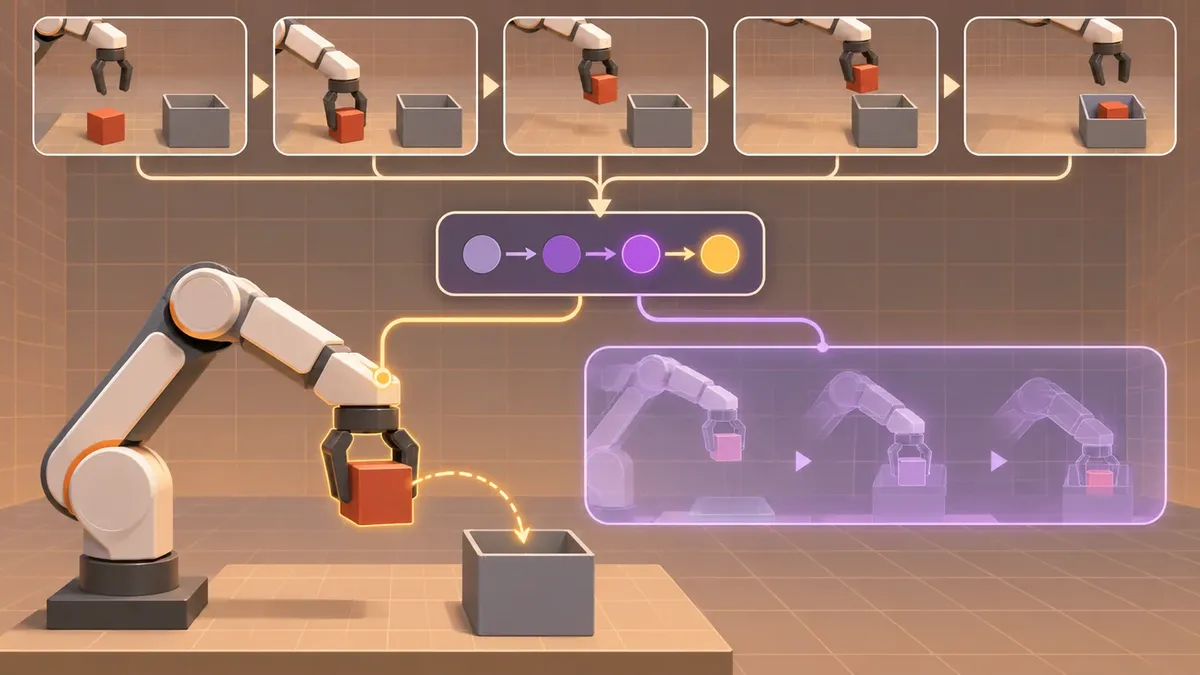
Robots may need to remember earlier steps even after those observations leave their current input. LoCo-WAM addresses this by updating part of a world-action model as it receives new observations, rather than giving it a longer history window.
The challenge of a short memory
A robot working through a multi-step task may need to track whether it has already opened a drawer or moved an object. Yet many world-action models make decisions from only a short window of recent observations. Extending that window can increase the computation required at each decision and may require training a separate model for the longer history.
In “LoCo-WAM: Test-Time Training as Long Context for World-Action Models,” Sheng Cheng and Deqian Kong ask whether a model can instead learn from what happens during a task. LoCo-WAM updates a small part of the model using observations gathered as the robot acts. The update accumulates within an episode—the interaction sequence for a task—and resets before the next episode.
Learning from observed outcomes
The models studied combine a video expert, which predicts future frames, with an action expert, which uses that imagined future to help choose actions. After the environment responds to an action, new frames become available. When a frame window’s future has been observed, LoCo-WAM uses those frames as targets for the video expert’s self-supervised prediction loss. It updates the model based on the earlier history that preceded the window, rather than treating a frame as a target before it has been observed.
The update uses a low-rank adapter: a compact set of trainable parameters attached to the video expert. The pretrained weights and the model’s history length remain unchanged. In the main setup, the action expert itself is not updated; it uses the adapted video expert’s predictions and features to guide later actions. Because the adapter retains updates across decisions in an episode, information from earlier observations can continue to influence behavior after those observations leave the input window.
The method learns from observations in the current episode. It does not require expert action labels, rewards, additional data or meta-training. The authors also test running updates while the robot executes its current action chunk, which can reduce the added time before the next action, though the computation still has to be done.
Tests in simulation
The paper evaluates LoCo-WAM with two models, Long-WAM and LingBot-VA, on four simulation benchmarks: RoboCasa GR-1, RoboCasa365, LIBERO-Mem and RoboTwin 2.0. The authors report improvements over the corresponding base models in their tested settings. For RoboTwin 2.0, however, the reported evaluation uses eight selected tasks, not the full benchmark; the results should be understood as applying to that subset. These experiments are simulations, not tests on physical robots.
A comparison on RoboCasa GR-1 illustrates the approach. Long-WAM with 2.4 seconds of history reached a reported 73.6% success rate with LoCo-WAM, close to the base model’s 73.5% with 9.6 seconds of history. With 4.8 seconds of history, the adapted model reached 78.3%—4.8 percentage points above that 9.6-second base-model result. These figures describe this benchmark and setup, not a guarantee that shorter histories will always suffice.
On LIBERO-Mem, LingBot-VA with an eight-chunk history matched the reported success and subgoal-completion rates of the base model with a 30-chunk history. On the selected RoboTwin 2.0 tasks, the gains over the tested base models were more modest.
What the updates appear to do
The authors’ analysis suggests that observations from the environment are important to the effect. The update improved prediction of upcoming frames before those frames were used as training targets. In a test that substituted the model’s own predictions for observed frames as targets, the success-rate gain disappeared.
Experiments applying the update in different parts of the model suggest that it affects actions mainly through the imagined future, while adapted features also contribute. The effect on actions grew as updates accumulated during an episode. When the researchers stopped updating early and held the adapter fixed, much of the performance gain disappeared. This is consistent with a benefit from continued adaptation to episode-specific observations, rather than a one-time adjustment.
There are costs as well as potential benefits. Updating requires computation and memory, even when performed alongside execution. In the reported RoboCasa GR-1 comparison, the synchronous setup with 2.4 seconds of history took 0.76 seconds per decision, compared with 0.67 seconds for the 9.6-second-history base model. An asynchronous version reduced the time from observation to action in that setup, while still doing update computation. Results also depended on task and configuration; for example, longer history did not improve every RoboCasa GR-1 task category.
A result with limits
LoCo-WAM offers one way to let a robot model carry information forward without enlarging its input window: adapt its predictions as it encounters a task. But the evidence covers two models and four simulation benchmarks, with RoboTwin results limited to selected tasks. It does not establish how reliably the approach transfers to physical robots, unfamiliar environments or tasks beyond those tested. The paper also reports computational costs, so shorter input history does not mean the updates are free.
The source is an arXiv preprint, and its claims should be treated as provisional rather than settled conclusions from peer review. The comparisons are specific to the reported experimental settings; they do not show that test-time updating is universally better than longer context or other memory methods. Broader evaluation will be needed to establish robustness and practical costs.
- robot learning
- world-action models
- test-time training
- robot memory
- simulation benchmarks
- LoCo-WAM
Reviewed cross-references
These connections were reviewed by a model, not independently fact-checked by a human. Similarity does not imply agreement; consult the original papers and the evidence below.
How action-free human videos could help robots learn
Supporting evidence: Both papers report that visual-state prediction can contribute to robot action performance, but through different mechanisms: LoCo-WAM updates a video-expert adapter during execution and reports gains across simulation benchmarks, while Ego Guidance trains a shared backbone with action-free human videos and reports improved out-of-distribution performance. These results are compatible evidence for a bounded role of visual-prediction learning, not a direct comparison; the training methods and evaluation settings differ.
Model review: · openai-codex/gpt-6-luna
Evidence and provenance
Selected excerpts, not complete papers. PDF extraction can omit figures or damage equations, tables and reading order; sources may be preprints.
2611.26853v1 — Original paper
Excerpt reference:
static/papers/2611.26853v1.md:160-219
Basis: Paper text
Source SHA-256:f411bba69b44f964f943e656e01e4f014d5309c812f74cb6c3ea72aa9487fae42611.13685v1 — Original paper
Excerpt reference:
static/papers/2611.13685v1.md:76-149
Basis: Paper text
Source SHA-256:479872a7136e5a49fa0bdf94ea97c188a67a7deb1dcaed5cddfedec2a8e1c21c2611.13685v1 — Original paper
Excerpt reference:
static/papers/2611.13685v1.md:374-462
Basis: Paper text
Source SHA-256:479872a7136e5a49fa0bdf94ea97c188a67a7deb1dcaed5cddfedec2a8e1c21c
Related reading
Automatically matched by shared topic keywords. These links do not imply that the sources agree or establish a consensus.
A better-balanced link between vision and action improves robot performance in experiments
Source published
Shared keywords: robot learning
ToolDex records human tool improvisation—and tests where AI falls short
Source published
Shared keywords: robot learning
A Robot Memory System That Keeps the Lesson, Not Every Detail
Source published
Shared keywords: robot memory
Why robot action models can know the target but ignore it
Source published
Shared keywords: world action models
A smarter cache could help robot models act faster
Source published
Shared keywords: world action models