TRANSMISSION // 2611.26822v1
A vision transformer reconstructs velocities in FLAMINGO skies
Source published
A vision transformer outperformed a quadratic estimator on one FLAMINGO simulation realization, but the result may reflect overfitting and did not hold across all tests.
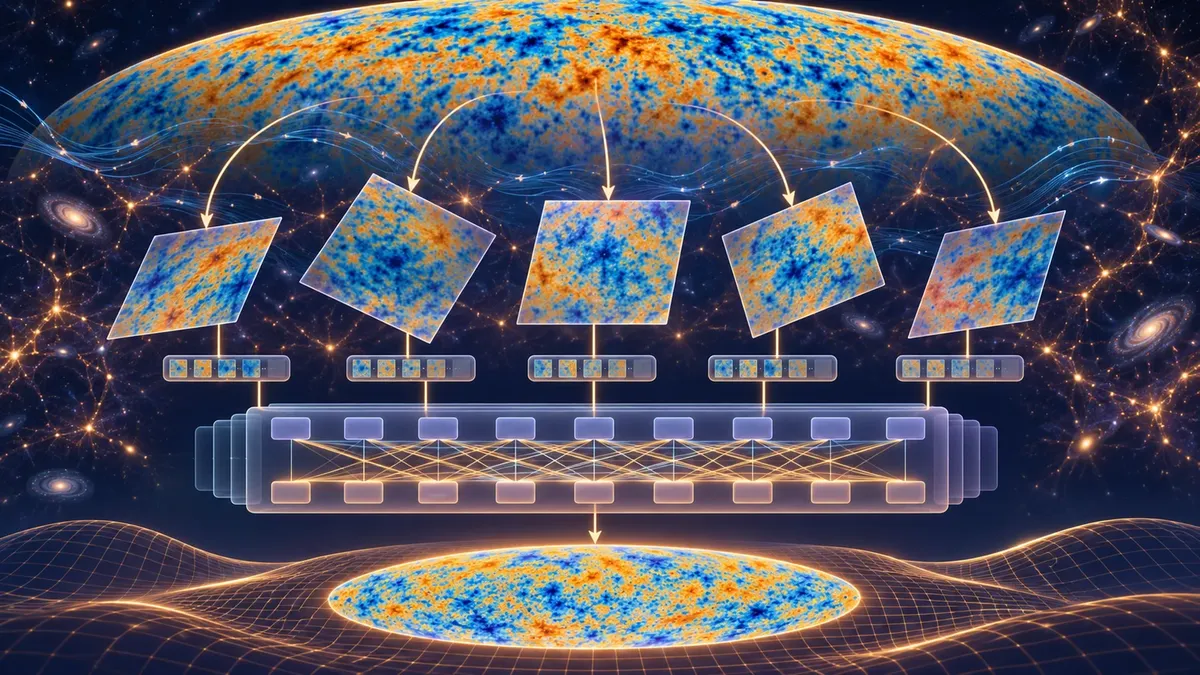
The kinetic Sunyaev–Zel’dovich effect links the cosmic microwave background to motions of ionized gas. Sophie Coulombe and Matthew C. Johnson test whether a vision transformer can use that signal to reconstruct cosmic velocities in simulated skies. The fine-tuned network performs better than a standard estimator on FLAMINGO maps, but only one relevant simulation realization was available, leaving generalization uncertain.
Reading motion in the afterglow
The cosmic microwave background (CMB) is ancient light that has crossed the universe on its way to us. When its photons scatter from ionized gas moving relative to the CMB, their temperatures shift slightly. This is the kinetic Sunyaev–Zel’dovich effect, or kSZ. The signal depends on gas motion along our line of sight, so combining CMB maps with maps that trace large-scale structure can help researchers infer cosmic velocities.
A standard reconstruction method is the quadratic estimator. In broad terms, it combines filtered map values to identify patterns linking the CMB signal and a tracer of structure. The estimator is unbiased and has minimum variance under the paper’s assumptions that the velocity and optical-depth fields are Gaussian. Real cosmic fields can have non-Gaussian correlations, particularly on small scales, which may contain information that this estimator does not use.
Sophie Coulombe and Matthew C. Johnson investigate whether a vision transformer (ViT)—a neural network that learns relationships across image-like inputs—can improve these reconstructions. Their NeurIPS 2026 workshop paper tests the approach on simulations, not observational data.
Learning from mock and simulated maps
The researchers use maps from the FLAMINGO cosmological simulation suite, selecting simulated shells spanning redshifts 0.4 to 1.0 and grouping them into three redshift bins. The network receives a CMB temperature map and optical-depth maps for those bins, and outputs estimated radial velocities. Optical depth describes the likelihood of photons scattering through gas. It is not directly available in real observations, where a tracer such as galaxy number density would be used instead.
Because full-sky maps are too large to process directly, the team divides them into tiles. Training happens in two stages. First, the ViT learns from random Gaussian mock maps built to reproduce the FLAMINGO maps’ two-point correlation structure. A curriculum gradually increases the primary CMB fluctuations added to these mock inputs, making the kSZ signal harder to distinguish. The researchers then fine-tune the network on rotated versions of the FLAMINGO maps. Rotations change which subsets of the same underlying map appear in tiles; they do not provide independent simulated universes.
The team compares reconstructed velocities with the known velocities in the simulations and with estimates from the quadratic estimator. Their main measure examines how closely the reconstructed and true velocity patterns correlate across angular scales. They also report results for the network before fine-tuning, but this comparison cannot cleanly establish which training stage accounts for its performance: the FLAMINGO training and evaluation data come from the same single realization.
Better on one simulation, not every test
On the FLAMINGO maps, the fine-tuned ViT produces higher-fidelity reconstructions than both the quadratic estimator and the ViT trained only on Gaussian mocks over a range of scales. The authors interpret this as consistent with the network using non-Gaussian information in the inputs. The result does not establish exactly which correlations it learned, or whether the improvement will hold beyond these maps.
The Gaussian-mock comparison is more mixed. Without primary CMB fluctuations, the ViT performs slightly better than the quadratic estimator. With those fluctuations included, the quadratic estimator performs better at low angular multipoles. The paper also presents an aggregate signal-to-noise-style metric that favors the ViT, but that measure is dominated by high-multipole performance; it does not remove the low-multipole difference.
In the FLAMINGO results, the quadratic estimator and the Gaussian-trained, unfine-tuned ViT also show anti-correlation with the true velocities. This pattern does not appear in the Gaussian mocks with matching two-point correlations. The authors speculate that it could be related to features of the map construction, such as how simulation boxes were assembled into light cones, but leave the cause unresolved.
What remains uncertain
The main limitation is that the researchers had only one FLAMINGO realization containing the relevant correlated kSZ and structure maps. Rotating and retiling that map creates different training examples, but not independent simulated universes. Because training and testing can involve different subsets of the same map, the performance estimate may be overly optimistic. The authors explicitly cannot rule out overfitting.
The study also does not show whether the network generalizes to simulations with different cosmological parameters or baryonic-physics assumptions, or works on real survey maps. Observations bring additional complications, including partial sky coverage, foregrounds, redshift-space distortions and uneven survey depth. Independent simulation realizations and tests with observational data would be important next steps.
This is a promising demonstration, not evidence that the method is ready to replace existing reconstruction approaches. The result is limited to the tested simulations, and the paper is a preprint/workshop contribution rather than a settled assessment. Its central open question is whether the apparent gain survives evaluation on genuinely independent simulated skies and, eventually, real data.
- kinetic Sunyaev–Zel’dovich effect
- cosmic microwave background
- peculiar velocities
- vision transformers
- cosmological simulations
- FLAMINGO
Reviewed cross-references
These connections were reviewed by a model, not independently fact-checked by a human. Similarity does not imply agreement; consult the original papers and the evidence below.
What Galaxy Triangles Could Reveal About Cosmic Flows
Supporting evidence: Coulombe and Johnson report ViT velocity reconstruction using simulated FLAMINGO maps. Guidi et al. identify kSZ-reconstructed velocity fields as a possible input to velocity–galaxy three-point analyses, while noting that reconstruction response, noise and correlations with density tracers need further modeling. This supports a potential application, not validation of the three-point model or the ViT’s performance for that analysis. The ViT study uses one correlated FLAMINGO realization, notes possible overfitting and does not assess generalization to other simulations; these selected excerpts limit the comparison.
Model review: · openai-codex/gpt-6-luna
Evidence and provenance
Selected excerpts, not complete papers. PDF extraction can omit figures or damage equations, tables and reading order; sources may be preprints.
2611.26822v1 — Original paper
Excerpt reference:
static/papers/2611.26822v1.md:106-152
Basis: Paper text
Source SHA-256:72e00b205145c27cb4158d1ffe01a4193f57004474245b8a371e64fe708d04262611.26822v1 — Original paper
Excerpt reference:
static/papers/2611.26822v1.md:838-890
Basis: Paper text
Source SHA-256:72e00b205145c27cb4158d1ffe01a4193f57004474245b8a371e64fe708d04262611.08589v1 — Original paper
Excerpt reference:
static/papers/2611.08589v1.md:122-173
Basis: Paper text
Source SHA-256:f178b4e19bd3b673bd697d6b9320d9c225151ed70a57b2ac08c51c0c6679d338
Related reading
Automatically matched by shared topic keywords. These links do not imply that the sources agree or establish a consensus.
Galaxy motions shift a megamaser estimate of cosmic expansion downward
Source published
Shared keywords: cosmic microwave background, peculiar velocities
Could cosmic voids reveal uneven dark energy?
Source published
Shared keywords: peculiar velocities
Could ancient magnetic fields have brought forward cosmic reionization?
Source published
Shared keywords: cosmological simulations
Teaching vision transformers where finer image patches matter
Source published
Shared keywords: vision transformers
What Galaxy Triangles Could Reveal About Cosmic Flows
Source published
Shared keywords: peculiar velocities