TRANSMISSION // 2611.26820v1
Satellite size and friction in modeled galaxies
Source published
In controlled simulations, more extended satellites generally experienced weaker dynamical friction, though the size effect varied with orbit and model.
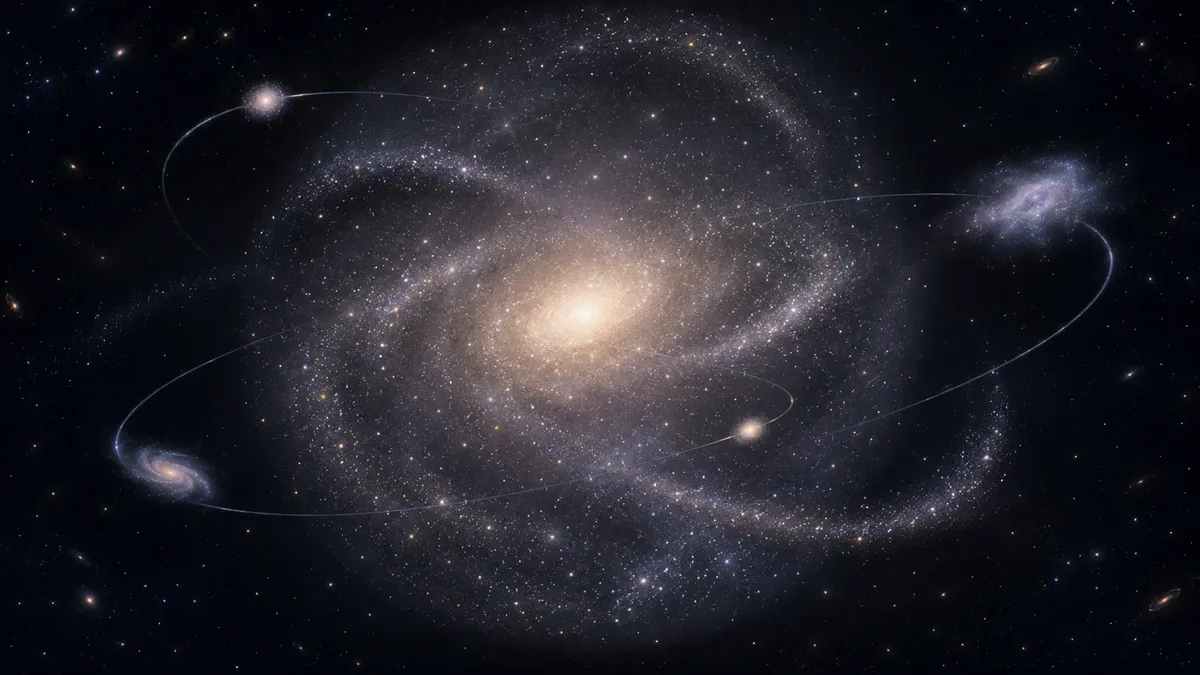
Dynamical friction can slow a satellite as it moves through a galaxy, but the effect depends on how the satellite and host are modeled. Simulations by Pierfrancesco Di Cintio and Carlo Nipoti find that, in their chosen galaxy models, more extended satellites generally experience weaker friction. The trend is not equally strong for every orbit.
A massive object moving through a galaxy gravitationally disturbs the surrounding stars. Their collective response can exert a drag on the object, changing its orbit. This process, called dynamical friction, can contribute to orbital decay, though it does not guarantee that a satellite will keep sinking: the paper discusses cases where decay slows or stalls.
Chandrasekhar’s original formulation describes a point-like perturber moving through an infinite, uniform background. Later treatments have addressed more realistic settings and finite-sized objects. Di Cintio and Nipoti revisit how a satellite’s size affects friction, using simulations of a satellite orbiting within an idealized galaxy.
Comparing satellite and host models
The researchers modeled the host as a spherical galaxy with a Hernquist density profile and the satellite as a Plummer sphere. They varied satellite mass and scale radius, initial orbital eccentricity, and the host’s velocity structure, including isotropic and radially biased cases.
They compared several numerical approaches. In full N-body simulations, particles represented both host and satellite; the satellite could deform and lose mass through tidal forces. In semi-reduced simulations, the satellite was represented by a single extended particle interacting with host particles. In reduced simulations, host particles moved in a fixed, smooth galaxy potential and exerted forces on the extended satellite particle. These reduced approaches do not capture satellite deformation and tidal mass loss as the full simulations do. The researchers also compared the simulations with semi-analytical orbit calculations using friction prescriptions.
The different approaches help separate aspects of the problem, but they are not interchangeable. In particular, a satellite that loses mass can experience less friction because its mass decreases, while tidal tails can also affect its motion.
Size matters, but the effect depends on the orbit
At fixed host model and satellite mass, the general trend in the tested simulations was that more extended satellites experienced weaker dynamical friction and took longer to decay inward. The authors report this trend in both isotropic and radially anisotropic hosts. It was especially evident for initial orbital eccentricities above about 0.3.
The trend was not equally strong across the tested orbits. For one nearly circular case, with initial eccentricity 0.02, changing satellite size had little effect on the drag. This result applies to that setup; it does not establish what happens for every nearly circular orbit or galaxy model.
In the comparisons, standard Chandrasekhar-based calculations generally predicted faster orbital decay than the simulations. For highly eccentric orbits and a satellite-to-host mass ratio around 10⁻³, the manuscript says the overestimate could reach about an order of magnitude. Adjusting the Coulomb logarithm—a factor representing the range of gravitational encounters included in the formula—did not remove the mismatch in a model-independent way. A treatment for extended objects developed by Mulder came closer in some comparisons, particularly when mass loss was small, but the authors do not establish it as a universal solution.
Tides add another complication
The full simulations included tidal stripping, which can reduce the satellite’s mass. The authors also examined self-friction, their term for additional orbital effects associated with tidal tails. In a specific example, a satellite on an orbit with initial eccentricity 0.24 showed roughly 10% reduction in its orbital apocentre over about 15 passages when evolved without dynamical friction, due to the tails. For lower-eccentricity cases, the reported reduction was about 2% after 20 passages.
The authors report that, in their simulations, the extra drag associated with tidal tails was almost entirely countered by mass loss. This is a result for the modeled systems, not a universal rule for satellites in galaxies.
What the study can—and cannot—show
The experiments use a spherical Hernquist host, Plummer satellites, and selected ranges of masses, sizes, and orbits. The full simulations allow deformation and mass loss; the simplified reduced simulations omit these effects, making them useful for examining friction under different assumptions but not a substitute for the full setup. The paper also notes that stalling behavior can depend on numerical resolution.
The findings therefore support a qualified conclusion: satellite size can affect dynamical friction, and more extended satellites generally experienced weaker friction in the configurations studied. The strength of the effect depends on the orbit and modeling choices, so these simulations do not settle how every real satellite will evolve. The source is a manuscript labeled “Draft” and “A&A proofs,” dated November 2026; that status does not by itself establish a peer-review outcome.
- dynamical friction
- satellite galaxies
- N-body simulations
- orbital decay
- galaxy dynamics
- tidal stripping
Related reading
Automatically matched by shared topic keywords. These links do not imply that the sources agree or establish a consensus.
Could nearby star clusters have helped populate the Milky Way’s crowded centre?
Source published
Shared keywords: dynamical friction, n body simulations
Earth 2.0 could reveal shrinking orbits around three distant stars
Source published
Shared keywords: orbital decay
Why Some Galaxies Look More Lopsided Than Others
Source published
Shared keywords: galaxy dynamics
Could magnetic fields help explain gas rotation in the Sunflower Galaxy?
Source published
Shared keywords: galaxy dynamics
Self-interacting dark matter deepens a galactic bar puzzle in simulations
Source published
Shared keywords: dynamical friction