TRANSMISSION // 2611.26806v1
MedicalRSI aims to help medical AI learn from mistakes
Source published
MedicalRSI trains a medical agent and the strategy that improves it together. Its abstract reports stronger benchmark performance and transfer, but clinical readiness remains unproven.
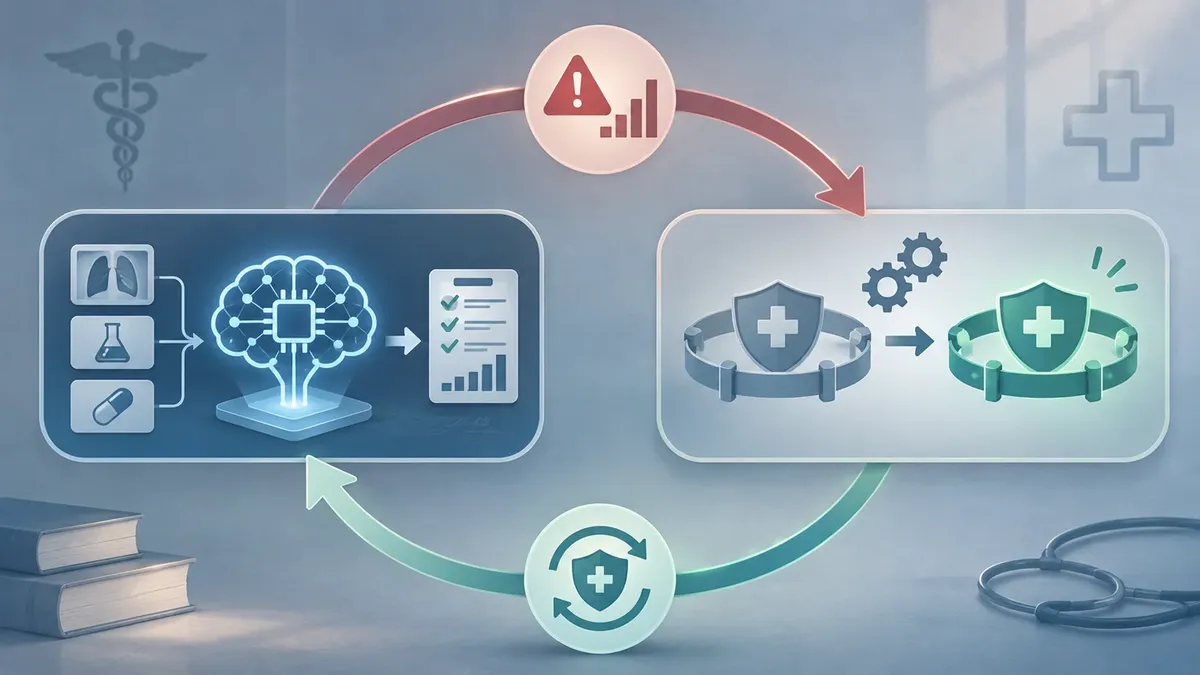
MedicalRSI asks whether a medical AI agent can improve not only its performance, but also the strategy it uses to make improvements. The authors report gains on benchmarks and transfer to new settings. The supplied evidence is only the paper’s abstract, so the details and clinical significance of those results remain uncertain.
Medical AI agents may repeat errors if experience from one attempt does not help with later attempts. Existing self-improvement methods can update an agent’s model weights or its medical harness, but the strategy for making those changes may remain fixed. The authors argue that this limits improvement, especially when an early fix does not address problems that arise later.
The paper proposes MedicalRSI, a framework for recursive self-improvement: the system seeks to improve both the agent and the process used to improve it. The authors call this Clinical Model-Harness Co-Evolution.
One model takes two roles. The Solver performs medical tasks. The Improver uses the Solver’s failures to write a medical harness. The abstract does not specify the harness’s contents or format. Each harness is rewarded according to its gain over acting without it. The two roles are trained together, with the aim of helping the Improver adapt to problems the Solver has not yet solved.
The key distinction is that the improvement strategy itself is learnable. Rather than repeatedly applying an unchanged recipe for revising the agent or its harness, MedicalRSI trains the Improver alongside the Solver. In principle, this lets the strategy respond to evidence about which harness changes help. Whether that mechanism works broadly depends on the evaluation, whose details are not available in the supplied source.
The abstract says the authors evaluated MedicalRSI on multiple benchmarks and large language model backbones. They report that it outperformed existing context-level and weight-level self-improvement methods, and transferred to unseen workflows, new language models, and new databases. The abstract provides no benchmark names, scores, sample sizes, or comparison details. The size and scope of the reported gains therefore cannot be judged from this evidence alone.
These are reported benchmark findings, not evidence that MedicalRSI improves patient outcomes or is safe for clinical use. Transfer to unfamiliar workflows and databases is a research result; it does not establish reliability in hospitals or with real patient records. The abstract also does not describe how failures are identified, how proposed changes are checked, or what safeguards might address harmful revisions. Those questions matter for any system that uses its past performance to change how it acts.
This article is based on the paper’s abstract only; the full methods, detailed results, and limitations were not available in the supplied evidence. The source is an arXiv item, but the supplied information does not establish its review status. MedicalRSI is best understood here as a proposed research framework with reported benchmark results—not as a validated clinical system.
- MedicalRSI
- medical AI
- large language models
- recursive self-improvement
- clinical workflows
- AI evaluation
Reviewed cross-references
These connections were reviewed by a model, not independently fact-checked by a human. Similarity does not imply agreement; consult the original papers and the evidence below.
VirtualTrialHarness aims to make clinical database studies more consistent
Supporting evidence: Both studies report gains from adding task-relevant procedural guidance to medical workflows: MedicalRSI reports better benchmark performance with co-evolved harnesses, while VTHarness reports more complete cohort delivery with stage-specific skill selection than with retrieval of the same procedural corpus. The results support only the bounded idea that workflow-aligned guidance can help in the tested settings; the systems, tasks and outcome measures differ, so this is not a direct comparison or evidence of clinical benefit.
Model review: · openai-codex/gpt-6-luna
Evidence and provenance
Selected excerpts, not complete papers. PDF extraction can omit figures or damage equations, tables and reading order; sources may be preprints.
2611.26806v1 — Original paper
Excerpt reference:
static/papers/2611.26806v1.md:181-229
Basis: Paper text
Source SHA-256:6c62597e2805f32c3b63be0a9faa726c89e4bea2bd75e320dd41bd0d9e430afb2611.26806v1 — Original paper
Excerpt reference:
static/papers/2611.26806v1.md:749-905
Basis: Paper text
Source SHA-256:6c62597e2805f32c3b63be0a9faa726c89e4bea2bd75e320dd41bd0d9e430afb2611.05551v1 — Original paper
Excerpt reference:
static/papers/2611.05551v1.md:210-258
Basis: Paper text
Source SHA-256:6c36510ec07017aa3e4034f5fa5bfeeae84d664accc19b81f96a3d728a1d8078
Related reading
Automatically matched by shared topic keywords. These links do not imply that the sources agree or establish a consensus.
A CT-labeling system gives an AI reviewer fewer decisions to make
Source published
Shared keywords: large language models
Can coding agents make language models smaller without breaking them?
Source published
Shared keywords: ai evaluation, recursive self improvement
A broader test for medical AI recommendations
Source published
Shared keywords: ai evaluation, medical ai
How to test an AI assistant’s self-updates before they stick
Source published
Shared keywords: ai evaluation, recursive self improvement
A pathology AI that can ask questions of a slide
Source published
Shared keywords: medical ai