TRANSMISSION // 2611.26804v1
How Dust Opacity Shapes a Route to Gas Giants
Source published
Three-dimensional disk simulations find that reduced dust opacity promotes fragmentation. Clumps that form have broadly similar early masses and orbits across the tested opacity models.
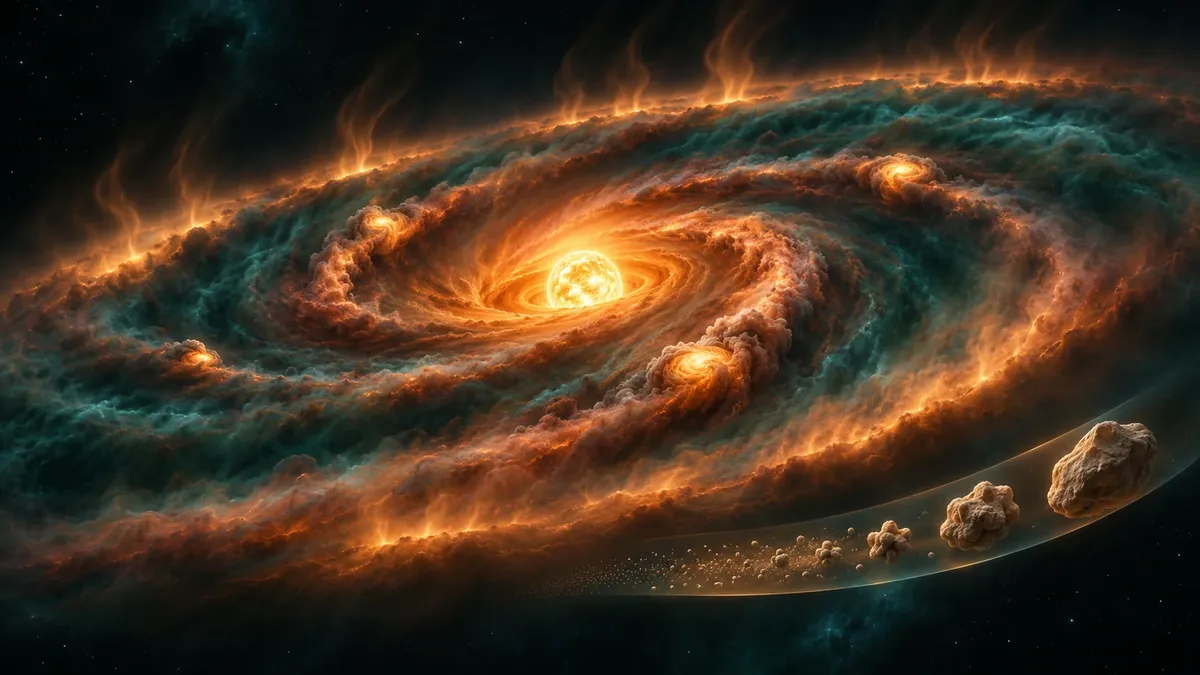
Could growing dust grains help a young star’s disk form gas giants by collapsing under its own gravity? Alan P. Boss’s simulations find that lower-opacity disks fragment more readily. Among the models, viable clumps form in all reduced-opacity cases but only some standard-opacity cases; the early properties of clumps that form are broadly similar. These are model results, not evidence that this pathway dominates in nature.
Why dust matters to planet formation
A young star is often surrounded by a rotating disk of gas and dust. In one proposed route to making gas giant planets, called gas disk gravitational instability (GDGI), a sufficiently massive, cool disk develops dense regions that collapse under their own gravity. For this to happen, the gas must shed heat quickly enough. Dust grains affect how readily heat escapes: their size and abundance influence the disk’s opacity, or resistance to radiation passing through it.
Alan P. Boss investigates how reduced opacity changes this process in three-dimensional computer simulations. The motivation is that dust grains can grow beyond the small sizes used in traditional opacity assumptions, potentially lowering opacity. Lower stellar metallicity may also be associated with lower opacity. The central question is whether these changes help a disk fragment into clumps that could become gas giant protoplanets.
Simulating disks with different opacity
The study uses the EDTONS code to model the coupled motion of gas and gravity, with radiative transfer to follow heat. Each model begins with a disk of 0.091 solar masses around a solar-mass protostar. The disk extends from 4 to 20 astronomical units, where one astronomical unit is the average Earth–Sun distance. Models vary initial conditions, including the minimum Toomre stability parameter, which ranges from 1.3 to 2.7. In broad terms, lower values indicate greater susceptibility to gravitational instability.
There are 24 models: eight use the standard opacity, eight reduce it by a factor of 10, and eight by a factor of 100. These reductions are deliberate modeling choices, not direct measurements of particular stars’ dust populations or metallicities. The simulations use high spatial resolution and radiative transfer, but cover only a few hundred years of disk evolution. A minimum disk temperature of 40 kelvin is imposed.
More fragmentation, similar properties among clumps
All 16 reduced-opacity models fragmented into multiple virtual protoplanets, compared with five of the eight standard-opacity models. The paper also assesses whether dense clumps meet three criteria for being viable: they must be gravitationally bound, massive enough to collapse, and small enough relative to their orbit to avoid being torn apart by the star’s tides. Viable clumps formed in all reduced-opacity models, but in only three of the eight standard-opacity models.
The clumps’ early properties were broadly similar across opacity choices in cases where viable clumps formed. The study reports masses of about 0.2 to 0.7 Jupiter masses and semimajor axes of 6 to 13 astronomical units. A semimajor axis describes the size of an orbit. Thus, lowering opacity appears to help viable clumps form in these simulations without substantially changing the early masses and orbits of those clumps. This does not mean every model produced a viable clump.
Lower opacity does affect cooling: the models show higher cooling rates in regions that have not reached the imposed 40-kelvin floor. But some disks remain optically thick, and the floor limits how much cooler their midplanes can become. The author suggests this temperature constraint helps explain why the largest opacity reductions do not produce a more dramatic change in clump properties.
What the results can—and cannot—show
The simulations support a specific conclusion: in this set of compact, massive disks, reduced opacity makes fragmentation and viable-clump formation more common. They do not establish that grain growth causes gas giants to form around real stars, or that metallicity alone predicts which systems will fragment. Opacity was changed by fixed factors rather than calculated from a detailed, evolving grain population, and the simulated disk conditions cover a limited range.
There are further modeling limits. The minimum temperature is an imposed assumption, and the calculations stop early. The paper says longer evolution would be needed to follow clump contraction and survival. Virtual protoplanets are computational tracers, not fully resolved planets; the assumed accretion prescription may overestimate their growth, while the short simulated evolution prevents a firm account of their later fate. The models also omit magnetic fields, whose influence the paper notes may matter.
The work is therefore a numerical test of how opacity affects one proposed route to gas giants, not a final verdict on planet formation. It is available as an arXiv preprint. The paper acknowledges that it was improved in response to a reviewer’s report; the source information here does not establish its publication status or whether its conclusions represent scientific consensus.
- gas giant formation
- dust grain growth
- disk instability
- protoplanetary disks
- radiative hydrodynamics
- planet formation
Related reading
Automatically matched by shared topic keywords. These links do not imply that the sources agree or establish a consensus.
A proposed Webb survey would map dust, ice and shadows in planet-forming disks
Source published
Shared keywords: planet formation, protoplanetary disks
A new look at the spirals around IM Lup
Source published
Shared keywords: planet formation, protoplanetary disks
Gas persists inside the dust gaps of three planet-forming disks
Source published
Shared keywords: planet formation, protoplanetary disks
Five simulated giant planets migrate inward—but their shared destination is not a universal rule
Source published
Shared keywords: protoplanetary disks
A moving dust feature hints at a hidden planet around DR Tau
Source published
Shared keywords: planet formation