TRANSMISSION // 2611.26774v1
Gaia uncovers close companions in debris-disk systems
Source published
A Gaia-based search of 94 stars with resolved debris disks reports several companion detections and tentative candidates, including planets orbiting close to their stars.
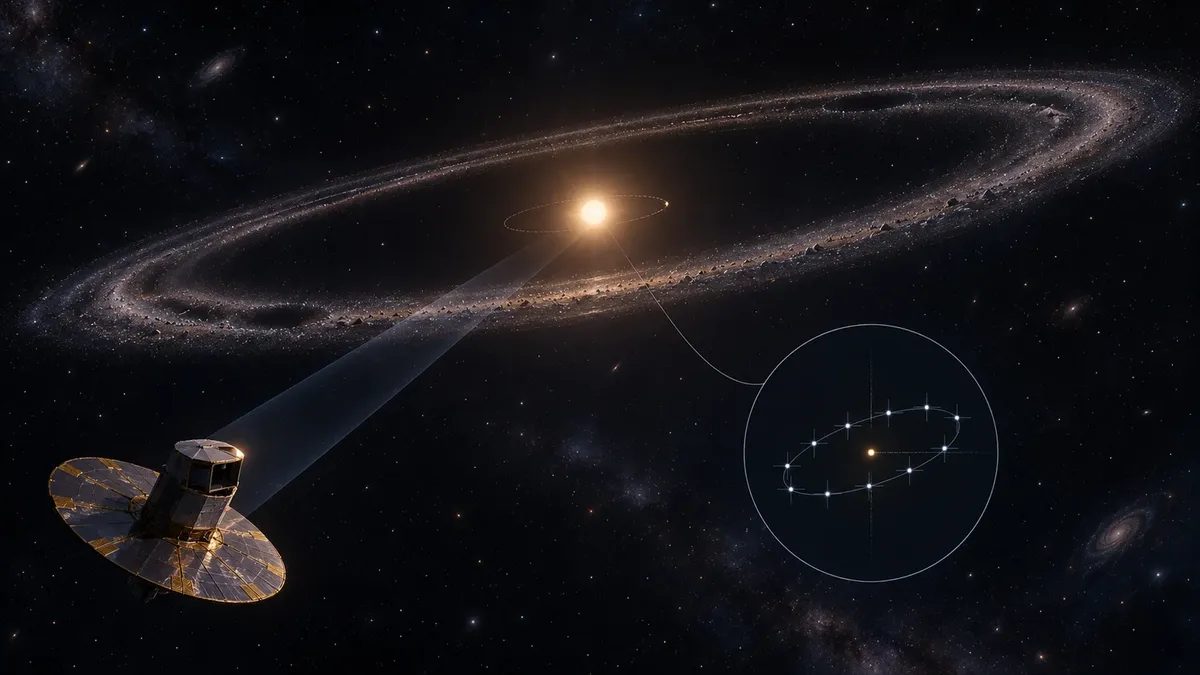
Debris disks can show rings and gaps that hint at unseen planets, but those patterns do not prove a planet is present. Researchers used Gaia’s measurements of stellar motion, alongside other observations, to search for companions that are difficult to see directly. Some signals point to giant planets; others remain uncertain.
A dusty ring around a star can preserve clues about its planetary system. Gaps, edges and multiple rings may be shaped by planets, but other processes can also create disk structure. A key question is whether companions can be found where conventional direct imaging is less effective: relatively close to their stars, at a few astronomical units (au). One au is the average distance between Earth and the Sun.
In this study, A.-M. Lagrange and colleagues searched 94 stars whose debris disks have been spatially resolved. Their tool, GaiaPMEX, looks for signs that a star’s motion differs from what would be expected if it were alone. A companion’s gravity can make its host star wobble; Gaia can register this in astrometric measurements, which track a star’s position. For stars also observed by Hipparcos, the researchers used changes in measured proper motion between the two missions as an additional clue.
The team tested possible companion masses and orbital distances against the astrometric signals. For promising cases, they combined the results with radial-velocity measurements—which detect motion toward and away from Earth—and high-contrast imaging, designed to reveal faint objects close to bright stars. The paper also reports limits on companions that could have escaped detection in selected systems.
The clearest new planetary-mass result is around HD 107146, a roughly 150-million-year-old star with a ring-like disk. Combining GaiaPMEX with radial-velocity and imaging constraints, the authors estimate a companion mass of 2–6 Jupiter masses, orbiting about 2–10 au from the star. They note that this close-in object alone cannot explain the disk’s inner edge, about 50 au from the star; it might instead affect more distant planets that could help shape the disk.
The study also reports a companion around HD 106906, a close binary star with an edge-on debris disk and a known, very distant planet. The new companion’s allowed properties are broad: about 3–70 Jupiter masses at 3–30 au, with the most likely solutions concentrated around 7–20 Jupiter masses and 3–10 au. That range crosses the boundary between giant planets and brown dwarfs, so the object’s classification is not settled. Its presence may require earlier models of the system’s history to be reconsidered.
Three other systems—BD+45 598, TWA 7 and HD 120326—show indications of companions at about the 2-sigma level, weaker evidence than the paper’s more secure detections. Follow-up data narrow the possibilities for TWA 7 and HD 120326, but the authors still treat them as candidates. For TWA 7, the estimated companion is about 2–8 Jupiter masses at roughly 0.7–4 au; for HD 120326, the paper describes a possible 10–20-Jupiter-mass object near 2 au under a coplanar-orbit assumption. BD+45 598 remains especially uncertain: its possible companion spans planetary to stellar masses, and additional observations are needed.
The five systems with detections at 3-sigma significance include two stellar or borderline stellar/substellar companions, not just planets. HD 54341 has a reported stellar companion, while HD 146897’s companion could be a low-mass star or brown dwarf. HD 206893 was also included among the detections, but its known companions explain the Gaia signal in the study’s modelling; the authors find no evidence for an additional one.
The results do not establish that the companions caused the disks’ structures. Indeed, the paper stresses that disk features can have explanations other than planets. Nor does a non-detection mean a system has no planets: sensitivity varies with a star’s properties and with companion mass and orbital distance. The authors provide upper limits for selected systems, including AU Mic, Beta Pictoris and Epsilon Eridani, rather than a complete census of all possible companions.
This is a preprint manuscript identified as an Astronomy & Astrophysics paper, and the supplied version does not give a final publication status. Its estimates depend on modelling and on assumptions used when combining different data sets; the paper itself calls for further observations and dynamical analysis. Gaia’s next data release is expected by the authors to help confirm and better characterize the tentative companions. For now, the work shows how stellar-motion measurements can complement imaging and radial velocity in the search for worlds that remain hidden close to their stars.
- Gaia
- debris disks
- exoplanets
- astrometry
- planetary companions
- HD 107146
- HD 106906
Reviewed cross-references
These connections were reviewed by a model, not independently fact-checked by a human. Similarity does not imply agreement; consult the original papers and the evidence below.
Gaia and Hipparcos map possible companions around 100,000 stars
Shared method: Both studies use absolute astrometry to infer companions: the debris-disk study applies GaiaPMEX to Gaia astrometric signatures and, where available, Gaia–Hipparcos proper-motion anomalies; the G23H study fits companion posteriors using Gaia and Hipparcos astrometric constraints. Their samples and modeling differ, so this is a methodological connection, not evidence that their findings independently confirm one another.
Model review: · openai-codex/gpt-6-luna
Evidence and provenance
Selected excerpts, not complete papers. PDF extraction can omit figures or damage equations, tables and reading order; sources may be preprints.
2611.26774v1 — Original paper
Excerpt reference:
static/papers/2611.26774v1.md:18-69
Basis: Paper text
Source SHA-256:d57c3d5603066df27a790cfefea7ac49aefef52ebeaa30203649f7eadd35f8912611.12841v1 — Original paper
Excerpt reference:
static/papers/2611.12841v1.md:49-136
Basis: Paper text
Source SHA-256:ef58aa5fa76432a1c3ce57d2e67d3142cd0674335137af29d0749439ab07d33b
Related reading
Automatically matched by shared topic keywords. These links do not imply that the sources agree or establish a consensus.