TRANSMISSION // 2611.26759v1
Windchime turns spoken prompts into music and moving images
Source published
An audiovisual installation uses speech recognition and audio-language models to connect visitors’ words with artist-made sound and interactive animation.
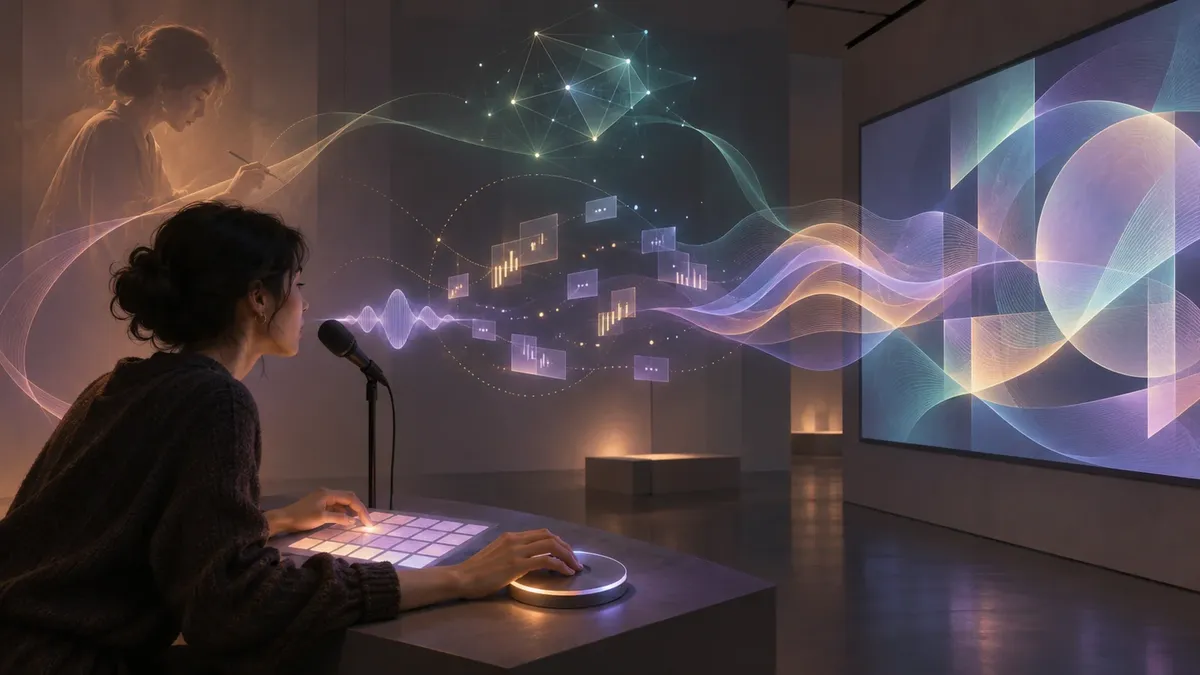
What happens when a visitor speaks to an artwork and an AI system decides which sounds and images answer? Windchime is an installation built around that question. Its creators describe a system that combines spoken prompts, music retrieval and hands-on animation controls—and use it to explore how artistic choices, software and visitors share influence.
An artwork that listens, searches and responds
Windchime is an audiovisual installation in which visitors speak into a microphone and receive a changing combination of music and interactive animation. The project was created by Trent Eriksen and Celeste Betancur. Rather than generate every sound or image from scratch, it searches collections of material authored or assembled for the installation, then recombines selected elements into a response.
The authors’ central question is not simply whether an AI model can recognize a prompt. It is how control is shared when a visitor’s words guide an artwork, but software determines which parts of an artist’s collection become audible. The paper frames this as a question of agency: who shapes the result—the artist, the visitor, or the model connecting them?
From spoken words to sound and image
A local automatic speech-recognition system first turns a visitor’s speech into text. An audio-language model then converts that text into a numerical representation, or embedding. The system compares it with embeddings for audio in a searchable index and ranks possible matches by similarity. A selection rule limits the retrieved material so that, at most, one sound stem from each instrument role is chosen among the forty nearest matches.
The sound collection contains 406 audio stems, including musical parts and field recordings. The installation can play different portions of a selected recording according to preset sound modes. A live-coding system called Strudel adds musical fragments designed to complement the retrieved audio. To help choose those fragments, the system calculates audio descriptors such as energy, brightness, key, tempo and onset density, then uses a planner to select a template and its parameters. The paper says the planner can use a hosted language model, a local model as a fallback, or a deterministic template.
Speech also triggers the retrieval of scenes from a separate collection of 135 Three.js animations. Visitors can manipulate the animations with monome grid and arc controllers. In the public installation described in the paper, an interaction is organized around four spoken inputs, each up to 15 seconds long, with opportunities to explore the controls between them.
The model is part of the artwork’s choices
The audio-language model is interchangeable: the authors describe several options, including general-purpose, music-focused and multilingual models. The sound collection and retrieval rules remain fixed when the model changes. According to the paper, different models can retrieve different parts of the collection, so choosing a model can influence what visitors hear. The authors therefore treat that choice as a curatorial decision, not just a technical setting.
The artist still shapes the experience by selecting the source material, organizing categories and setting constraints. The visitor initiates each search and can touch the controls, but does not directly choose which sound matches a phrase. The model helps settle that correspondence. This can produce what the authors call “structured surprise”: an unexpected pairing that still comes from a system with human-designed boundaries.
That is the project’s main finding in the sense supported by this paper: a description and implementation of an artwork that makes these relationships visible and interactive. The paper does not report a controlled study showing how visitors interpret the installation, whether one model produces better matches, or how much the artwork changes people’s views about AI. Its discussion of agency is the authors’ interpretation of the design, rather than a measured effect on audiences.
What the account can—and cannot—establish
Windchime is a creative installation, not a benchmark comparing models on a standardized test. The paper describes its components and design choices, but the supplied text does not give quantitative results for retrieval quality, speech-recognition accuracy, visitor experience or comparisons among the available models. Claims about the system’s artistic possibilities should be read in that context.
The source is an arXiv preprint listed as part of a NeurIPS 2026 Creative AI track. A preprint is a publicly shared research manuscript; its presence on arXiv alone does not establish peer review or independent validation. This article is based on the available paper text and does not independently verify the installation or its performance. The authors also point readers to a demonstration and supplemental materials, but those do not substitute for a reported audience study.
Even with those limits, Windchime offers a concrete way to think about AI in art: not as an autonomous creator, but as one influence inside a system shaped by source material, model choice, interaction rules and human participation. Its importance here lies in making that division of influence part of the experience—and an explicit subject for discussion.
- Windchime
- audiovisual installation
- audio-language models
- interactive art
- music retrieval
- AI and agency
Related reading
Automatically matched by shared topic keywords. These links do not imply that the sources agree or establish a consensus.