TRANSMISSION // 2611.26755v1
A calibrated assist for testing gravity and entanglement
Source published
A theoretical proposal uses a controllable interaction and a special-angle calibration to explore how gravity-induced entanglement might be tested under greater force noise.
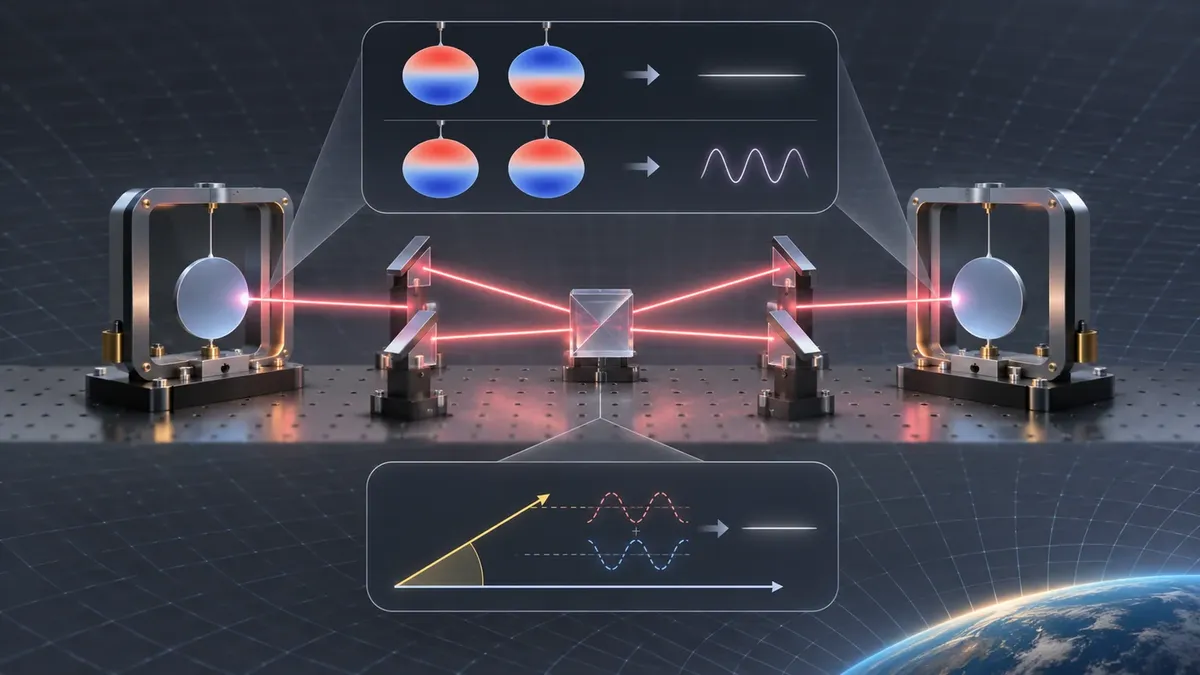
Could two masses become entangled through their mutual gravity? A new theoretical proposal adds a carefully calibrated interaction to help investigate this question. The strategy may relax one noise requirement, but it does not remove the need for precise control or establish that gravity-generated entanglement has been observed.
The question is fundamental but operational: if two initially separate masses become entangled through their mutual gravity, what would that tell us? Such an observation would be incompatible with descriptions in which the relevant interaction between the masses can be implemented using only local operations and classical communication (LOCC). It would not, by itself, settle every question about gravity’s underlying nature.
The obstacle is that Newtonian gravity is weak. In a mechanical experiment, random forces and thermal noise can overwhelm its effect before entanglement becomes detectable. Daisuke Miki, Alfred Li and Yanbei Chen propose a way to ease the absolute force-noise requirement: add a controllable, coherent interaction between the masses and calibrate it carefully.
Assistance with a boundary condition
The added interaction might be produced optomechanically through a shared optical field. The proposal requires that this additional channel, including its force noise, satisfy a condition that guarantees it preserves separability: by itself, it cannot create entanglement from a separable input. The combined interaction and noise can then be arranged so that suitable initial states and interaction times may generate entanglement when gravity contributes.
These conditions are not interchangeable. The paper’s separability-preservation bound is a sufficient condition for the added dynamics to remain non-entangling. Violating the corresponding bound for the combined dynamics does not guarantee that every starting state will become entangled. The authors’ claim is conditional: if the additional channel is certified to preserve separability and entanglement is observed with gravity included, that gravitational contribution would be incompatible with an LOCC description within the model’s assumptions.
The authors model two mechanical modes, include force noise, and derive conditions for separability preservation and possible entanglement generation. Their illustrative calculations use initially independent squeezed states and estimate entanglement using the negativity of a two-mode Gaussian state. They also analyze an optomechanical implementation in which a common cavity field produces both the added coupling and its associated backaction.
A null for selected modes, not for gravity
Gravity cannot simply be switched off for a control measurement. Instead, the proposal uses the directional structure of the Newtonian tidal coupling. By selecting a mechanical coordinate at a particular angle to the line joining the masses, the projected coupling between those selected modes vanishes. This “magic angle” provides a reference for calibrating the added interaction and force noise; it does not make gravity itself vanish.
That distinction matters because couplings involving other mechanical modes can remain. The proposal assumes those modes are sufficiently isolated or that their effects are independently bounded. A reference measurement at the magic angle also cannot automatically be carried over to a different orientation: the optical coupling and noise may vary with angle, so they must be matched or calibrated between the reference and operating configurations.
The paper illustrates the trade-off with model-dependent estimates. In its example, the thermal-noise ratio is defined as R_th = γT/(γ₀T₀), relative to an unassisted benchmark. Under the stated modeled setup—including M/d³ = 20 g/cm³ and thermal noise dominating optical backaction—the authors estimate that R_th = 10 could be compatible with entanglement using about 10 decibels of initial squeezing; R_th = 1,000 is shown with about 20 decibels. These are not experimental results or general performance guarantees. Greater noise tolerance comes at the cost of tighter control of the added coupling and its backaction.
What remains uncertain
The interpretation depends on several conditions: the noise and interactions must fit the assumed Markovian model; the added channel must be independently shown to preserve separability; and its coupling and noise must be calibrated between angles. The analysis also assumes additive interactions and effective isolation of the selected mechanical modes. A gravity-related contribution that persists at the magic angle, or changes between the reference and operating configurations, could complicate the comparison unless independently characterized.
This is a theoretical protocol, not a report of gravity-generated entanglement. The source is an arXiv preprint, and the provided material does not establish peer review or scientific consensus. The proposal changes the experimental challenge rather than eliminating it: it aims to tolerate more force noise while requiring precise calibration and control of angle-dependent effects.
- gravity-induced entanglement
- quantum gravity
- optomechanics
- force noise
- magic angle calibration
Reviewed cross-references
These connections were reviewed by a model, not independently fact-checked by a human. Similarity does not imply agreement; consult the original papers and the evidence below.
Can gravity’s quantum phase survive an entanglement washout?
Shared method: Both papers propose theoretical tests that compare gravitational dynamics with specified classical alternatives rather than treating entanglement alone as a universal test. The assisted-entanglement proposal uses a magic-angle calibration and a Markovian separability-preservation bound; the dephasing study compares conditional-phase dynamics with passive local-phase and broader diagonal-PPT models. These are related model-comparison strategies, not the same protocol, and each conclusion depends on its stated assumptions.
Model review: · openai-codex/gpt-6-luna
Evidence and provenance
Selected excerpts, not complete papers. PDF extraction can omit figures or damage equations, tables and reading order; sources may be preprints.
2611.26755v1 — Original paper
Excerpt reference:
static/papers/2611.26755v1.md:12-56
Basis: Paper text
Source SHA-256:5c7a041a90ba37e66e247b17a085bcb21cdaaaa35438f5b901c6078dd4e1006c2611.26755v1 — Original paper
Excerpt reference:
static/papers/2611.26755v1.md:187-283
Basis: Paper text
Source SHA-256:5c7a041a90ba37e66e247b17a085bcb21cdaaaa35438f5b901c6078dd4e1006c2611.12229v1 — Original paper
Excerpt reference:
static/papers/2611.12229v1.md:106-164
Basis: Paper text
Source SHA-256:3c7fd8eb92d2a07cd742e69224020558fd6dbe235ab3bc32586d18ddeb014cb72611.12229v1 — Original paper
Excerpt reference:
static/papers/2611.12229v1.md:165-217
Basis: Paper text
Source SHA-256:3c7fd8eb92d2a07cd742e69224020558fd6dbe235ab3bc32586d18ddeb014cb7
Related reading
Automatically matched by shared topic keywords. These links do not imply that the sources agree or establish a consensus.
Encoding a black-hole mass model in qubits
Source published
Shared keywords: quantum gravity
Could a quantum horizon timescale shape cosmic expansion?
Source published
Shared keywords: quantum gravity
A quantum model links baby universes to hidden observer information
Source published
Shared keywords: quantum gravity
Can gravity’s quantum phase survive an entanglement washout?
Source published
Shared keywords: quantum gravity
Can gravity seed cosmic structure without an inflaton?
Source published
Shared keywords: quantum gravity