TRANSMISSION // 2611.26745v1
MomentMem teaches robots to save visual memories
Source published
MomentMem stores selected images from earlier moments so a robot can use details that have disappeared from view. In simulated tasks and small real-robot tests, it improved performance, though texture matching and broader generalization remain challenges.
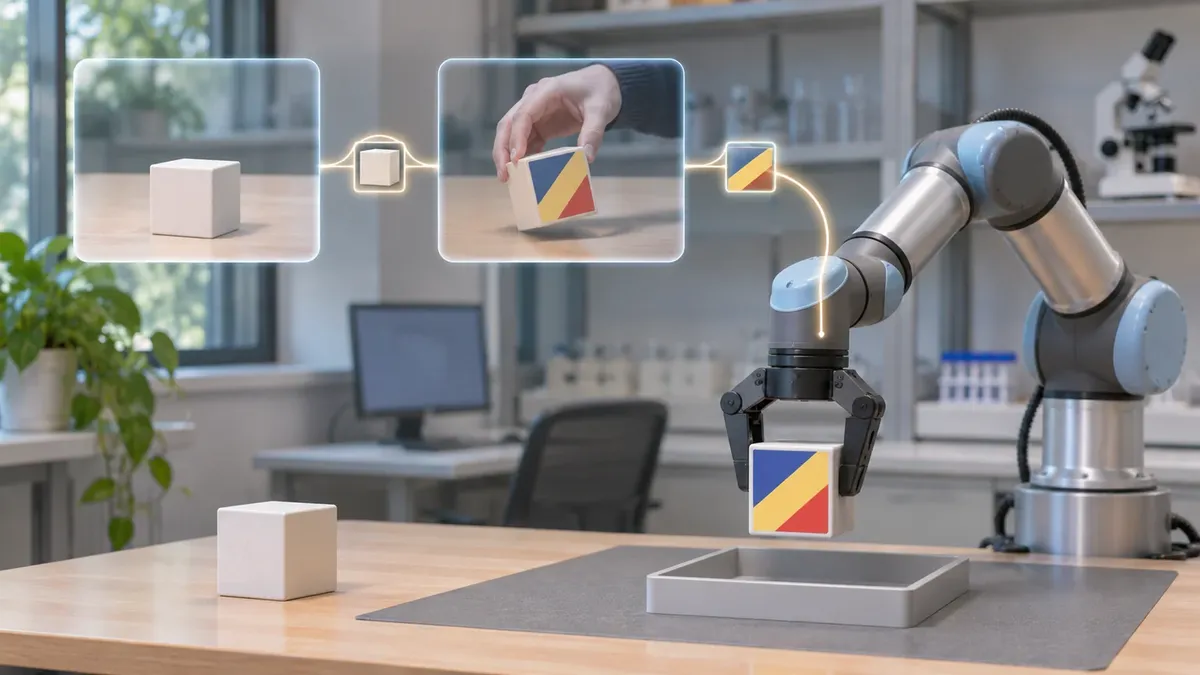
A robot may need to remember where an object was, or which color appeared at which location, after the clue is gone. MomentMem tackles this by learning which images to keep—not by saving every observation or relying only on text.
A robot that moves a cube away from its demonstrated position may later need to return it to that location. But if the relevant scene is no longer visible, the robot must rely on memory. The challenge is not simply remembering that something happened: it may need to retain a precise position, a visual pattern, or the link between a particular appearance and a place.
The paper MomentMem: Memorizing Key Moments for Robot Manipulation asks whether a robot can learn to save useful visual evidence as it encounters it, then use that evidence to act later. Its authors argue that keeping every image can create a long, redundant history, while a short text description may miss details such as exact locations or patterns.
A benchmark for fleeting clues
To test this idea, the researchers introduce VMBench, a set of nine long-horizon manipulation tasks built in simulation. The tasks require robots to remember spatial locations, visual appearances, or associations between the two. For example, a robot might have to place a cube where a brief beacon appeared, match a revealed pattern, or remember which color a detector showed at each position.
The clues are visible only for a limited time, and in some tasks the robot must act to reveal them. The benchmark uses a simulated Franka Panda robot and two camera views. The researchers collected 100 successful demonstrations for each task and evaluated policies on 100 rollouts per task with previously unseen initial configurations.
MomentMem separates two jobs. A vision-language model (VLM)—a model that processes images and language—acts as the “memorizer,” deciding whether to store the current image. A separate action model, the “executor,” uses stored keyframes alongside its current observations to predict robot actions. The memory therefore consists of selected images, rather than a running text summary or the full observation history.
The team trained the memorizer with annotated time intervals in which important evidence was visible. Instead of requiring one exact frame, training allowed any frame in the interval to serve as a memory. The researchers also exposed the model during training to histories containing its own imperfect selections, so it could learn to make later decisions when earlier choices had gone wrong.
Stronger results, with important qualifications
On VMBench, MomentMem achieved an average task success rate of 49.9%, which the authors report as 31.7 percentage points higher than the strongest evaluated baseline. This is a result on this benchmark, not a claim that robots generally succeed about half the time on real-world tasks. The paper reports that MomentMem’s largest gains came on tasks involving associations between appearances and locations. It did not beat the strongest baseline on the benchmark’s appearance-focused tasks.
That weakness helps show why saving a clue is not the same as using it correctly. In a pattern-matching task, the memorizer could retain the relevant images, yet the executor often struggled to identify which pattern matched. A diagnostic analysis found that the executor’s features represented individual textures well, but did a poor job of representing which textures matched. The authors therefore identify reasoning over stored visual details—not just selecting and preserving them—as a remaining problem.
The researchers also tested transfer. A memorizer trained on standard scenes was applied to altered appearances, including changes to the room, lighting, and distractors. The complete policy reached 55.2% average success in this setting. However, the executor was trained on action demonstrations from the altered target scenes. The experiment therefore tests whether the memorizer transfers to new appearances; it does not show that the entire system works in a wholly unfamiliar environment without further training.
For a held-out task, the team adapted the memorizer using five annotated demonstrations. The resulting policy reached 43.7% success, close to 44.3% with full memory supervision. These figures concern one task and a particular training setup; they do not establish that the method can adapt to arbitrary new tasks from only a few examples.
The authors also report competitive results on the RMBench memory benchmark and test two tasks on a physical Franka Panda robot. Across 30 trials per task, MomentMem succeeded in 14 trials for placement imitation and 17 for finding a cube under cups. These are encouraging demonstrations, but the real-world evaluation is small and uses only two task types.
What remains uncertain
The study suggests that a robot can benefit from retaining sparse, original images of important moments. But memory selection and successful manipulation are distinct: a robot can save the right image and still fail to interpret it or execute the needed movement. MomentMem also adds the cost of running a separate VLM memorizer. The authors note that VMBench uses one robot embodiment and a fixed camera setup, so performance under changing viewpoints remains untested.
This article is based on the authors’ arXiv preprint, version 1, rather than an independently verified assessment. The reported comparisons and conclusions should be read as the authors’ experimental findings; the available source does not establish peer review or independent replication. The work provides evidence for a specific approach in its tested settings, not proof that sparse visual memory will solve robot memory more broadly.
- robotics
- robot manipulation
- visual memory
- MomentMem
- VMBench
- vision-language models
- robot learning
Related reading
Automatically matched by shared topic keywords. These links do not imply that the sources agree or establish a consensus.
Can a large vision model use a smaller model’s visual memory?
Source published
Shared keywords: vision language models
A Robot Learns From Its Own Attempts
Source published
Shared keywords: robot manipulation, vision language models
Robot-coding agents need better failure diagnosis, not just more feedback
Source published
Shared keywords: robot manipulation
A robot's-eye view, generated from outside video
Source published
Shared keywords: robot learning, robot manipulation
EgoLAM separates hand motion from camera motion
Source published
Shared keywords: robot learning, robot manipulation