TRANSMISSION // 2611.26740v1
A low-rank route to Coulomb interactions on quantum computers
Source published
A Cartesian tensor decomposition could lower the estimated gate cost of grid-based Coulomb terms. Numerical tests and a one-dimensional toy model explore its potential, but do not demonstrate geometry sampling on quantum hardware.
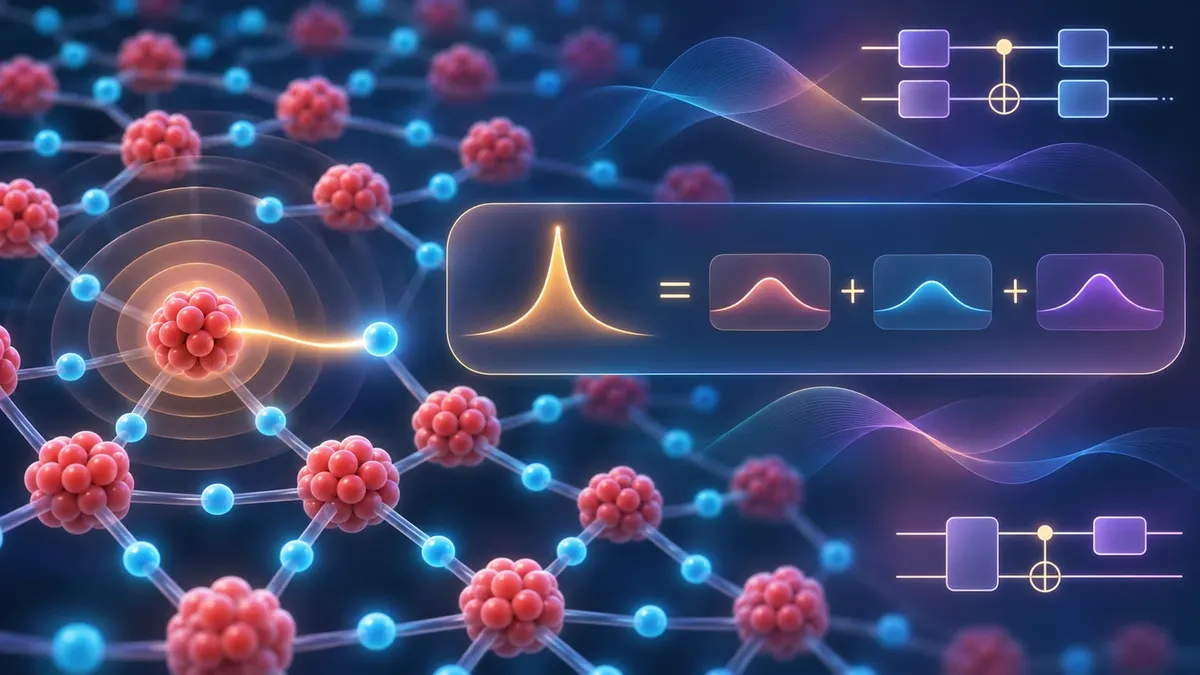
Coulomb forces are central to quantum chemistry, but representing them efficiently can be costly in quantum-computing algorithms. This preprint proposes a compact way to encode those interactions and explores what the representation might make possible.
The challenge: encoding Coulomb forces
Electrons attract nuclei and repel one another through the Coulomb interaction. In a grid-based quantum simulation, each electron’s position is represented across a set of grid points. The interaction depends on the distance between particles, and encoding it can be a significant circuit cost.
James Brown, Masashi Takahashi, Robert Wodraszka and James Whitfield ask whether the Coulomb potential can be represented as a compact sum of simpler pieces. The work focuses on real-space grids, where such a representation could make the interaction easier to use in quantum algorithms.
Breaking the potential into pieces
The authors use a canonical polyadic, or CP, decomposition. In plain terms, it expresses a three-dimensional object as a sum of terms, each built from separate factors for the x, y and z directions. They find these factors using alternating least squares: repeatedly improving one set of factors while holding the others fixed.
For their sinc-based representation of the Coulomb potential, they report that a rank-8 decomposition—eight terms in the sum—reproduces the tested potential with high accuracy. The factors are based on Cartesian components, rather than molecular orbitals, as in some other approaches. The paper says this decomposition can be reused across grid spacings and molecular systems within its stated setup. However, the reported factors cover index differences only up to 120; this is not a demonstration on arbitrarily large grids.
The authors show how to use the compressed representation in a block encoding, which embeds an operator into a larger quantum operation. Their resource analysis estimates that applying one Coulomb term takes a number of T gates that grows as O(N^(1/3)), where N is the total number of grid points per electron. T gates are a common measure of cost for fault-tolerant quantum circuits. This is a per-term estimate, not the total cost of a chemistry calculation, which also depends on how many terms are applied and how often the block encoding is used.
What the tests show
The paper tests the representation in several calculations. For hydrogen, the rank-8 approximation reproduces the tested low-lying energy levels to within about 0.1 millihartree at the grid spacing used. The authors also report a helium ground-state calculation reaching chemical accuracy with a compressed wavefunction representation. For lithium hydride, they calculate a Hartree–Fock potential-energy curve and find that the sinc-derived potential is qualitatively closer to the selected larger-basis comparison than the standard momentum-space Coulomb form they tested. They also apply a CP decomposition to the local part of a lithium pseudopotential.
These examples do not establish uniformly accurate results for all molecules or grid choices. The helium calculation compresses the wavefunction as well as the potential, so it does not isolate the potential decomposition’s contribution.
The authors also explore whether a quantum algorithm could favor low-energy molecular geometries. Their proposal places nuclear positions in a superposition and filters toward low-energy states. The demonstration, however, is a one-dimensional pseudo-Coulomb toy model evaluated using Hamiltonian matrices—not explicitly constructed quantum circuits. Its probability distribution favors lower-energy configurations in that model. This is a numerical proof of concept, not evidence that a quantum computer can find useful geometries for real molecules.
Finally, the paper estimates how faster convergence with grid spacing might affect time-evolution costs. Assuming, illustratively, that the usable grid spacing can be doubled, the authors estimate an approximately eightfold reduction in T-gate cost per unit of simulated time. This back-of-the-envelope estimate omits contributions to the block-encoding normalization and does not include a full constant-factor circuit analysis.
Promise, with open questions
The central contribution is a compact representation of a grid-based Coulomb potential and a circuit construction with an estimated per-term gate cost that scales as the number of grid points per spatial dimension. The work suggests that improved potential representations could let some algorithms use coarser grids for a target accuracy. Whether that lowers the cost of a complete calculation depends on the molecule, desired accuracy, algorithm and implementation.
The authors identify further work, including extending decompositions to larger grids and reducing costs for two-body terms. The geometry-sampling example does not include explicit circuit construction, and the resource estimates are not hardware demonstrations. This account is based on arXiv version 1, dated November 2026. It is a preprint and may not have undergone peer review; the available source material does not establish expert consensus or provide a systematic assessment of counterevidence.
- quantum computing
- quantum chemistry
- Coulomb potential
- tensor decomposition
- molecular geometry
Related reading
Automatically matched by shared topic keywords. These links do not imply that the sources agree or establish a consensus.
A leaner orbital basis for quantum chemistry
Source published
Shared keywords: quantum chemistry, quantum computing
Fulqrum speeds up the classical step in quantum-assisted energy calculations
Source published
Shared keywords: quantum chemistry, quantum computing
A shallow circuit imitates QPE outcomes
Source published
Shared keywords: quantum chemistry, quantum computing
Quantum-assisted simulation follows a proton between two water molecules
Source published
Shared keywords: quantum chemistry, quantum computing
Quantum proposals improve a fixed-size molecular calculation
Source published
Shared keywords: quantum chemistry, quantum computing