TRANSMISSION // 2611.26734v1
Can carefully chosen examples help segment surgical video?
Source published
INCISE selects annotated reference frames to cover a target video’s visual variety, then uses frozen models to segment it without target-video masks or fine-tuning.
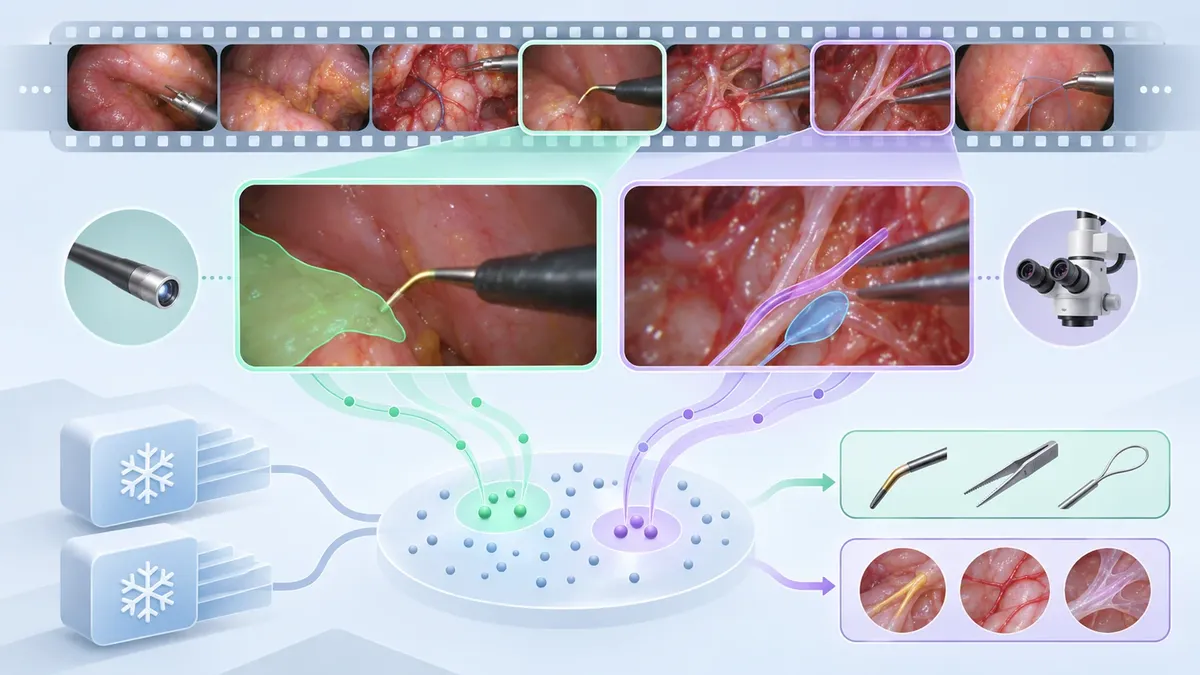
Surgical video segmentation can require many expert-drawn masks. INCISE tests a different approach: use a small set of labeled frames from other operations, chosen to represent the target video’s varied appearances. Its benchmark results are promising, but they do not establish clinical readiness.
Surgical videos show changing combinations of anatomy and instruments. Some tools appear only briefly; delicate structures may occupy only a small part of the image. Training an AI system to outline these objects can require many expert-drawn masks. Could a system instead use a few labeled examples from other operations to segment a new video—without being fine-tuned for that task?
The paper introduces INCISE, a method for training-free in-context segmentation. It uses annotated reference frames as examples for frozen models: the models’ parameters are not updated for the target task. Crucially, INCISE aims to choose examples that cover the target video’s range of visual appearances, rather than favoring only scenes that look like its most common view.
Selecting examples, then segmenting
INCISE first uses the frozen vision model DINOv3 to extract features from an unlabeled target video and a pool of frames from other videos. It groups local patterns in the target—visual patches that may show tissue or part of an instrument—into clusters. A selection procedure then chooses frames from the pool that collectively match those clusters. Its weighting can give less-common patterns more importance, potentially helping the chosen references include brief or small objects.
The masks for selected references are revealed only after selection. For segmentation, DINOv3 transfers labels by matching visual features between the reference frames and each target frame. A frozen SAM 3 tracker contributes temporal information and refined masks. INCISE builds a fresh pseudo-label for each frame from the references and that frame, and stores those labels—not SAM 3’s final predictions—in a short history. The authors’ rationale is to give the tracker recent context while avoiding a loop in which one mistaken prediction is repeatedly fed back into later predictions.
The evaluation covers six surgical benchmarks across general surgery, urology and ophthalmology. The authors also test transfer to a colonoscopy polyp-segmentation dataset. Their principal reported measure is mean intersection over union (mIoU), which compares predicted regions with the dataset’s expert-labeled regions; higher scores mean greater overlap. With ten reference frames per target video, INCISE reports a mean mIoU of 67.2% across the six surgical benchmarks. The paper reports this as 9.2 percentage points above the strongest fine-tuned method in its comparison.
That number needs context. The fine-tuned methods in that comparison receive a labeled frame from each target video, whereas INCISE uses references from other videos and no target-video mask. These are different supervision setups, not a like-for-like test of identical inputs. The paper also compares INCISE with training-free methods that use external references, and reports higher scores for INCISE in that setting.
What the evidence says—and what it doesn’t
Tests of reference selection on three benchmarks found that coverage-based selection performed better than random selection and global-similarity retrieval in the reported comparisons. In an analysis of reference budgets, performance rose steeply from one to about ten references and then changed little as more were added. This supports the idea that which frames are selected can matter, but it does not mean annotation disappears: experts still have to label the chosen references.
Across the six reference pools, the authors report annotating 1.7% of pool frames. That figure describes their experimental setup; it is not a general estimate of annotation time or cost, which can vary with the frame and the task. On PolypGen, a separate transfer test, INCISE reports a Dice score of 72.9%. Because this is a different dataset and metric, it should not be directly compared with the surgical mIoU result.
There are also practical limits. Reference selection uses the unlabeled target video as a whole, so that stage is not fully online. Once references are fixed, the segmentation process reads the video in temporal order. And benchmark overlap scores do not show whether the method improves surgical decisions or is safe to use during an operation. Results on these datasets and model settings cannot by themselves establish performance in other clinical environments.
The source is an arXiv preprint, a research manuscript that may not have undergone peer review. Its results should therefore be read as reported evidence, not settled consensus. INCISE offers a promising research method for reducing reliance on target-video masks: carefully selected examples may help frozen models handle varied scenes. Whether it can do so reliably across real clinical settings remains an open question.
- surgical video segmentation
- in-context segmentation
- medical AI
- computer vision
- video object segmentation
- annotation
Reviewed cross-references
These connections were reviewed by a model, not independently fact-checked by a human. Similarity does not imply agreement; consult the original papers and the evidence below.
A Surgical Tool Blocks the View. Can Earlier Frames Fill the Gap Without Guessing?
Shared method: Both use reference images to process surgical video frames: INCISE uses annotated references from other surgeries for segmentation, while TransGHOST aligns an earlier frame and resamples recorded pixels to reconstruct occluded regions. This is a bounded shared reference-guidance strategy, not evidence that either method’s results transfer to the other task; their reference sources and outputs differ.
Model review: · openai-codex/gpt-6-luna
Evidence and provenance
Selected excerpts, not complete papers. PDF extraction can omit figures or damage equations, tables and reading order; sources may be preprints.
2611.26734v1 — Original paper
Excerpt reference:
static/papers/2611.26734v1.md:259-316
Basis: Paper text
Source SHA-256:0bd9cbd70cce8e28827682550b6f5b41fa10b1ed38d0707193c05b3c996c03382611.13971v1 — Original paper
Excerpt reference:
static/papers/2611.13971v1.md:13-80
Basis: Paper text
Source SHA-256:78bbba3fde5ac8c1e61c74716b2e666c7ef63d8a30b60c43893395e6302ffb79
Related reading
Automatically matched by shared topic keywords. These links do not imply that the sources agree or establish a consensus.
Glyph turns hidden medical AI features into testable disease-risk clues
Source published
Shared keywords: medical ai
Why 360° Drone Tracking Challenges AI
Source published
Shared keywords: computer vision
Why Shape-Aware Matching May Help Spot Surface Defects
Source published
Shared keywords: computer vision
Can several camera views help find the same suitcase?
Source published
Shared keywords: computer vision
Beyond spotting windows: A LiDAR benchmark asks what building features do
Source published
Shared keywords: computer vision